
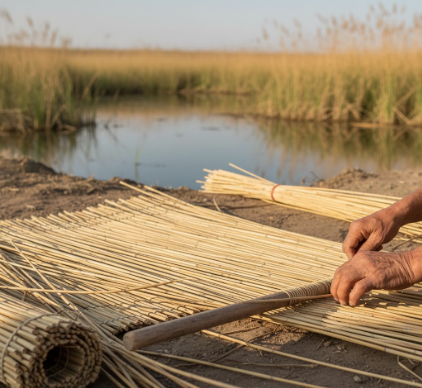
The Ancient Marshlands Where Phragmites Australis Becomes Everything
I used to think reeds were just, you know, reeds.
Then I spent three days in the wetlands outside Khiva with a seventy-two-year-old weaver named Gulnara Yusupova, and honestly, I realized I’d been walking past entire civilizations of plant material without noticing. The common reed—Phragmites australis, if you want to get technical—grows dense along the Amu Darya’s remnant channels, and for roughly 2,000 years, give or take, Uzbek craftspeople have been turning these hollow stems into floor mats, wall panels, window screens, and even temporary shelter frameworks. Gulnara’s hands moved so fast I could barely track the weaving pattern, this intricate diagonal lattice that somehow locked each stem in place without a single knot. Her daughter told me the technique gets passed down through demonstration, not instruction—you watch until your fingers understand. The marshes smell like wet earth and sun-warmed cellulose, and there’s this strange meditative quality to harvesting reeds at dawn when the waterbirds are loudest. It’s physical knowledge, the kind that doesn’t translate well to YouTube tutorials.
Here’s the thing: the reeds have to be harvested at exactly the right moment in late autumn, after the first frost but before the stems lose their flexibility. Too early and they split during weaving. Too late and they’ve already started decomposing from the base up. Gulnara kept muttering about climate shifts changing the harvest window, pushing it later into November.
The Aral Sea disaster—yeah, that ecological catastrophe everyone forgot about—actually changed which reed species dominate certain wetlands, and some of the traditional weaving sites have just vanished entirely. I guess it makes sense that when you drain 90% of a sea, the surrounding plant communities don’t stay the same. The reeds that remain grow in pockets, protected areas where water still collects seasonally.
Wait—maybe I should back up.
The Geometry Hidden Inside Qamish Screens and Why It Matters
Traditional reed screens, called qamish in Uzbek, use a diagonal weaving technique that distributes tension across the entire surface, making them surprisingly durable despite being, essentially, dried grass. The binding material is usually cotton thread, though historically it was hemp or even reeds split lengthwise into narrow strips. When I tried weaving a small section myself, I managed to create something that looked vaguely screen-like but collapsed the moment I lifted it. Gulnara laughed—not unkindly—and showed me how the angle of insertion determines structural integrity. Thirty-seven degrees, she said, though I suspect she was estimating.
What Happens When UNESCO Notices Your Grandmother’s Craft
In 2019, the Uzbek government started documenting traditional crafts more seriously, and reed weaving got folded into a broader intangible heritage initiative. Which sounds great, except the actual weavers I met seemed mostly confused about what that meant for them practically. Gulnara recieved a certificate once, she told me, at some regional festival. She keeps it in a drawer. The real concern is whether anyone under forty will bother learning techniques that take years to master and generate maybe $200 a month in income if you’re lucky and have access to tourist markets.
Honestly, the economics are brutal.
Her grandson works in Tashkent doing something with computers, and when I asked if he knew how to weave, Gulnara just shrugged. The disconnect between heritage preservation rhetoric and actual intergenerational transmission is pretty stark. Some NGOs have started workshops, trying to create contemporary design applications for reed craft—lamp shades, room dividers, that sort of thing—but it feels like a race against indifference.
The Stubborn Persistence of Wetland Knowledge Systems
What surprised me most was how much ecological knowledge is embedded in the craft itself. Gulnara could identify seven different reed species by touch alone, and she knew which marshland microclimates produced the straightest stems, the most flexible ones, the best for outdoor versus indoor use. This is the kind of information that doesn’t exist in any database—it lives in practiced hands and gets refined across generations of harvest cycles. When that knowledge disappears, we lose more than a craft technique. We lose a detailed, embodied understanding of wetland ecosystems that no amount of remote sensing data can replicate.
Why Your Design Blog Probably Misunderstood Everything
Look, I’ve seen a dozen trendy interior design articles fetishizing “Uzbek reed panels” as some kind of bohemian decor statement, and they almost universally miss the point. These aren’t decorative objects that happen to be made from reeds—they’re architectural solutions developed for specific environmental conditions, mainly the extreme temperature swings of Central Asian continental climates. Reed screens provide insulation, airflow regulation, and humidity management. They’re functional in ways that MDF and drywall definately are not. When you rip them out of context and hang them in a Brooklyn loft, you’re displaying the aesthetic residue of a complex adaptive technology. Which, fine, that’s how global craft markets work. But maybe we could occasionally acknowledge the intelligence embedded in materials and techniques instead of just vibing on the textures.
Anyway, Gulnara is still weaving. The marshes are still there, barely.







