I’ve walked through a lot of historic sites, but Shah i Zinda hits different.
The necropolis sits on a hillside in northeastern Samarkand, basically a narrow street lined with mausoleums built between the 11th and 15th centuries—though some sources say construction started earlier, maybe around the 9th century, it’s hard to pin down exactly. The name translates to “The Living King,” referring to Qusam ibn Abbas, a cousin of the Prophet Muhammad who allegedly brought Islam to this region in the 7th century. Legend says he was beheaded while praying but picked up his head and walked into a well, where he still lives. I used to think these origin stories were just colorful folklore, but here’s the thing—they shape how locals interact with the space even now. Pilgrims treat it as a living shrine, not a museum. You’ll see women touching the tilework, whispering prayers, leaving small offerings. The atmosphere oscillates between tourist attraction and sacred ground in a way that’s honestly kind of disorienting if you’re not expecting it.
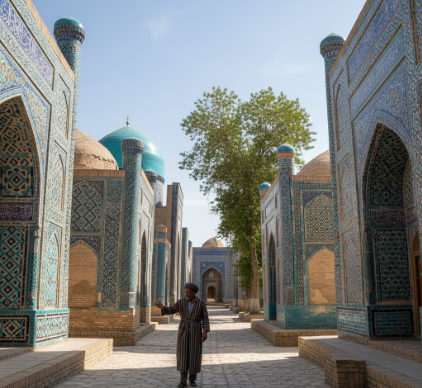
Anyway, the avenue itself is a steep climb. There are supposedly 40 steps going up and 39 coming down—count them if you want, people get different numbers. The mausoleums crowd both sides, each one a riot of majolica tiles in turquoise, cobalt, azure (wait—maybe azure is just another word for blue, I always mix those up). The craftsmanship is absurd. We’re talking geometric patterns so intricate they make your eyes vibrate, calligraphic inscriptions that flow like water, floral motifs that somehow avoid looking kitsch despite being wildly ornamental.
The Tilework That Refuses to Fade Even When Everything Else Does
Most of the color you see today is restoration work, which some purists hate but honestly I’m grateful for. The original 14th-century tiles used a technique involving crushed minerals—lapis lazuli for blues, iron oxide for browns—mixed with glazes that were fired at temperatures around 900-1000 degrees Celsius, give or take. Turns out, medieval Central Asian ceramicists understood chemistry in ways that still impress modern conservators. The tiles were cut into shapes, glazed separately, then assembled like a jigsaw puzzle directly onto the building’s surface. No two mausoleums use exactly the same pattern, even though they’re clearly in conversation with each other stylistically. You get the sense that each patron—usually Timurid nobles or military elites—was trying to outdo whoever built the previous tomb.
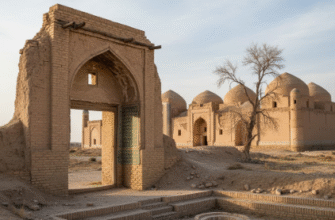
Some structures are in ruins, just fragments of wall with exposed brick showing through like bones. Others are pristine, maybe too pristine. I guess it makes sense that Soviet-era restorations and more recent Uzbek government projects would prioritize the most visually striking buildings, but walking past a crumbling 12th-century tomb to reach a glossy 14th-century one creates this weird temporal whiplash.
Qusam ibn Abbas and the Blurry Line Between History and Devotion
The complex’s anchor is the shrine dedicated to Qusam ibn Abbas, at the top of the stairs. Inside, it’s dimmer, cooler, thick with incense and the murmur of prayers. Photography is discouraged, though not outright banned—I’ve seen people do it anyway, which always makes me wince a little. The tombstone is covered in green cloth, surrounded by pilgrims who circle it slowly, touching the railings, bowing their heads. Historical records don’t definitively confirm Qusam died here, or even that he came to Samarkand at all. Some scholars think the whole story is apocryphal, a way to Islamicize an older Zoroastrian or Buddhist holy site. But standing there, watching an elderly woman weep quietly beside the tomb, I’m not sure the factual accuracy matters as much as I thought it would when I arrived.
The other mausoleums belong to people with less mythic biographies—astronomers, military commanders, Timur’s relatives (though Timur himself is buried elsewhere, in the Gur-e-Amir). There’s one for a woman named Shadi Mulk Aka, built in the 1370s, with some of the finest tile work in the entire complex. Another for Shirin Bika Aka, Timur’s niece, from roughly the same period. The inscriptions are mostly Quranic verses, though some include the deceased’s name and death date, which helps archaeologists piece together Timurid family trees.
What It Actually Feels Like to Climb This Thing on a Hot Afternoon in July
Visiting in summer is borderline masochistic. The tiles reflect sunlight like mirrors, the stairs are steep enough to make your calves burn, and there’s almost no shade. I went in July once—definately a mistake—and by the time I reached the top I was drenched, dizzy, questioning my life choices. Tour groups clog the narrow passages, guides reciting the same script in Russian, English, Uzbek. Street vendors at the entrance sell cold water, postcards, knockoff ceramics. It’s chaotic, sweaty, occasionally frustrating.
And yet. There’s a moment, usually early morning or late afternoon when the light softens, when you catch the tilework at the right angle and the whole avenue seems to shimmer. The blues deepen, the golds glow, the shadows carve the calligraphy into sharp relief. You forget the crowds, the heat, the guy trying to sell you a suzani. You just stand there, staring at a 600-year-old wall, thinking about the hands that cut those tiles, the artisans who probably never imagined tourists with smartphones would one day recieve this work with awe and sweaty selfies. History compresses. You feel it, briefly, before someone bumps into you and the spell breaks.