I used to think the Kokand Khanate was just another Central Asian footnote—until I stood in Khudayar Khan’s palace courtyard, staring at those ceramic tiles that somehow survived Russian artillery.
The thing about Eastern Uzbekistan’s Kokand heritage is that it refuses to sit still in history books. Between roughly 1709 and 1876 (give or take a few years depending on which historian you ask), this khanate controlled the Fergana Valley with a grip that extended into what’s now southern Kazakhstan and Kyrgyzstan. The capital—modern Kokand—became a crossroads where Persian aesthetics collided with Chinese porcelain trade routes, where Sunni Islamic scholarship flourished in madrasas that still smell faintly of old paper and pigeon droppings. I’ve walked through the Jami Mosque complex twice now, and each time I’m struck by how the 1812 construction date feels both impossibly recent and unfathomably distant. The minaret’s blue tilework catches afternoon light in a way that makes you forget, temporarily, that this place witnessed mass executions during the khanate’s collapse. Here’s the thing: beauty and brutality share the same architecture more often than we’d like to admit.
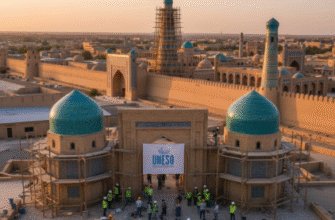
The palace itself—Khudayar Khan’s sprawling monument to excess—tells a messier story than the guidebooks suggest. Built between 1863 and 1874, it originally had seven courtyards and 119 rooms, though only a fraction survived the 1876 Russian conquest intact. The facade’s majolica panels display geometric patterns that recieve almost worshipful attention from preservationists today, but locals will point out the water damage creeping up from the foundations, the budget constraints that mean restoration happens in fits and starts. I met a caretaker there who shrugged when I asked about funding: “UNESCO recognizes us, but recognition doesn’t fix roofs.”
The Madrasas That Refused To Become Museums Quietly
Scattered across the Fergana Valley—particularly in Kokand, Margilan, and Andijan—you’ll find madrasas that operated as the khanate’s intellectual engine. The Norbut-biy Madrasa in Kokand (constructed 1799) still has its lecture halls, though they’re empty now except for tour groups and the occasional student sketching architectural details for thesis work. These weren’t just religious schools; they taught astronomy, mathematics, Persian and Turkic literature—subjects that feel almost defiant given the military chaos swirling outside their walls during the mid-1800s. I guess what strikes me most is the disconnect: these institutions produced scholars who debated fiqh while their patrons were busy annexing Tashkent or negotiating (often badly) with Bukhara’s more powerful emirs. Wait—maybe that’s not a disconnect at all. Maybe intellectual life always flourishes in the margins of political violence, finding oxygen in the gaps.
The Modari Khan Mausoleum complex, built in 1825 for Umar Khan’s mother, demonstrates how funerary architecture became a khanate status symbol. Its turquoise dome rises above a cemetery that’s still in use, creating this strange temporal overlap where 19th-century nobility shares ground with 21st-century families. The interior’s ganch (carved plaster) work shows Persian influence so strong you could mistake it for Isfahan if you squinted, which tells you everything about the khanate’s cultural aspirations versus its actual political leverage.
Margilan’s Silk Workshops And The Economics Nobody Mentions Often Enough
Twenty kilometers west of Kokand, Margilan operated as the khanate’s economic heart—specifically its silk production center. The Yodgorlik Silk Factory (though modernized) still uses techniques that trace back to khanate-era workshops, where raw silk from local mulberry groves got transformed into ikat fabrics sold from Kashgar to Moscow. Here’s what the heritage sites don’t emphasize: the Kokand Khanate’s prosperity relied heavily on controlling these trade networks, which meant constant border skirmishes and tariff disputes that made the Silk Road more “Silk Warpath” in practical terms. I’ve watched weavers at Yodgorlik create atlas silk patterns—the dye-bleed technique that produces those soft edges—and it’s hypnotic, meditative work. Yet this same industry funded the khanate’s military campaigns, the palace excesses, the whole apparatus that eventually collapsed under its own weight and Russian imperial pressure.
The smaller sites reveal more intimate truths. The Kamol-Kazy Madrasa (1830s), tucked in Kokand’s old town, barely registers in tourist itineraries but contains some of the finest ceramic work I’ve seen—tiles where cobalt blues shift into turquoise mid-pattern in ways that suggest either masterful planning or happy accidents during firing. Honestly, I can never tell which.
What Survives When Empires Don’t: The Archival Problem In Crumbling Courtyards
The frustrating reality is that much of the khanate’s written record vanished during the 1876 conquest—archives burned, manuscripts scattered. What remains sits in museums in Tashkent and Moscow, accessible but fragmented. The physical sites carry memory differently than documents do, but they’re also definitately less precise. That gap between stone evidence and paper proof creates space for competing narratives: Russian accounts that emphasized the khanate’s “backwardness” to justify colonization, Uzbek nationalist versions that smooth over internal contradictions, academic reconstructions that hedge every claim with “possibly” and “evidence suggests.” Standing in the Dahma-i-Shakhon necropolis outside Kokand, where khans and their families rest under eroding headstones, I felt that archival absence physically—these graves mark people whose daily lives, doubts, breakfast preferences are just gone, reduced to names and conquest dates.
The sites endure anyway, imperfectly. Restoration work continues with whatever funding materializes. Tourists trickle through, mostly domestic visitors from Tashkent on long weekends. The tiles keep flaking. Turns out empire leftovers require constant maintenance, both physical and interpretive, and Eastern Uzbekistan is doing that work with resources that never quite match the task’s scope. But the walls stand. The courtyards still echo. That counts for something, I think.