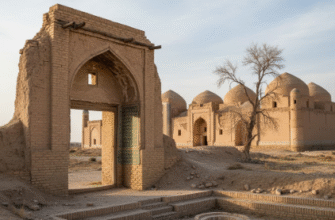
Kirk Kiz sits about 3 kilometers west of Termez, and honestly, the first time you see it rising from the scrubby desert, it doesn’t look like much.
I used to think fortresses had to be dramatic—towering walls, battlements that screamed power across centuries. But Kirk Kiz, which translates roughly to “Forty Maidens” (though nobody really knows why), is different. It’s a corrugated mud-brick structure, about 54 meters square, with these massive corrugated walls that ripple outward like someone pleated the earth itself. The whole thing dates back somewhere between the 9th and 11th centuries CE, give or take a few decades depending on which archaeologist you ask. Some scholars argue it was a caravanserai—a rest stop for Silk Road travelers hauling spices and silk through Central Asia. Others insist it was a palace, maybe even a fortress-palace hybrid, built during the early Islamic period when this region was basically a crossroads for everyone from Arab conquerors to local Sogdian merchants. The corrugations aren’t just decorative; they’re structural reinforcements, a technique that let builders create thicker walls without using as much material. Pretty clever for the 10th century.
Here’s the thing: the name doesn’t match the evidence. Folklore says forty maidens defended this place against invaders, but there’s zero archaeological proof of any battle here. The structure shows no burn marks, no weapons caches, no mass graves. It’s more likely the name came later, grafted onto the ruins by locals who needed a story to explain why this weird, corrugated box sat abandoned in the desert.
The Architecture That Refuses to Collapse Completely Even After a Millennium
Walk around Kirk Kiz today and you’ll notice the walls are still standing—barely.
The corrugated design creates a kind of wavelike pattern, with each corrugation about 2 meters deep. This isn’t decorative whimsy; it’s engineering. By increasing the surface area of the walls without adding proportional weight, builders achieved stability in a region prone to earthquakes and flash floods. The Termez area sits near the Amu Darya River, which has flooded catastrophically throughout history, and seismic activity from the nearby Hindu Kush mountains has leveled plenty of structures over the centuries. Yet Kirk Kiz endures. The mud-brick construction—called pakhsa in Uzbek—uses layers of compacted loess soil mixed with straw and water. It’s not baked; it’s dried in the sun, which makes it vulnerable to erosion but also incredibly cheap and renewable. When I first read about this, I thought, wait—maybe that’s why so many Central Asian fortresses look half-melted. They are, sort of. Every rainstorm chips away a little more.
The interior layout is surprisingly complex for something that looks so plain from outside.
There are roughly 35 to 40 rooms arranged around a central courtyard, though the exact count varies because some walls have collapsed into ambiguous rubble. The rooms are small—maybe 3 by 4 meters each—with narrow doorways and no windows on the outer walls. Defensive, clearly. But also kind of suffocating, if you imagine living there. Some rooms have vaulted ceilings, a technique borrowed from Persian architecture, which suggests whoever built this had connections to broader Islamic building traditions. There’s evidence of a second story, now mostly gone, which would have given defenders or residents a vantage point over the surrounding flatlands. Turns out, if you wanted to control trade routes or watch for approaching armies, this spot was ideal. The Amu Darya provided water and a natural barrier, while the desert offered visibility for kilometers in every direction.
What Archaeologists Found When They Finally Started Digging in the 1930s
Soviet-era excavations in the 1930s and again in the 1970s unearthed pottery shards, a few coins, and some corroded metal tools—nothing spectacular, but enough to confirm the site was occupied during the Samanid dynasty, which ruled parts of Central Asia from the 9th to 10th centuries. The Samanids were prolific builders, and they definately left their mark across what’s now Uzbekistan, Tajikistan, and Afghanistan. Kirk Kiz fits their architectural style: practical, fortified, and built to last just long enough to serve its purpose before being abandoned when trade routes shifted or political power moved elsewhere.
I guess it makes sense that a place this remote would fade from memory.
By the 12th century, Termez itself had become a major city under the Kara-Khanid Khanate, but Kirk Kiz was already obsolete. Newer fortifications and urban centers drew people away, and the fortress was left to the elements. Mongol invasions in the 13th century devastated the region, but Kirk Kiz was probably already empty by then. It’s weirdly peaceful, imagining this structure just sitting here, ignored, while empires rose and fell nearby. No dramatic last stand, no heroic defense—just slow, quiet abandonment.
Why Preservationists Are Worried About the Next Fifty Years More Than the Last Thousand
Modern preservation efforts started in earnest in the 1990s after Uzbekistan gained independence, but funding is inconsistent and climate change is accelerating erosion.
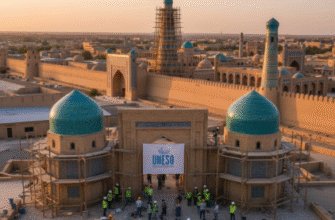
The same mud-brick construction that survived a millennium is now crumbling faster due to unpredictable rainfall patterns and temperature extremes. UNESCO has listed the broader Termez archaeological area as a site of concern, but Kirk Kiz itself isn’t a World Heritage Site, which means it gets less attention and fewer resources. Local conservationists have tried stabilizing walls with modern materials, but that introduces its own problems—cement and mud-brick don’t age the same way, and sometimes interventions cause more damage than inaction. There’s this tension between letting the site decay naturally, as it has for centuries, and trying to freeze it in time for future tourists and researchers. Honestly, I’m not sure which approach is right. Part of me thinks Kirk Kiz has earned the right to slowly melt back into the desert. Another part knows that once it’s gone, we lose a tangible link to the people who built it—people whose names we don’t know, whose daily lives remain mostly mysterious, but who left behind this strange, corrugated monument to survival in a harsh landscape.
And maybe that’s enough.