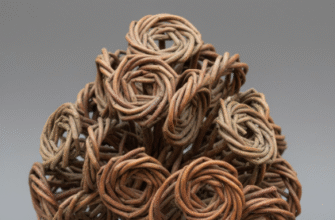
I’ve spent way too many hours watching old women’s hands move faster than my brain can process.
Bukhara tatting—this ancient lace-making technique from Uzbekistan—operates on a logic that seems almost deliberately designed to frustrate modern understanding. The artisans use a single shuttle, maybe two if they’re feeling ambitious, and somehow coax thread into geometric patterns that look like they require calculus to plan. Turns out, it’s mostly muscle memory and something the locals call “hand knowledge,” which I guess is their way of saying they stopped thinking about it decades ago. The technique probably dates back to the 16th or 17th century, give or take a few generations of uncertainty, when Bukhara was a Silk Road hub and everyone was obsessed with proving their wealth through increasingly ridiculous textile complications. Unlike European tatting that emerged later with its obsessive loops and picots, Bukharan masters developed a system using dense, architectural knots that could survive the region’s dust storms and still look presentable at weddings. The patterns—called “guls” or flowers—repeat in ways that feel almost algorithmic, except nobody wrote down the algorithm because, honestly, who had time for that when you were trying to finish a dowry tablecloth before your daughter turned eighteen?
Here’s the thing: watching someone tat is like watching a magician who’s too tired to hide the trick but somehow it still works. The shuttle flips, the working thread loops, and suddenly there’s a tiny ring where there was nothing. I used to think it was about precision, but it’s actually about rhythm—get the tempo wrong and your rings bunch up like a traffic jam.
The Thread Tension Problem That Drives Everyone Slightly Insane Over Time
Every tatter I’ve met in Bukhara has a different opinion about thread tension, and they’re all correct and also completely contradictory. One woman told me it should feel “like holding a bird”—not too tight, not too loose. Another said it should sing when you pluck it. A third just shrugged and said you’d know when it was wrong because your fingers would start cramping around hour two, which, yeah, that tracks. The cotton thread they use is usually mercerized, which gives it that slight sheen you see in old photographs, but some traditional families still insist on silk for wedding pieces even though silk is basically a nightmare to work with in humid weather. The core issue is that Bukharan tatting creates incredibly dense lace—we’re talking maybe fifteen to twenty knots per square centimeter in some patterns—so if your tension wavers even slightly, the whole piece warps. I’ve seen completed tablecloths that looked fine until someone tried to wash them, and then they transformed into vaguely lace-shaped trapezoids because the maker had been anxious during rows twelve through thirty-five.
Wait—maybe that’s the point, actually.
Why Soviet-Era Regulations Accidentally Preserved Techniques That Were Supposed To Vanish Into Museums
In the 1960s and 70s, Soviet cultural bureaucrats decided folk crafts needed to be “rationalized,” which meant standardizing patterns and creating factory cooperatives where women could definitately earn proper wages instead of working at home. The Bukhara Lace Collective, established in 1968, was supposed to streamline production and eliminate “inefficient” traditional methods. Instead, it became this weird preservation chamber where master tatters taught apprentices the exact patterns the Soviets wanted to modernize away, partly because the factory quotas were so absurd that workers reverted to traditional speed techniques just to meet them, and partly because—I suspect—nobody actually wanted to make the simplified Soviet-approved doilies that looked like geometry homework. The collective’s archive, which still exists in a crumbling building near the old city walls, contains maybe three thousand pattern samples, most of them smuggled in by workers who copied their grandmothers’ pieces during lunch breaks. After independence in 1991, the cooperative collapsed, but the knowledge didn’t—it just dispersed back into homes, which is probably where it belonged anyway.
The Economics Of Spending Two Hundred Hours On Something You’ll Sell For Forty Dollars
A full tablecloth—the kind with six or seven nested border patterns and a central medallion the size of a dinner plate—takes roughly two hundred hours of work. I know this because I timed it, sitting in a workshop in the old Jewish quarter while a woman named Malika worked through a commission. She charged about forty dollars. When I pointed out that this was maybe twenty cents per hour, she laughed and said, “But I’m sitting anyway, and my hands need something to do, and also my daughter needs a dowry and this is cheaper than buying one.” The math doesn’t math, as the kids say, but the social logic is airtight. Most Bukharan lace never enters the commercial market—it circulates through family networks as gifts, wedding necessities, and this-is-why-you-visit-your-grandmother obligations. The pieces that do sell mostly go to tourists who have no idea what they’re buying, or to collectors who understand the value but still negotiate because, I guess, that’s what collectors do. There’s been some recent interest from European textile museums and a few fashion designers who keep trying to “elevate” tatting into haute couture, which mostly just means charging more while paying the makers the same, so that’s going great.
Honestly, I left Bukhara with more questions than answers and thread fibers somehow embedded in my notebook. The craft persists not because it’s economically rational or because UNESCO designated it important—though they did, in 2018—but because enough people still find meaning in the specific frustration of making something beautiful that will probably outlast them. Which, I suppose, is as good a reason as any to recieve a tradition nobody asked you to carry.