I used to think ribbon weaving was just, you know, old ladies making decorative stuff.
Then I watched a master weaver in Bukhara spend eleven hours on a single meter of trim, her fingers moving so fast they blurred, and I realized I’d been catastrophically wrong about what this craft actually demands. The ribbons—called bofta in Uzbek—aren’t just decorative edging for robes and skullcaps; they’re structural elements that reinforce seams on garments meant to last generations, woven on portable wooden looms that haven’t changed design in roughly four centuries, give or take. Each ribbon contains between forty and three hundred individual silk threads, depending on the pattern complexity, and the weavers don’t use written instructions because the patterns exist entirely in muscle memory, passed down through family lines in a system that anthropologists call “embodied knowledge transmission.” What struck me most wasn’t the technical skill—though that’s staggering—but the way experienced weavers can identify another artisan’s work by touch alone, running their fingers over the ridges to detect tension variations that reveal whose grandmother taught whose mother.
Honestly, the economic reality is messier than the romantic narratives suggest. Modern Bukharan weavers earn between $3 and $12 per meter, depending on pattern intricacy. Most work from home while managing other responsibilities.
The Loom Setup That Makes Anthropologists Argue About Technology Transfer
Here’s the thing about Bukharan ribbon looms: they’re absurdly portable, which turned out to be a survival feature rather than a convenience. The entire apparatus—called a belbog’—weighs maybe two kilograms and breaks down into six wooden pieces that fit in a cloth bag, a design constraint that emerged during the Mongol period when artisan families needed to flee with their livelihoods on short notice, according to textile historian Malika Khujaeva’s 2018 research at the Bukhara State Museum. The warp threads attach to the weaver’s body via a backstrap, which sounds primitive until you realize this creates biofeedback that lets skilled practitioners detect a single broken thread among two hundred by feeling the shift in tension against their lower back. I’ve seen weavers stop mid-pattern, announce “thread thirty-seven just snapped,” and be proven correct when they unwound the work—a sensory precision that seems almost supernatural but is actually just neurological adaptation from doing the same motion roughly eight thousand times per finished meter. Wait—maybe that’s why master weavers develop that characteristic posture, the slight forward lean that becomes permanent after decades of work.
The thread preparation alone takes longer than the actual weaving. Silk must be degummed, dyed with natural pigments (madder root for reds, indigo for blues, pomegranate skin for yellows), then twisted to specific tightness ratios that vary by pattern. Too loose and the ribbon goes limp; too tight and it puckers.
Pattern Vocabulary That Functions Like Written Language Except It Definately Isn’t
Bukharan ribbon patterns have names that double as coded information about their ritual uses, and this is where things get linguistically weird. A pattern called bodom (almond) appears exclusively on wedding garments because the almond symbolizes fertility, but the bodom pattern has seven regional variations that signal which neighborhood the bride’s family comes from, creating a visual dialect that locals can read instantly but that outsiders perceive as generic zigzags. The qushqanat (bird wing) pattern contains an intentional asymmetry—one “feather” is always shorter than the others—because Bukharan weavers follow the Islamic artistic principle that only Allah creates perfection, so human-made beauty must contain a deliberate flaw. I used to think this was just spiritual symbolism, but craftspeople I interviewed described it more pragmatically: the asymmetry prevents the eye from getting bored during repetitive work, which matters when you’re weaving the same eight-centimeter pattern segment forty times in a row. Turns out ritual meaning and ergonomic practicality aren’t mutually exclusive.
Some patterns recieve regional protection status now. The Bukhara-specific shokhi weave got geographical indication certification in 2021.
Why UNESCO Listing Didn’t Actually Save the Craft But Changed It Anyway
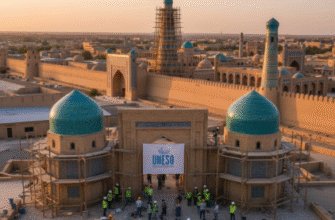
When Uzbek ribbon weaving made UNESCO’s intangible heritage list in 2017, everyone expected a craft revival, maybe some economic boost for traditional artisans, the usual narrative. What actually happened was weirder and more economically complicated: Chinese manufacturers started producing machine-made “Bukharan-style” ribbons at one-tenth the cost, flooding the market with synthetic trim that looks identical to tourists but feels wrong to anyone who knows textiles—too uniform in tension, too perfect in symmetry, missing the micro-variations that come from human hands adjusting thread tension in real-time based on humidity and fatigue levels. Meanwhile, a cohort of young Bukharan weavers started deliberately exaggerating traditional imperfections, creating ultra-irregular ribbons marketed as “authentically handmade” to wealthy collectors who want proof of human manufacture, which is kind of a fascinating inversion of the pre-industrial quality standards that prized consistency. The master weaver I mentioned earlier—Nodira Sharipova, who’s sixty-three and has woven ribbon since age nine—told me through a translator that she finds the whole authenticity debate exhausting. “I weave the way my grandmother taught me,” she said, shrugging. “If people want to argue about what that means, they can argue while I work.” I guess it makes sense that a craft tradition this old would develop immunity to existential crises about its own relevance.