I used to think belts were just belts.
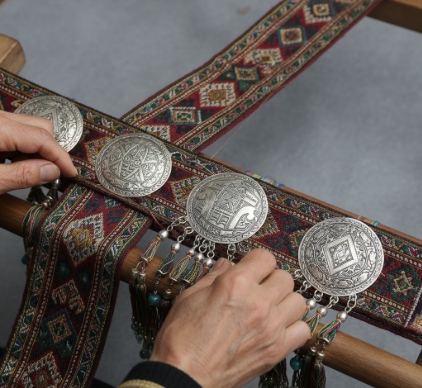
Then I held a Bukhara belt in my hands—an actual one, made by a craftsman in Uzbekistan who’d learned the technique from his grandfather—and realized I’d been missing something enormous about how clothing works as cultural memory. The weight surprised me first: easily half a kilo, maybe more, depending on the silver content and how elaborate the buckle was. These weren’t accessories in the modern sense, those flimsy things we thread through denim loops and forget about. They were investments, status markers, sometimes the most valuable thing a person owned besides maybe a good knife or a really exceptional carpet. The metalwork alone could take weeks—embossed silver plates connected by leather or heavy fabric, each geometric pattern carrying meanings I’m still not entirely sure I understand, though craftsmen insist every triangle and star references something specific about Islamic cosmology or tribal affiliation or both, depending on who you ask.
Here’s the thing about traditional Bukharan belts: they weren’t meant to be subtle. Men wore them over chapans (those quilted robes that look deceptively simple until you realize the construction), and the belt became the focal point of the entire outfit—sometimes eight, ten centimeters wide, gleaming with silver or niello work. Women’s versions could be even more elaborate, though they wore them differently, often hidden under outer layers but revealed during celebrations.
The Silver Economy That Ran Through Your Waistline
Bukhara was a crossroads, right? Silk Road trading hub, carpets going west, spices coming east, and somewhere in all that commercial chaos, metalworking became an art form. The belts weren’t just decorative—they were portable wealth. If your family hit hard times, you could pawn the belt, melt down the silver, convert stored value back into cash or goods. I guess it makes sense when you think about Central Asian nomadic traditions, where everything you owned needed to be either wearable or packable. A belt met both criteria and looked spectacular doing it.
How Craftsmen Actually Make These Things Without Losing Their Minds
The process is absurdly labor-intensive. First, you cast or hammer the silver plates—usually five to fifteen of them, depending on the belt’s length and the wearer’s waist size. Each plate gets engraved or embossed with patterns: floral motifs borrowed from Persian miniatures, geometric designs that echo tilework from Bukhara’s madrasas, sometimes calligraphic fragments though that’s less common than you’d think. Then comes the backing: leather strips, sometimes silk-reinforced fabric, occasionally velvet for really high-end commissions. Everything gets hand-stitched because, apparently, even in the 21st century, machines can’t replicate the specific tension needed to keep heavy silver plates secure without making the belt too rigid to wear comfortably. Wait—maybe that’s changed recently with industrial equipment, but the craftsmen I talked to insist handwork produces better results, and honestly, after seeing both versions, I believe them.
The Symbolic Language Nobody Agrees On Anymore
This is where things get messy.
Different sources give contradictory information about what specific patterns meant. One jeweler in Bukhara told me triangular motifs represented mountain peaks and spiritual ascension—the journey toward enlightenment, basically. Another craftsman, working literally three streets away, said no, triangles were about fire and transformation, borrowed from Zoroastrian symbolism that predated Islamic influence by centuries. Both seemed equally confident. Both could be right, or wrong, or describing regional variations that merged over time as families moved and intermarried and techniques spread across Central Asia. The truth is probably lost, fragmented across oral histories that didn’t always get written down, and what we have now are educated guesses wrapped in cultural authority.
Why These Belts Still Matter When Nobody Actually Wears Them Daily
You don’t see Bukhara belts in everyday Uzbek life anymore, obviously. They appear at weddings, cultural festivals, museum exhibitions—contexts where tradition gets performed rather than lived. But the craft hasn’t died, which surprises me every time I think about it. Young apprentices still learn silverwork, still study the old patterns, even though the market is tiny and mostly sustained by tourists and diaspora communities buying heritage pieces. There’s something stubborn about that continuity, something that refuses the narrative where globalization erases local traditions completely. These belts represent a specific aesthetic—maximalist, heavy, unapologetically ornate—that runs counter to contemporary minimalism, and maybe that’s part of the appeal now. In a world of mass-produced fast fashion, owning something that took a human being three weeks to make, using techniques refined over centuries, feels almost defiant.
Anyway, I definately didn’t expect to care this much about belts. But here we are.