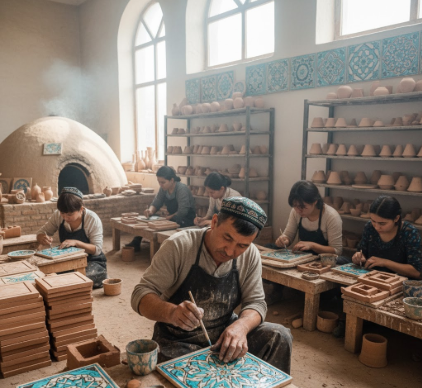
I never thought I’d spend a Tuesday morning watching a seventy-something craftsman argue with clay.
But here’s the thing about traditional Uzbek tile-making workshops—they operate on a different temporal plane entirely, one where a single geometric pattern might take six hours to sketch and nobody, absolutely nobody, rushes the firing process. The workshops clustered around Samarkand and Bukhara have been producing those iconic turquoise-and-cobalt tiles for roughly seven centuries, give or take a few decades, and the masters running ceramic tours today use techniques that would feel familiar to artisans from the Timurid era. Watching Alisher Nazirov coat a bisque-fired square with mineral pigments mixed in his grandfather’s mortar, I realized these weren’t demonstrations—they were living arguments against planned obsolescence. The pigments alone require sourcing: cobalt from specific mountain deposits, turquoise from copper compounds, manganese for the deep purples that edge those floral motifs. It’s chemistry pretending to be art, or maybe the reverse.
Most tour operators partner with family workshops that have occupied the same courtyards for generations. You’ll get your hands dirty, assuming you don’t mind the instructor correcting your brush angle seventeen times. The repetition matters, apparently.
The Geometry That Refuses to Simplify No Matter How Hard You Squint
Uzbek tilework operates on geometric principles that make my high school math teacher’s Pythagorean obsession look quaint. The girih patterns—those interlocking star-and-polygon designs—follow rules codified centuries before Europeans figured out similar tessellations, and workshop instructors will hand you a compass, a straightedge, and approximately zero sympathy. I watched a German tourist spend ninety minutes on a single eight-pointed star, erasing and redrawing until the paper wore thin. The master supervising her barely glanced over, muttering something in Uzbek that the translator rendered as “the star knows when you’re faking it.” Turns out these patterns encode ratios and proportions that tile infinitely without repetition—mathematical concepts Western scholars didn’t formalize until the 1970s, though Uzbek artisans had been firing them onto mosque domes since the 1400s. The workshop at Gijduvan, run by the Narzullayev family dynasty, teaches a simplified version for tourists: twelve-pointed rosettes that only require fourty-five minutes of preliminary sketching. Only.
Why Your Tile Will Probably Crack and Why That’s Acutally the Point
The clay mixture used in authentic workshops contains specific ratios of kaolin, quartz, and regional soil that affects thermal expansion rates during firing.
Which is a technical way of saying: your tile will crack, and the master will nod approvingly because the crack pattern reveals whether you wedged the clay properly three hours earlier. I’ve seen tour participants nearly weep over fractured tiles, only to have instructors explain that historical Uzbek ceramics included deliberate imperfections—tiny asymmetries that proved human hands, not molds, shaped them. The kilns themselves operate at temperatures between 900-1000°C, heated by wood or gas depending on the workshop’s modernization level, and the firing cycle takes anywhere from eight to fourteen hours. You don’t wait around for that part. Most tours include bisque-fired blanks you can glaze and paint, with the workshop shipping your finished piece weeks later, assuming it survived the final firing. The survival rate hovers around seventy percent for amateur attempts. I used to think that was discouraging until an instructor in Bukhara pointed out that medieval artisans considered a thirty-percent loss rate acceptable—they just made more tiles.
The Uncomfortable Economics of Keeping Dead Crafts Breathing
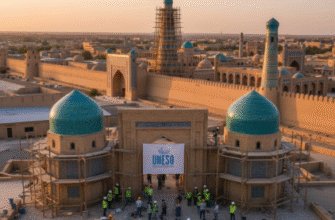
Here’s what nobody mentions in the glossy tour brochures: traditional tile-making barely survives economically, propped up by UNESCO heritage designations and tourists willing to pay $40-120 for half-day workshops. The Narzullayev workshop in Gijduvan produces tiles for restoration projects at Samarkand’s Registan Square, but that work pays a fraction of what tour revenue generates, and younger family members increasingly eye Tashkent’s tech sector instead of inheriting pigment recipes. The master craftsmen leading these workshops—average age somewhere north of sixty—represent a generational bottleneck. Apprenticeships traditionally lasted seven years; modern workshops compress basics into three-hour sessions for visitors who’ll never touch clay again. It’s cultural preservation as performance, which sounds cynical until you consider the alternative: these techniques vanishing entirely, reduced to museum placards and Wikipedia entries. The workshops adapt or disappear, and adaptation means teaching foreigners to paint wobbly lotuses onto tiles that’ll decorate Minnesota kitchens.
I guess what I’m saying is, the tours feel simultaneously authentic and contrived. You’re learning real techniques from actual masters, but within an economic structure that wouldn’t exist without your $80 and your Instagram post. Anyway, my tile cracked in the kiln, and I’ve never been more proud of a failure.