
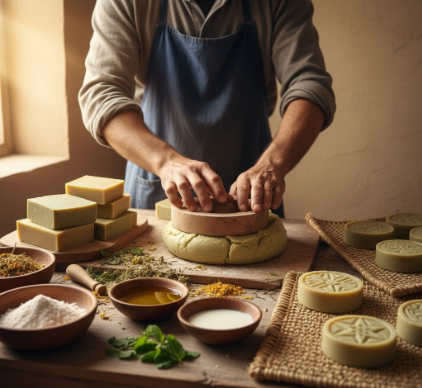
I used to think soap was just soap.
Then I spent an afternoon in a cramped workshop in Tashkent’s old quarter, watching a woman named Gulnara stir a massive copper cauldron filled with what looked like molten honey but smelled like a forest after rain. The steam rising from that pot carried scents I couldn’t quite place—something herbal, something earthy, maybe a hint of smoke. She’d been making soap this way for thirty-seven years, she told me, using a recipe her grandmother had taught her when she was barely tall enough to reach the workbench. Traditional Uzbek soap making, I learned that day, isn’t just about getting clean—it’s about maintaining a connection to ingredients that have been growing in Central Asian soil for centuries, and honestly, about rejecting the idea that everything worth having comes wrapped in plastic from a factory somewhere. Gulnara’s hands moved with a rhythm that suggested she could probably do this entire process in her sleep, adding pinches of dried herbs at intervals that seemed arbitrary but clearly weren’t, occasionally pausing to wipe her forehead with the back of her wrist. The whole scene felt both utterly ordinary and somehow sacred, like watching someone perform a ritual they’ve internalized so deeply it’s become indistinguishable from breathing.
Here’s the thing about traditional soap making in Uzbekistan: it starts with whatever’s available.
The base usually involves animal fats—mutton tallow is common in rural areas—or vegetable oils like cottonseed, which Uzbekistan produces in abundance. Cotton isn’t just for textiles here; it’s woven into nearly every aspect of material culture, sometimes literally, sometimes in ways you wouldn’t expect. Alkaline agents traditionally came from plant ash, particularly from halophytic plants that thrive in the region’s saline soils, though these days many soap makers use a combination of traditional ash and commercially available lye to ensure consistency. Wait—maybe I should back up. The chemistry here is basically saponification, that ancient process where fats react with alkali to produce soap and glycerin, but saying it that way makes it sound sterile and scientific when really it’s more like alchemy performed in someone’s backyard. Gulnara added handfuls of dried herbs—I recognized chamomile and maybe mint, plus others I definately didn’t know—which she said helped with skin irritation and added what she called “memory” to the soap.
The Mountain Plants That Nobody Else Seems to Want Anymore
Uzbek soap makers prize ingredients from the Tian Shan and Pamir-Alay mountain ranges.
These highland zones produce plants adapted to extreme conditions—intense UV radiation, temperature swings, limited water—which apparently translates to higher concentrations of protective compounds that happen to be excellent for human skin. I guess evolution doesn’t care about our skincare routines, but we’ve gotten good at hijacking its results. Soap makers collect wild thyme, juniper, sage, and something called ferula (locals call it “koma”), a resinous plant with a smell so pungent I actually stepped back when Gulnara opened the container. She laughed at my reaction. These mountain herbs contain volatile oils, tannins, and other compounds that act as natural preservatives and antimicrobials, which matters when you’re making a product without synthetic stabilizers. The collection happens seasonally—usually late spring through early summer—and many soap makers either gather plants themselves or buy from rural collectors who know which slopes produce the most potent specimens. It’s knowledge that gets passed along in conversations, not written down, and I worry sometimes about what happens when those conversations stop happening.
Why Ancient Recipes Keep Getting Quietly Modified Without Anyone Admitting It
Tradition isn’t static, turns out.
Every soap maker I talked to insisted they followed their grandmother’s exact recipe, but when I compared notes later, the variations were significant. One family in Samarkand added apricot kernel oil; another in Bukhara swore by sesame. Some used fragrant resins imported along old Silk Road routes—frankincense, myrrh—while others stuck to local lavender and rose petals. The ratios of fat to alkali varied, the cooking times differed, and the curing periods ranged from two weeks to three months. I started to realize that “traditional” might just mean “the way we’ve been doing it for as long as I can remember,” which could be a generation or could be five. There’s something honest about that fluidity, though—recipes evolve because circumstances change, because someone experiments and discovers an improvement, because the old supplier retired and the new one’s cottonseed oil behaves slightly differently. A craft stays alive by adapting, even when its practitioners insist nothing’s changed.
The Stubborn Economics of Making Something Slowly When Everything Else Is Fast
Gulnara sells her soaps at the Chorsu Bazaar for roughly 15,000 som per bar—about $1.20.
Industrial soap costs maybe a quarter of that. She can make perhaps forty bars per batch, and each batch requires about six hours of active work plus weeks of curing time. Do the math and it’s clear this isn’t a path to wealth. So why continue? The answers I got were complicated and often contradictory. Pride in craftsmanship, yes. Cultural preservation, sure. But also—and this surprised me—a growing market among younger, urban Uzbeks who’ve become skeptical of mass-produced products with ingredient lists they can’t pronounce. The global “natural products” trend has created unexpected demand for soaps that would have seemed hopelessly old-fashioned a decade ago. Some soap makers have started exporting, mostly to Russia and Kazakhstan, where Uzbek goods carry associations of authenticity and traditional quality. It’s still a marginal business, economically speaking, but marginality has its own kind of sustainability—when you’re not chasing growth, you can focus on just continuing.
What Happens to Craft Knowledge When Youtube Becomes the Teacher
I met a twenty-four-year-old named Davron who learned soap making from online videos.
His grandmother had made soap, but she died before teaching him, and his mother had moved to factory work and wasn’t interested. So Davron watched tutorials—some from other Uzbek makers, some from American homesteaders, some from Syrian refugee craftswomen in Turkey—and synthesized his own approach. His soaps incorporate Uzbek herbs but also shea butter from West Africa and essential oils from wherever. He sells primarily through Instagram, branding his products as “heritage craft meets modern wellness,” which made me wince slightly but also seemed perfectly reasonable for someone trying to make a living. Here’s what bothers me, though: Davron’s soap is probably excellent, but he’s missing the embodied knowledge that comes from standing next to someone for years, learning not just the steps but the adjustments, the recovery techniques when something goes wrong, the tacit understanding of how materials behave. Can craft knowledge survive the jump to digital transmission? Maybe. But something gets lost in translation, something I can’t quite articulate—maybe it’s just the smell of that workshop, the specific way afternoon light came through the window and hit the drying racks, the sound of Gulnara humming while she worked. Or maybe I’m being sentimental about things that don’t actually matter. Hard to say.







