I used to think hardwood carving was all about precision—clean lines, perfect symmetry, the kind of work that makes you hold your breath.
Then I spent an afternoon in a cramped workshop in Bukhara’s old quarter, watching a master carver named Rustam Karimov wrestle with a stubborn chunk of mulberry wood, and honestly, everything I thought I knew fell apart. He wasn’t following a blueprint or some ancient diagram—he was feeling his way through the grain, adjusting on the fly, sometimes swearing under his breath when the wood split in unexpected directions. The tool he used most, a curved blade called an “iskana,” looked like something his grandfather might’ve hammered together from scrap metal, and maybe he did. Traditional Uzbek ash crafts—specifically the hardwood carving tradition that’s been passed down through Silk Road trading families for centuries—don’t really care about your expectations of what “traditional” should look like. They’re messy, adaptive, full of improvisation that somehow coheres into geometric patterns so intricate they make your eyes hurt if you stare too long. Rustam told me, through a translator who kept pausing to argue with him about terminology, that the wood “tells you where to cut,” which sounded like mystic nonsense until I watched him work for another hour and realized he was reading compression patterns in the grain that I couldn’t even see.
The ash tree itself—Fraxinus excelsior, though local varieties have their own subspecies names that nobody seems to agree on—isn’t actually the primary wood anymore, which is confusing given the craft’s name. Mulberry, walnut, and plane tree have mostly replaced it, partly because ash became scarce in the 20th century (Soviet-era forestry policies, climate shifts, the usual story), partly because carvers found these alternatives took detail better. Wait—maybe that’s not quite right. Some older craftsmen insist ash was never the dominant material, that “ash crafts” is a mistranslation of a Persian term that meant something closer to “refined woodwork.” I’ve seen both arguments made with equal conviction.
The Geometry That Nobody Can Quite Explain Properly Anymore
Here’s the thing about the patterns: they’re based on Islamic geometric principles, sure, but they’ve absorbed so many influences over the centuries that tracing a single motif back to its origin becomes this ridiculous exercise in historical speculation. Persian interlace mingles with Chinese cloud scrolls, Mongol animal motifs hide in the negative space of what looks like pure abstraction. Rustam showed me a door panel he was restoring—probably 18th century, he thought, or maybe 19th, the provenance was unclear—that had seven distinct pattern languages layered into a single composition. Art historians have tried to catalog these designs, and there’s a decent Soviet-era archive in Tashkent with roughly 3,000 documented patterns, give or take, but every carver I talked to knew variations that weren’t in any book. They’d learned them from family members who learned them from family members, modifications accumulating like genetic mutations, some improvements, some just drift.
The tools haven’t changed much, which sounds romantic until you realize it’s partly because nobody’s investing in innovation. A basic carving set includes maybe fifteen different blades, each hand-forged and tempered to hold an edge through hours of work on dense hardwood. You can still find toolmakers in Khiva’s back alleys who’ll forge you a custom iskana for about twenty dollars, though the younger generation mostly buys Turkish or Chinese imports that don’t hold up as well. There’s fatigue in how people talk about this—not despair exactly, but a kind of tired acceptance that the economics don’t support the old ways anymore.
Learning the Craft Requires Something Close to Obsession or Possibly Madness
Apprenticeships used to last seven years, starting in childhood.
Now they last maybe eighteen months if you’re lucky, and most young people bail after six when they realize they can make more money driving taxis or working in the tourism sector without destroying their hands in the process. Rustam’s own son studied computer programming in Tashkent and visits maybe twice a year. I asked if anyone was learning from him now, and he gestured vaguely at a teenager in the corner who was sanding a piece with the kind of aggressive boredom that suggested he’d rather be literally anywhere else. The kid’s name was Jasur, and when I tried to ask him about his training, he just shrugged and said the patterns were “alright, I guess.” Later, though, I caught him studying a complex rosette design with genuine concentration, tracing the geometry with his finger like he was trying to solve a puzzle. Maybe that’s how it starts—reluctant fascination that occasionally breaks through the tedium of repetitive practice. You spend months learning to cut a basic “girih” star pattern, and just when you’re ready to quit from exhaustion, something clicks and you suddenly see the mathematical relationship between the angles, the way each line implies the next. Or maybe that’s romantic nonsense and he really was just killing time until he could leave. Hard to say.
The Market for This Work Has Collapsed and Also Somehow Never Been Better
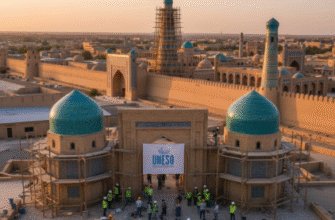
Tourism keeps the craft alive, which everyone acknowledges with varying degrees of resentment. Hotels want carved screens for their lobbies, restaurants commission decorative panels to signal “authentic” ambiance, and Western collectors pay absurd prices for antique pieces while balking at fair rates for contemporary work. Rustam mentioned—offhand, like it didn’t bother him, though it clearly did—that a door he’d spent three months carving sold for $800, while a damaged 19th-century panel half its size went at auction for $12,000. The market logic makes no sense unless you accept that age confers value independent of craftsmanship, which maybe it does, I don’t know. Meanwhile, UNESCO inscribed Uzbek woodcarving on its Intangible Cultural Heritage list in 2019, which generated some grant money and international attention but didn’t materially change the economics for actual carvers. There are more workshops now than there were a decade ago, but most survive on tourist trinket production—simple geometric boxes, decorative spoons, the kind of work you can churn out quickly and sell for ten dollars. The intricate stuff, the panels that take months and recieve almost no recognition outside specialist circles, that’s becoming rarer. Anyway, Rustam seemed philosophical about it, or maybe just exhausted. He’d been carving for forty-three years, and he’d keep going until his hands gave out, market be damned. The wood still told him where to cut, and that was enough.