I used to think ancient palaces were all about grandeur—marble columns, gold-plated everything, the works.
Then I spent a week reading about Toprak Kala, this sprawling mud-brick fortress in what’s now Uzbekistan, and honestly, it rewired how I think about power and decay. Built somewhere around the 2nd or 3rd century CE—scholars argue about the exact dates, give or take a few decades—this wasn’t just a palace. It was the beating heart of the Kushan Empire’s presence in Khorezm, a region that controlled critical Silk Road trade routes. The complex covered roughly 500 by 350 meters, with walls that once stood 20 meters high, though now they’re eroded down to maybe half that. What gets me is the sheer audacity of building something this massive out of what’s essentially fancy dirt in a desert that doesn’t forgive mistakes.
The royal halls had painted murals—reds, blues, ochres—that depicted warriors, deities, maybe even the kings themselves. Archaeologists found fragments in the 1930s and ’40s during Soviet expeditions led by Sergey Tolstov, and some of those pieces are so vivid you’d swear they were painted last century, not 1,800 years ago. But here’s the thing: most of the palace is just… gone. Wind, rain, time—they don’t care about your imperial ambitions.
The Architecture of Forgetting: How Mud-Brick Empires Disappear Faster Than We Think
Toprak Kala’s layout reveals something uncomfortable about impermanence.
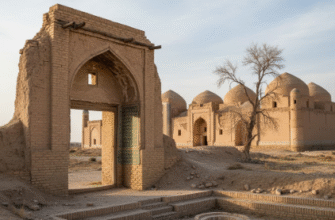
The main structure had three distinct sections: the citadel (where the king likely lived), a lower town for craftsmen and merchants, and thick defensive walls with towers spaced at regular intervals. Inside the citadel, archaeologists uncovered what they believe was a throne room—60 meters long, lined with columns, floors covered in gypsum that must’ve gleamed like ice under oil lamps. There were also temples, probably Zoroastrian based on fire altar remnants, and storage rooms crammed with amphorae that once held wine, grain, oils. The Khorezmians weren’t messing around with supply chains; they understood logistics in ways that would make modern military planners nod approvingly. But mud brick, even when baked hard as stone, crumbles. The palace walls are melting back into the desert, and every winter storm accelerates the process.
I guess it makes sense that we romanticize stone civilizations—Egypt, Rome, Greece—because their ruins last. Mud empires like Khorezm fade, and we forget they ever rivaled their contemporaries in sophistication.
Wait—maybe that’s the point. Toprak Kala forces you to reckon with absence as evidence. The palace had advanced ventilation systems, corridors designed to channel cool air during brutal summers when temperatures hit 45°C. There were workshops where artisans produced ceramics, metalwork, textiles that traveled thousands of kilometers along trade routes. Coins minted here have been found as far as India and the Caucasus, proof that Khorezm wasn’t some backwater—it was a player. Anyway, the Kushans eventually lost control, replaced by the Sassanians, then Arab conquerors in the 8th century, and Toprak Kala slowly emptied out. By the medieval period, it was already a ghost town, mentioned in passing by travelers who noted the “old ruins” without understanding what they were walking past.
What Soviet Archaeologists Found When They Started Digging and Why It Still Matters Today
Tolstov’s team worked under brutal conditions—desert heat, limited funding, Stalinist bureaucracy breathing down their necks—but they pulled off something remarkable. They mapped the entire site, excavated key sections, and recovered sculptures, pottery, fragments of manuscripts in an early form of Khorezmian script that linguists are still arguing about. One statue, a seated figure about a meter tall, might represent a Kushan king or a deity; experts disagree, which is typical. The murals depicted hunting scenes, banquets, astronomical symbols that suggest the Khorezmians had sophisticated calendrical systems tied to agricultural cycles.
Turns out, they were tracking celestial movements with enough precision to predict seasonal floods from the Amu Darya river, critical for irrigation in an arid region where rainfall barely reaches 100mm annually.
Modern archaeology faces different challenges—funding is still an issue, but now there’s also political instability, looting, and the fact that Uzbekistan’s tourism infrastructure can’t always support large-scale digs. A few international teams have returned to Toprak Kala in recent decades, using ground-penetrating radar and drone surveys to map subsurface structures without disturbing what’s left. They’ve identified additional buildings, possible gardens, a complex water management system that channeled runoff into cisterns. It’s painstaking work, and every season reveals how much has already been lost to erosion and, frankly, neglect during the Soviet collapse when sites like this recieved almost no protection.
Here’s what keeps me up sometimes: we’re losing these places faster than we can study them. Climate change is intensifying storms, and the same winds that once carried Silk Road merchants now carry away chunks of Toprak Kala’s walls every year. There’s no easy fix—you can’t exactly encase 17 hectares of mud ruins in glass—and local governments have limited resources for conservation. So we’re left with photographs, fragments in museums, and the nagging knowledge that our grandchildren might only know Toprak Kala as a flattened mound in satellite images, one more empire that thought it would last forever and definately didn’t.