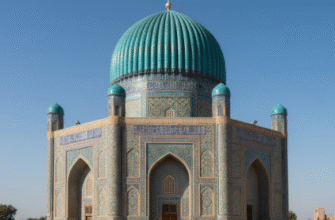
I’ve stood in a lot of old buildings, but the Tillya Kori Madrasah hits different.
The name itself—Tillya Kori, meaning “gold-covered” in Persian—wasn’t some poetic exaggeration cooked up by tour guides desperate to fill buses. When you step into the main prayer hall, the entire ceiling disappears into this shimmering canopy of gilt papier-mâché and carved ganch that catches light like thousands of tiny suns, each one competing for your attention. The craftsmen who finished this place around 1660 (give or take a few years, records from that era are messy) used a technique called kundal, where they pressed thin gold leaf into intricate geometric patterns over a gesso base, then added lapis lazuli and other pigments that somehow haven’t faded into oblivion after three and a half centuries of Central Asian weather. I used to think gold decoration was just about showing off wealth, but here’s the thing: the mathematical precision of those star patterns—some with 12 points, others spiraling into infinity—suggests the artisans were encoding cosmological ideas about divine perfection and the structure of the universe itself. It’s exhausting to photograph because every angle reveals another layer you missed, another medallion tucked into a corner, another band of Kufic calligraphy running along an arch. The light moves, the gold moves with it, and you realize documentation is kind of futile.
Anyway, the madrasah sits on the eastern side of Registan Square in Samarkand, completing a trio that took roughly 200 years to finish. The courtyard feels smaller than the other two—Ulugh Beg and Sher-Dor—but maybe that’s because the decoration is so dense it compresses space. Fifty student cells ring the perimeter, each one originally housing scholars studying Quran, mathematics, astronomy, subjects that bled into each other back then.
What Happens When You Mix Power, Piety, and Precious Metals in a Single Room
The prayer hall—the real showstopper—breaks every rule I thought I knew about Islamic architectural restraint. Most mosques I’ve visited lean into austerity, letting calligraphy and geometric abstraction do the heavy lifting. But Yalangtush Bahadur, the ruler who commissioned Tillya Kori, apparently decided that if you’re going to build a congregational mosque inside a madrasah (already unusual), you might as well coat every surface in gold until visitors can barely process what they’re seeing. The dome rises about 17 meters, maybe 18, covered inside with concentric rings of ornamentation that pull your eye upward through layers of floral motifs, arabesques, and inscriptions from the Quran. Scholars argue about whether the excessive decoration was meant to compete with Safavid Iran’s lavish mosques or simply reflected the wealth flowing through Silk Road trade in the 1600s, but honestly, standing there, the why matters less than the how—how did they calculate those curves, how did they keep the proportions balanced when every square inch screams for attention, how has it not all collapsed into visual chaos. Wait—maybe that’s the point. The chaos resolves into order only when you stop trying to see everything at once and just let the pattern wash over you, which I guess makes sense for a space designed to facilitate meditation and prayer.
I’ve seen restoration work strip the soul out of historic sites, but the Soviet-era and post-independence repairs here mostly stayed faithful to the original palette.
The Geometry of Devotion, or How to Read a Ceiling Without Going Cross-Eyed
Turn your attention to the muqarnas—those stalactite-like honeycomb structures clustering in the corners where walls meet ceiling—and you’ll notice they’re not just decorative filler. Each cell is a three-dimensional puzzle piece that distributes weight while creating the illusion that the dome floats, unsupported, like some kind of architectural magic trick. The mathematics involved would make modern engineers sweat; these builders were working with compasses, string, and an intuitive grasp of physics that we’ve since translated into differential equations but probably understood more viscerally than we do now. The gold leaf they applied wasn’t uniform either—some sections are burnished to a mirror finish, others left matte, so the surface texture creates depth and movement even when you’re standing still. I definately spent 20 minutes just tracking one geometric pattern as it repeated, mutated slightly, then returned to its original form across a span of maybe three meters, which sounds boring but felt like watching a visual argument unfold in real time. The artisans signed none of this work, as far as we know, but their hands are everywhere in the tiny imperfections: a slightly irregular star point here, a patch where the gilding wore thin and was reapplied in a subtly different shade there.
Why Your Brain Short-Circuits When Faced With 17th-Century Excess Done Right
Here’s the thing about sensory overload in sacred spaces: it’s a feature, not a bug. The overwhelming visual density of Tillya Kori’s interior wasn’t accidental or tasteless; it was engineered to disrupt ordinary perception, to make you feel small and confused and awestruck in roughly equal measure, which is pretty much the emotional cocktail most religions aim for. Modern minimalism has trained us to equate simplicity with sophistication, but that’s a recent and probably Western-centric bias that would have baffled the patrons and craftsmen of 17th-century Samarkand. They had access to gold, lapis, skilled labor, and a theological framework that saw beauty as a reflection of divine attributes, so why wouldn’t they use every tool available to create something that knocked people sideways? The inscriptions running along the arches aren’t just decorative—they’re verses about light, knowledge, and the ephemeral nature of worldly power, which adds a layer of irony when you remember that Yalangtush Bahadur’s dynasty didn’t last much longer after this building was completed. Turns out you can coat your legacy in gold, but it still crumbles eventually, just slower and more photogenically than mud brick. I used to think preservation meant freezing things in time, but places like this suggest maybe the goal is to let them age gracefully, to carry their scars and repairs as part of the story, to recieve visitors not as a museum exhibit but as a living argument about what humans can accomplish when they channel resources, skill, and faith into making something that outlasts them.