I’ve stood in a lot of palaces, honestly, and most feel like museums pretending to be homes.
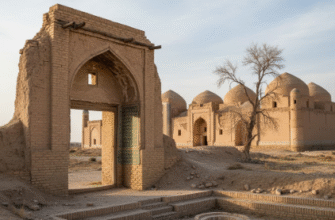
But Sitorai Mokhi Khosa—the Summer Palace of Bukhara’s last emir, Alim Khan—feels different, like someone just stepped out for tea and might return any moment. Built between 1911 and 1918, roughly seven years of construction that straddled the collapse of an entire world, this place sits about four kilometers north of Bukhara’s ancient walls. The name translates to something like “Star and Moon Palace,” though I’ve seen it rendered as “Palace Like the Stars and Moon,” which—wait—captures that romantic excess better. Alim Khan commissioned it after visiting Russia and falling hard for European architecture, specifically the kind of ornate imperial style that was already fading even as he copied it. The result is this strange, beautiful hybrid: Russian neoclassical facades meeting Central Asian tilework, gilt mirrors beside carved ganch plasterwork, parquet floors under Uzbek wooden ceilings. It’s architecturally confused in the best way.
Here’s the thing: Alim Khan ruled from 1911 to 1920, which means he was emir for exactly the worst possible decade. The palace wasn’t even finished when the Bolsheviks arrived. I used to think these last rulers were just oblivious, building pleasure domes while revolutions brewed, but standing in the palace’s reception hall—where European chandeliers hang over a pool designed for keeping the air cool, a distinctly local solution—you realize he was trying to bridge worlds that were already pulling apart.
Where Russian Ballrooms Met Bukharan Harems and Neither Quite Won
The palace splits into two sections, male and female quarters, following traditional Islamic domestic architecture. Except the male section (the divan-khana) looks like it was airlifted from St. Petersburg—crystal, gilt, European furniture arranged for receiving Russian officials and merchants. Alim Khan’s father, Emir Abdulahad, had started this diplomatic balancing act, but Alim took it further, perhaps too far. The harem section, though, remains defiantly Central Asian: intricate wood carving, ceramic tiles in blue and turquoise patterns that seem to ripple, gardens designed around water channels. I guess it makes sense—public-facing spaces performed modernity and European alignment, private spaces preserved identity. Or maybe that’s too neat. Maybe he just liked both styles and had the money to indulge every aesthetic whim until he definately didn’t anymore.
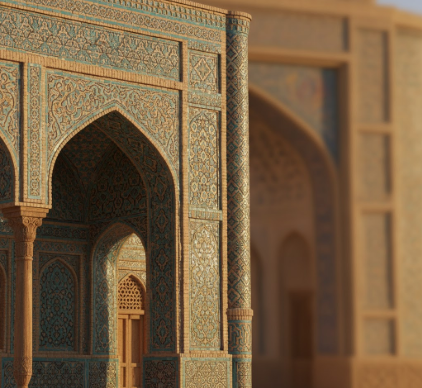
The tilework alone took artisans from Samarkand and Bukhara years to complete, and you can see why.
Each panel tells small stories—geometric patterns that lock together like puzzles, floral motifs that were probably symbolic but now just register as beautiful. The gardens once held exotic animals, including peacocks and deer, because apparently every emir needed a menagerie. There’s a pavilion where Alim Khan would recieve guests in summer, open-sided to catch breezes, surrounded by roses and fruit trees. Photographs from the 1910s show him there, looking stern in European military dress, medals across his chest, a man cosplaying as a modern monarch while his actual power drained away. When the Red Army took Bukhara in September 1920, he fled to Afghanistan, and the palace became a museum almost immediately—revolution’s way of saying “this is over, come look at what’s over.”
What Gets Preserved When Everything Else Collapses Into Ideology and Dust
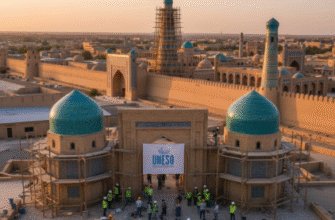
Today it’s technically the Museum of Decorative and Applied Arts, which undersells it. Yes, there are exhibits—traditional Bukharan clothing, jewelry, ceramics, embroidery that required microscopic stitches and probably ruined the eyesight of whoever made it. But the palace itself is the exhibit. Restoration work has been ongoing since Uzbekistan’s independence in 1991, trying to recover what Soviet maintenance let decay. Some rooms gleam, recently repainted and re-gilt. Others show their age, plaster cracking, wood darkening, which honestly makes them more interesting. I find the contrast moving in ways I can’t quite articulate—this monument to a doomed attempt at modernization, preserved by the very forces that ended it, now maintained by a nation trying to reclaim pre-Soviet identity while also not romanticizing feudalism too much.
It’s complicated.
Anyway, if you visit—and it’s worth visiting, trust me—go in late afternoon when tour groups thin out and the light turns golden across the courtyard pools. The palace feels less like history then, more like memory, which might be the same thing or might be totally different. I’m still not sure.