The lions don’t look right.
That’s the first thing you notice when you stand in Registan Square, craning your neck up at the Sher Dor Madrasah’s massive tympanum panels—these two tawny felines, each chasing a white deer across a field of turquoise majolica tiles, with suns rising behind them that have distinctly human faces. The whole composition feels like it shouldn’t exist in this context, not on a 17th-century Islamic madrasah where figurative representation was, well, complicated. The lions have these oddly delicate paws and their manes flow in ways that suggest the artisans had maybe seen illustrations of lions but never the actual animal, which—given that Samarkand sits pretty far from lion country—makes sense. The deer look perpetually startled, frozen mid-leap for four hundred years now. And those suns, those strange anthropomorphic suns with their radiating triangular rays, they’re watching everything with expressions that scholars still argue about: benevolent? indifferent? vaguely annoyed?
When Theological Pragmatism Meets Architectural Ambition (And Someone Decides Rules Are Flexible)
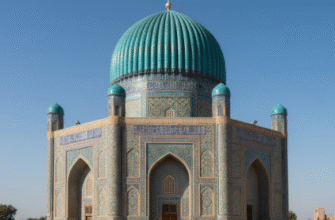
Here’s the thing about the Sher Dor, which translates to “Having Lions”—it was built between 1619 and 1636 by a governor named Yalangtush Bakhodur who apparently decided that Registan Square needed symmetry more than it needed theological purity. The Ulugh Beg Madrasah sat on the eastern side, elegant and restrained, so Yalangtush commissioned this mirror image for the western flank. Except he didn’t just copy the design. He went rogue with the decoration, slapping these massive predator-and-prey scenes right onto the facade in a move that still makes art historians raise their eyebrows. Islamic aniconism—the avoidance of depicting living beings, especially in religious contexts—was a real consideration in Central Asia, though interpretations varied wildly by region and era. Some scholars argue the lions are actually symbolic representations, maybe references to Ali ibn Abi Talib whose name means lion, or perhaps zodiac signs. Others think Yalangtush just really liked the aesthetic and figured he could get away with it.
The technical execution is honestly remarkable, even if the theological justification is murky. Each lion is composed of thousands of individual glazed tiles—majolica work that required firing colored pigments onto white slip at precise temperatures. The turquoise background, achieved through copper oxide, had to be applied in layers. One miscalculation and the whole panel could crack during firing or the colors could bleed into muddy browns.
The Geometry of Faces That Definitely Aren’t Supposed to Be There (But Definitely Are)
Wait—maybe the most unsettling part isn’t the lions at all.
It’s those sun faces, staring out with their weirdly Mongolian or possibly Chinese features, their expressions calm and inscrutable. Some theories suggest they represent Zoroastrian solar symbolism, a holdover from pre-Islamic Central Asian traditions that never quite disappeared despite centuries of Muslim rule. Zoroastrianism venerated fire and celestial bodies, and Samarkand—sitting on the Silk Road, absorbing influences from Persia, China, India, everywhere—was always a chaotic mixing bowl of iconographies. The rays extending from each sun form these sharp, almost aggressive triangles, interspersed with curving wisps that could be flames or clouds, depending on who you ask. The whole design radiates outward in a mandala-like pattern that draws your eye to the center, where the lions and deer are locked in their eternal, somewhat awkward chase.
I guess it makes sense that a building this ambitious would push boundaries. The Sher Dor wasn’t just a school—it was a statement, a flex of political power and artistic patronage in an era when the Shaybanid dynasty was trying to reclaim Samarkand’s former glory after Timur’s empire had crumbled. Yalangtush wanted something grand, something memorable, something that would make people stop and stare even four centuries later.
Survival Through Earthquakes, Soviet Restoration Attempts, and the Indignities of Modern Tourism
The mosaics almost didn’t make it to the 21st century, which feels like a minor miracle given Samarkand’s seismic history. A major earthquake in 1903 damaged portions of the facade, and by the time Soviet restorers arrived in the mid-20th century, chunks of tilework had fallen away, leaving raw brick exposed like wounds. The Soviet restoration was—how to put this gently—enthusiastic but not always accurate. Archival photographs show restorers essentially guessing at color patterns in sections where the original tiles had been lost, which means some of what you see today is historically informed speculation rather than original 17th-century work. The lions might have been slightly different shades. The sun faces could have had more nuanced expressions before Soviet artisans simplified them for efficiency.
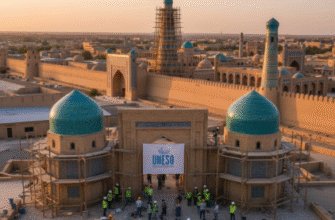
Climate change isn’t helping either, turns out. Temperature fluctuations cause the tiles to expand and contract at different rates than the brick substrate beneath them, creating microfractures that let moisture seep in. Freeze-thaw cycles do their slow, patient work of destruction. UNESCO listed Samarkand as a World Heritage Site in 2001, which brought funding but also thousands of tourists annually, their collective breath and body heat subtly altering the microclimate around the tilework. Conservation is now a constant, expensive process of monitoring humidity levels, replacing damaged tiles with careful reproductions, and trying to balance preservation with accessibility.
Standing there in the square at sunset, when the light hits the turquoise tiles just right and the lions seem almost three-dimensional, you can kind of forgive all the theological rule-breaking and historical messiness. The whole composition shouldn’t work—it’s too busy, too defiant of convention, too much a product of competing cultural impulses. But somehow it does, maybe because it’s so unapologetically itself, so confident in its own strange hybrid vision. The lions keep chasing their deer, the suns keep watching with their enigmatic faces, and four hundred years of viewers keep stopping to wonder what exactly they’re looking at and why it feels both completely wrong and somehow exactly right.