I never expected a wrestler’s tomb to make me reconsider what sanctity actually means.
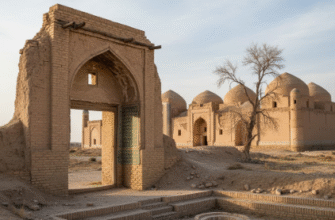
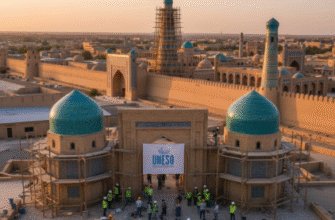
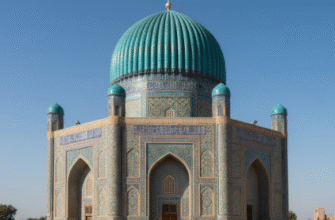
The Pakhlavan Mahmud Mausoleum sits in Khiva’s old town like a turquoise jewel box someone forgot to close, and honestly, the first time I walked past it I almost kept going. I’d been trudging through Uzbekistan’s Ichan-Kala fortress complex for maybe three hours, my feet aching in boots I should’ve broken in better, when the late afternoon light hit those blue-green tiles and I thought—wait, maybe this one’s different. Turns out Pakhlavan Mahmud wasn’t your typical 14th-century holy man: he was a wrestler, a poet, a furrier by trade, and apparently performed miracles on the side when he wasn’t pinning opponents or stitching leather. The mausoleum that bears his name was built around 1325, give or take a decade, though the complex grew over centuries like architectural sediment. People don’t just visit this place—they pilgrimage here, leaving prayers and hopes at the tomb of a man who somehow became Khiva’s patron saint despite spending his days grappling in the dirt.
The Philosopher-Wrestler Who Became Khiva’s Unlikely Spiritual Anchor
Here’s the thing about Pakhlavan Mahmud: his legend doesn’t quite add up, and that’s precisely what makes it fascinating. Born Mahmud ibn Uveys Bag around 1247, he supposedly trained as a furrier before discovering he had an exceptional talent for traditional wrestling—the kind where you grab your opponent’s belt and try to throw him into next week. But he also wrote Sufi poetry that scholars still study, verses about divine love and human weakness that feel weirdly modern when you read them. I guess what strikes me most is how the contradictions never bothered anyone. In the West, we’d probably demand he pick a lane: athlete or mystic, tradesman or intellectual. In Khiva, he was allowed to be all of it simultaneously, and when he died in 1325 or 1326 (sources vary, naturally), the city claimed him as their protector.
The original burial site was modest, just a small tomb. Then in 1701, the ruler Arap Muhammad Khan ordered the construction of the elaborate complex we see today—though “see” feels inadequate for what’s actually there.
Inside the Architectural Fever Dream Where Majolica Tiles Tell Stories You Can’t Quite Translate
I’ve seen plenty of Central Asian tilework, but the interior of this mausoleum operates on a different frequency entirely. The walls are covered in majolica tiles—blues ranging from pale sky to deep ocean, greens like oxidized copper, whites that seem to glow—arranged in geometric patterns so intricate they make your eyes vibrate if you stare too long. The main chamber houses Pakhlavan Mahmud’s cenotaph (the actual grave is in a crypt below), surrounded by carved wooden screens that smell faintly of age and incense. What gets me, though, is how the space feels simultaneously grand and intimate. The dome overhead, covered in muqarnas honeycomb vaulting, rises maybe 15 meters, but the room itself isn’t vast—maybe 10 by 10 meters, roughly speaking. You’re aware of other visitors, of the whispered prayers, of sunlight filtering through small windows and catching dust motes that haven’t settled since the Silk Road was an actual trade route.
The complex grew outward over time. An 18th-century summer mosque. A courtyard with iwans on three sides. Additional burial chambers for Khivan khans who wanted to spend eternity near the patron saint—a definately practical move if you believed his blessing extended beyond the grave.
Anyway, what strikes me now, years after that first visit, is how the mausoleum refuses easy categorization. It’s not just religious architecture—it’s political statement, artistic achievement, and collective memory box all fused together. Pilgrims still come to ask Pakhlavan Mahmud for intercession, tying strips of cloth to the wooden screens, touching the cenotaph with reverence. They’re praying to a wrestler-poet who’s been dead for roughly 700 years, and I used to think that seemed quaint or even superstitious. But standing in that blue-tiled chamber, watching how light transforms the space throughout the day, I started to understand it differently. Maybe sanctity isn’t about perfection or choosing a single identity. Maybe it’s about being fully, messily human—strong and thoughtful, practical and mystical, flawed and beloved—and somehow transcending the contradictions through sheer force of authenticity. Or maybe I’m projecting. Hard to say. Either way, the tiles keep reflecting light, the prayers keep accumulating, and Khiva’s patron saint keeps watch over a city that remembers him not despite his contradictions, but because of them.