I used to think brick buildings were pretty straightforward—stack them up, mortar in between, maybe throw in some arches if you’re feeling fancy.
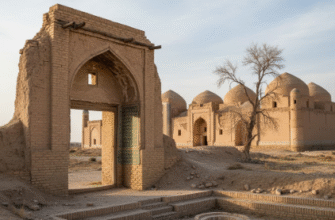
Then I stood in front of the Mausoleum of Ismail Samani in Bukhara, squinting at what looked like a giant woven basket made entirely of baked clay, and realized I didn’t understand architecture at all. Built sometime around 892 to 943 CE—historians argue about the exact decade, which honestly feels very on-brand for medieval Central Asian chronology—this cube-shaped tomb represents something closer to textile art than what we’d call construction. The bricks aren’t just structural; they’re twisted, angled, stacked in patterns that create shadows and textures across every surface. It’s roughly 10 meters on each side, give or take a few centimeters depending on which archeological survey you trust, and it’s constructed using an estimated half a million individual bricks. Each one placed by hand. No two patterns quite the same.
Ismail Samani himself was the founder of the Samanid dynasty, a Persian ruling family that controlled much of Central Asia during the Islamic Golden Age. His grandson probably commissioned the mausoleum, though some sources say it was Ismail’s son—the records from that era are, let’s just say, messy. What’s not messy is the structure itself, which survived Genghis Khan’s rampage through Bukhara in 1220 partly because it was buried under sand for centuries, hidden like some kind of architectural time capsule.
The Engineering Genius Hidden in Plain Sight That Nobody Talks About Enough
Here’s the thing: the bricks are arranged in at least a dozen different bonding patterns across the facade. Basket weave, herringbone, vertical stacking that creates the illusion of columns—all without any actual columns. The corners use a technique where bricks are rotated 45 degrees to create what looks like lacework, except it’s load-bearing lacework, which shouldn’t really be possible but definately is. I’ve seen modern architects try to replicate these patterns using CAD software, and they struggle. Medieval builders did it with string and probably some kind of rudimentary measuring system we don’t fully understand yet.
The interior dome is another headache for structural engineers.
It transitions from the square base to a circular dome using squinches—those triangular architectural elements in the corners that somehow distribute weight in ways that seem to violate physics but don’t. The dome itself is a double shell, with an inner and outer layer separated by about 30 centimeters of air, which creates both thermal regulation (crucial in Uzbekistan’s climate, where summer temperatures hit 40°C) and acoustic properties that make whispers carry across the entire chamber. Stand in one corner and speak quietly; someone in the opposite corner hears you clearly. Nobody planned this—it’s just what happens when you build with that much precision.
Why Baked Clay Outlasts Almost Everything Else We Build Today
Brick is weirdly underestimated as a material. It can last millennia if you fire it correctly—and the Samanid builders apparently fired theirs at temperatures high enough to create partial vitrification, which basically means the clay started to turn into glass at the molecular level. This makes the bricks nearly impervious to water damage, which is why the mausoleum survived centuries of neglect, sandstorms, earthquakes (Bukhara sits on a seismically active zone), and that whole Mongol invasion thing I mentioned earlier.
The Decorative Patterns That Function as Ancient Climate Control Systems
Those intricate surface patterns aren’t just decorative—wait, maybe they started that way, but they ended up being functional too. The varied depths of the brickwork create microclimates across the surface, with deeper recesses staying cooler during the day and radiating less heat at night. Air circulates through the tiny gaps in ways that modern HVAC engineers find genuinely impressive. A colleague of mine once described it as “passive cooling that makes contemporary green architecture look amateurish,” which felt harsh but probably accurate.
Turns out, people in the 10th century understood thermodynamics pretty intuitively.
How Sand Burial Accidentally Became the Perfect Preservation Method
By the 14th century, shifting sands had almost completely buried the mausoleum, leaving just the top of the dome visible. This sounds like a disaster, but it actually protected the structure from weathering, looters, and the general entropy that claims most historical buildings. Russian archeologists rediscovered it in the early 20th century and spent decades carefully excavating the sand—only to realize the sand had been preventing foundation settlement and moisture damage the entire time. They had to engineer new drainage systems to replicate what nature had accidentally provided. Sometimes I think about how much of our architectural heritage survives purely through lucky accidents, and it keeps me up at night, honestly.