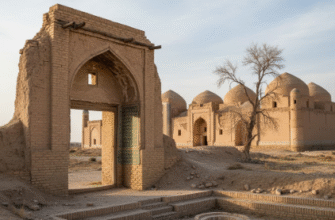
The fortress walls rise like broken teeth from the desert floor, and honestly, they’ve been doing that for roughly 2,000 years, give or take a few centuries.
When Buddhist Monks Built Cities That Nobody Remembers Correctly
I used to think Kyrk Kyz was just another forgotten pile of bricks until I started digging through the archaeological reports—turns out this place outside Termez was a major Buddhist monastic complex during the Kushan Empire, maybe around the 1st to 4th centuries CE. The name means “Forty Maidens” in Uzbek, which is weird because the legends attached to it have nothing to do with the actual Buddhist monks who lived there. Seven or eight massive structures still stand, these corrugated fortress-like buildings with strange vertical ribbing on the walls that nobody can quite explain. Some archaeologists think the design helped with ventilation in the brutal Central Asian summers. Others reckon it was purely decorative, maybe mimicking fabric or earlier wooden architecture that’s long gone. The Soviet-era excavations in the 1970s found Buddhist sculptures, coins with Greek inscriptions, and evidence of a sophisticated water management system—because here’s the thing, you can’t sustain a religious community in the desert without figuring out water pretty fast. The structures used a kind of fired brick that’s held up better than most modern construction, which is either embarrassing for us or impressive for them, probably both.
The Bactrian Crossroads Where Empires Kept Accidentally Meeting
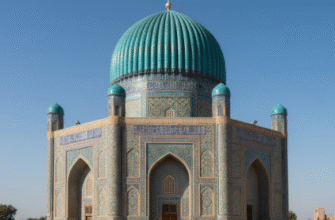
Termez sits right on the Amu Darya river, the ancient Oxus, and if you wanted to control the Silk Road trade routes, you definately needed a foothold here. Alexander the Great supposedly founded a city nearby around 328 BCE, though the exact location gets argued about in academic papers that nobody reads. What we know for sure is that the Greco-Bactrian Kingdom, then the Kushans, then various Islamic dynasties all saw Termez as crucial—militarily, economically, spiritually. Kyrk Kyz was probably built during the Kushan period when Buddhism was spreading like wildfire across Central Asia, funded by trade money and royal patronage. The Kushans were these fascinating cultural sponges, minting coins with Greek gods on one side and Buddha on the other, speaking Bactrian but writing in Greek script. Wait—maybe that’s why the ruins feel so disorienting, like they belong to three different civilizations at once. By the 7th century, the Chinese Buddhist pilgrim Xuanzang visited Termez and described flourishing monasteries with thousands of monks, though he didn’t mention Kyrk Kyz specifically, which either means it wasn’t important or his translators missed it.
Anyway, the Mongols showed up in 1220.
What Survives When Everything Else Gets Deliberately Erased
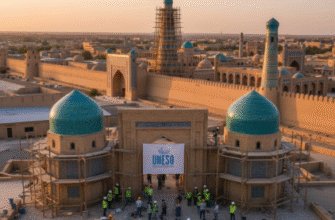
Genghis Khan’s armies didn’t just conquer Termez—they essentially deleted it, killing most of the population and destroying the irrigation systems that made urban life possible. Kyrk Kyz survived partly because it was already semi-abandoned by then, the trade routes having shifted and Buddhism having been replaced by Islam centuries earlier. The structures became livestock shelters, then landmarks for travelers, then eventually archaeological sites when Russian and later Uzbek researchers started paying attention in the 19th and 20th centuries. Modern conservation efforts are, I guess, better than nothing, though the site gets maybe a few hundred visitors per year compared to Samarkand’s millions. I’ve seen photographs where local kids play soccer against the ancient walls, which feels both wonderful and slightly alarming given the fragility of 1,800-year-old brickwork. The Uzbek government has been trying to get more Silk Road sites onto the UNESCO World Heritage list, but the paperwork and politics move slower than archaeological time. What strikes me about Kyrk Kyz isn’t the grandeur—it’s not grand anymore, just stubborn—but the layered forgetting and remembering that happens when a place outlives its original purpose by a millenia and just keeps existing anyway, accumulating new stories that have nothing to do with the old ones.