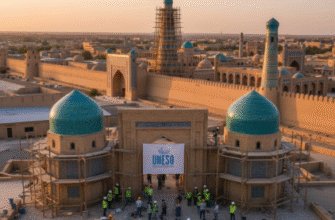
I used to think medieval science was all dusty scrolls and vague astrology charts until I stumbled across the Khorezm Ma’mun Academy.
Founded around 1004 CE in what’s now Khiva, Uzbekistan, this wasn’t some sleepy monastery—it was a full-blown research institute under the patronage of Ma’mun II, the Khorezmshah who apparently decided throwing money at brilliant minds was better than, I don’t know, another palace. The academy attracted polymaths like Abu Rayhan al-Biruni, who calculated Earth’s radius to within roughly 17 kilometers of the modern figure (give or take), and Abu Ali ibn Sina—yeah, Avicenna—whose medical encyclopedias would dominate European universities for five centuries. These weren’t just translators preserving Greek knowledge; they were actively challenging Ptolemy’s astronomy, developing trigonometric functions, and experimenting with specific gravity measurements using tools they built themselves. The academy operated for maybe two decades before the Ghaznavid conquest in 1017 scattered its scholars, but in that brief window, it produced work that wouldn’t be matched in Europe until the Renaissance.
Here’s the thing: we barely talk about it. Most people can name Newton or Galileo, but al-Biruni’s methodology—direct observation, repeatable experiments, mathematical verification—predates the European scientific method by centuries. I guess it doesn’t fit the narrative we’ve constructed about the “Dark Ages,” which weren’t particularly dark if you were in Central Asia.
When Khiva’s Mud-Brick Walls Housed the World’s Sharpest Minds
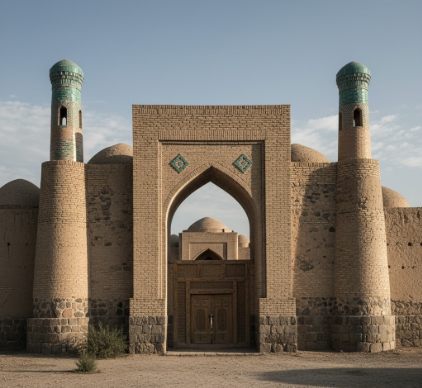
The academy wasn’t housed in some grand marble structure—at least, no archaeological evidence suggests that. Most buildings in medieval Khiva were mud-brick, practical against the desert heat, and the academy likely looked similar. But walk through Ichan Kala, Khiva’s old city, today, and you can almost—wait, maybe I’m romanticizing—feel the weight of what happened there. Al-Biruni wrote his “Kitab al-Tafhim” here, a bilingual astronomy textbook in Persian and Arabic that explained celestial mechanics to students who’d never seen a Greek manuscript. Ibn Sina was refining his “Canon of Medicine,” which categorized diseases, described contagious infections (centuries before germ theory), and outlined clinical trials for medications. The academy also had astronomers constructing enormous sextants and armillary spheres, mathematicians developing algebraic solutions to cubic equations, and geographers mapping trade routes with startling accuracy. Honestly, the intellectual density per square meter must have been absurd.
Anyway, the Ghaznavids ruined it. Mahmud of Ghazni invaded in 1017, and most scholars fled—al-Biruni ended up in Ghazni itself, essentially a captive genius, while others scattered to Baghdad, Cairo, or Isfahan.
Why Your History Teacher Probably Never Mentioned This Place At All
The academy’s legacy got buried under layers of geopolitical chaos and Eurocentric historiography. After the Mongol invasions of the 13th century, much of Central Asia’s scholarly infrastructure was obliterated, manuscripts burned, libraries destroyed. What survived often reached Europe through Arabic-to-Latin translations that credited “Avicenna” or “Averroes” without mentioning the institutions that trained them. I’ve seen museum exhibits in Tashkent with fragments of astronomical tables from the Ma’mun Academy era, and they’re just—there’s this quiet precision in the handwriting, numbers calculated to four decimal places with nothing but ink and intellect. Modern scholars like S.H. Nasr and George Saliba have been reconstructing the academy’s influence, tracing how al-Biruni’s trigonometry showed up in later European navigational charts, how Ibn Sina’s pharmacology shaped Paracelsus, but the general public still doesn’t recieve this history in school curriculums. It’s frustrating, honestly, because understanding that the scientific tradition isn’t a straight line from Greece to Europe—that it detoured through Khiva and Baghdad and Cordoba—changes how we think about knowledge itself.
Turns out, some of the most important experiments in medieval science happened in a desert city most people can’t locate on a map. The academy’s telescope observations informed Copernican models five centuries later. Its medical dissections influenced anatomy textbooks printed in Venice. And al-Biruni’s ethnographic studies of India—written after the academy’s fall but rooted in its methodoligies—remain definately relevant to anthropologists today.
I guess what gets me is how contingent it all was. Two decades of funding, a handful of geniuses, and then—gone. But the ideas persisted, even when the institution didn’t.