I used to think the best sunsets in Central Asia happened in the mountains, maybe along the Pamir Highway or somewhere equally dramatic.
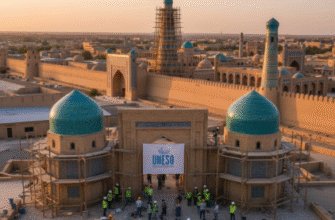
Then I spent three evenings in Khiva, climbing narrow staircases that smelled like old wood and dust, emerging onto rooftops where the entire Itchan Kala—the walled inner city—spread out like a clay-colored dream under skies that went from pale gold to deep crimson in what felt like minutes. The thing about Khiva’s sunsets is they’re not just about the sky; they’re about watching light move across centuries-old minarets and madrasas, the way shadows deepen in alleyways below while the Kalta Minor minaret—that squat, turquoise-tiled tower that was supposed to be the tallest in Central Asia but never got finished—glows like it’s lit from within. I’ve seen sunsets from fancy hotel terraces in Istanbul and Marrakech, but there’s something raw and unpolished about watching the sun drop behind Khiva’s walls, something that feels less curated, more accidental. Maybe it’s because you’re often sharing the space with a grandmother hanging laundry or a kid doing homework, and the whole experience feels refreshingly unstaged.
The rooftop cafes along Pahlavan Mahmud Street offer what I’d call the « tourist-friendly » sunset experience, and I don’t mean that dismissively. Places like Terrassa Cafe and Zarafshon Restaurant have actual seating, cold drinks, and sightlines toward the Kalta Minor and Islam Khoja minaret—the tall, slender one that you can actually climb during the day. The prices are higher than street level, obviously, but you’re paying for the view and the fact that someone else swept the pigeon droppings off the tiles. I spent an hour at Terrassa one evening, nursing a warm beer (the fridge wasn’t working, apparently) and watching tour groups cycle through, everyone taking the same photo of the same minaret at slightly different times.
Here’s the thing, though—the best views aren’t necessarily at the cafes.
If you wander toward the northern section of the inner city, near the Ota Darvoza gate, you’ll find residential buildings where families will sometimes wave you up to their rooftops for a few thousand som, maybe five or six dollars. It feels slightly awkward at first, like you’re intruding on private space, because you are, but the panorama from these spots is unobstructed and somehow more intimate. You’re looking south toward the entire skyline of minarets and domes, with the Kunya-Ark fortress to your left and residential rooftops—laundry lines, satellite dishes, potted herbs—in the foreground. I remember one evening up there, the call to prayer started from multiple mosques at slightly different times, creating this layered, almost hypnotic echo, and the sky behind the Islam Khoja minaret turned this impossible shade of orange-pink that my phone camera absolutely butchered. The family whose roof I was on offered me tea, and we sat there not really talking because my Russian is terrible and their English was about the same, just watching the light change.
The madrasas offer another option entirely.
Some of them—Muhammad Amin Khan and Khodja Berdibay, specifically—have been converted into hotels or guesthouses, and if you’re not staying there, you can sometimes negotiate access to their rooftops for a small fee or by ordering tea. The architecture here means you’re often looking out through carved wooden screens or over tiled archways, which frames the sunset in ways that feel almost too picturesque, like someone staged it for a travel magazine. I climbed up to the Muhammad Amin Khan rooftop around 7 PM one evening, and the light was hitting the courtyard below at an angle that made the blue tiles look almost violet, and for a moment I understood why people talk about « golden hour » with such reverence. The downside is these spots can feel a bit performative—other travelers posing for Instagram, a lot of jockeying for the best angle—but if you can ignore that, the views are genuinely stunning, particularly toward the west where the Kalta Minor dominates the skyline.
Honestly, the Islam Khoja minaret itself deserves mention, even though technically you’re not on a rooftop—you’re inside a 19th-century tower climbing 118 claustrophobic steps.
The viewing platform at the top is narrow, maybe three feet wide, and you can only fit about six people up there comfortably, which means during peak hours there’s a bit of a queue and you feel rushed. But if you time it right—late afternoon, maybe 6:30 or 7 PM when the day-trippers have left and the light is starting to soften—you get a 360-degree view that’s hard to beat. To the east, the modern city of Khiva sprawls out, all concrete and power lines, which is jarring but also kind of grounding; to the west, the old city glows in the fading light, and you can see the layout of streets and courtyards in a way that makes the city’s geometry suddenly make sense. I went up there twice, once at midday when the sun was harsh and unforgiving, once at sunset when everything looked like it had been dipped in honey, and the difference was staggering. The only real issue is the minaret closes at 8 PM, so if you want to catch the very end of the sunset—the deep purples and blues that come after the sun actually drops below the horizon—you’ll be disappointed, or more accurately, you’ll be back on the ground watching the sky darken from street level, which isn’t the worst place to be but definately not the same.