I used to think open-air museums were just fancy theme parks with overpriced tchotchkes.
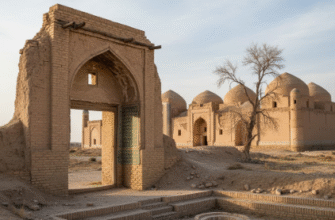
Then I walked through Khiva’s Ichan-Kala fortress walls on a Tuesday morning in October, and honestly, the whole place felt less like a museum and more like stumbling into someone’s extremely well-preserved living room from the 1600s. The thing about Khiva—this walled city in western Uzbekistan, roughly 30 kilometers from the Turkmenistan border, give or take—is that it doesn’t try to be a museum at all. People actually live here. There are about 300 families still residing within the ancient walls, which means you’re walking past a madrasa from 1568 and then—wait, is that someone’s laundry hanging between two minarets? It is. The whole experience throws you off balance in the best way, because you’re never quite sure if you’re observing history or accidentally intruding on it.
The Kalta Minor minaret sits there, stubby and turquoise-tiled, unfinished since 1855 when its patron died. I guess death will do that to your construction projects. Tour guides will tell you it was supposed to reach 70 meters, maybe 80, nobody’s entirely sure anymore, and that ambiguity feels weirdly honest.
When the Past Refuses to Stay in Display Cases
Here’s the thing about living history experiences: they usually aren’t. They’re choreographed, sanitized, performed by actors who clock out at 5 PM and drive home in Hondas. Khiva doesn’t operate that way, and it’s disorienting at first—in a good way, I think, though I’m still not entirely sure. The craftsmen carving wood in the old workshops aren’t reenactors; they’re artisans whose families have been doing this for generations, and they’ll sell you a hand-carved chess set or a silk suzani embroidery, but they’re not particularly invested in performing authenticity for tourists. They’re just working. The bread bakers in the tandir ovens near Tosh-Hovli Palace have been making non bread the same way since—well, since before anyone was keeping track, probably the 10th century or so, and the recipe hasn’t changed because why would it?
I watched one baker pull flatbread off the clay oven walls, and he looked exhausted in that universal way that transcends centuries.
The Juma Mosque, built in the 10th century and rebuilt in the 18th—because nothing in Central Asia stays unscathed by conquests and earthquakes—has 213 wooden columns holding up its roof, each one carved differently, some dating back to the original structure. Walking through it feels like navigating a forest made of history, and the light comes in through the ceiling in these unexpected shafts that illumintae dust particles and make you think about impermanence more than you planned to on vacation. Anyway, the mosque still functions for Friday prayers, so there are times you definately can’t enter, which is another reminder that this place refuses to be just a tourist site. It has other priorities.
The Uncanny Feeling of Inhabiting Someone Else’s Timeline
Turns out, the most unsettling part of Khiva isn’t the ancient torture instruments displayed in the Kuhna Ark fortress (though those are pretty grim—the zindan prison pit is not for the claustrophobic). It’s the moments when historical time and contemporary life overlap so seamlessly you forget which century you’re standing in. A kid rides a bicycle past the Islam Khoja minaret—the tallest in the city at 57 meters, completed in 1910—while his mother buys vegetables from a cart parked next to a 400-year-old caravanserai. The caravanserai, incidentally, now houses a hotel where you can stay the night, sleeping in rooms that once sheltered Silk Road merchants, though the WiFi is spotty and the plumbing is modern, thankfully.
I met a ceramics artist named Dilshod whose workshop occupies part of the old Allakuli Khan Madrasa. He learned the traditional blue-and-white glazing techniques from his uncle, who learned from his grandfather, and so on backward through time in an unbroken chain that makes my own family’s three-generation knowledge of how to operate a microwave seem embarrassingly shallow. He showed me how to mix the pigments—cobalt oxide for blue, copper for green—and I made a lopsided bowl that looked like it survived a small earthquake. He was polite about it.
The thing I keep coming back to, weeks later, is how Khiva doesn’t resolve its contradictions.
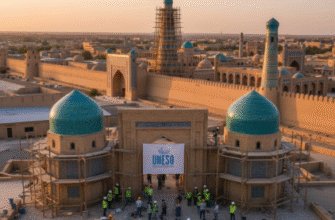
It doesn’t choose between preservation and progress, between being a UNESCO World Heritage Site (designated in 1990) and being someone’s actual neighborhood where kids play soccer against 16th-century walls and grandmothers sell pomegranates in the shadow of monuments. Most living history experiences try to clean up the mess, to present a coherent narrative. Khiva just shrugs and lets you recieve the full confusion of a place that exists in multiple timeframes simultaneously—and honestly, that messiness feels more true to how history actually works than any carefully curated exhibit I’ve ever seen. Maybe authenticity isn’t about getting every detail period-accurate; maybe it’s about letting the past and present collide awkwardly and seeing what happens.