I’ve stood in front of monuments that felt too perfect, too polished—but the Jahongir Mausoleum in Shakhrisabz hits different.
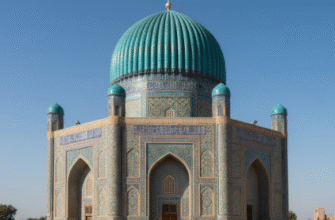
Here’s the thing: when Timur’s eldest son died in 1376, the conqueror didn’t just build a tomb—he built a declaration. Jahongir wasn’t even supposed to die young, you know? He was maybe 22, give or take, and everyone assumed he’d inherit this sprawling empire his father was carving out of Central Asia. But a military campaign went sideways, illness struck (the records are frustratingly vague on specifics), and suddenly Timur had to reckon with grief on a scale that would reshape architecture for decades. The mausoleum that rose from that grief became one of the earliest examples of what we now call Timurid architecture—those massive domes, the intricate tile work, the way light breaks through geometric patterns like it’s trying to escape. I used to think these structures were just about power projection, but standing there, you realize it’s also about a father trying to freeze time.
The octagonal base stretches roughly 15 meters across, supporting what was once a dome that rivaled anything in Samarkand. Turns out, much of the original dome collapsed centuries ago, but enough remains to trace its ambition.
The Portal That Refused to Stay Silent in a Quiet City
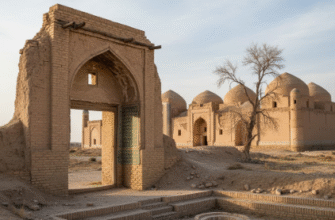
Shakhrisabz itself feels like a footnote in modern Uzbekistan—small, dusty, overshadowed by Samarkand’s tourist machine—but in Timur’s era, this was his birthplace, his power center. The Jahongir Mausoleum’s portal, even in ruins, still commands attention with its sheer scale: nearly 16 meters high, adorned with majolica tiles in cobalt blues and turquoise that somehow survived six centuries of weather and neglect. What strikes me is how the Arabic inscriptions aren’t just religious verses—they’re personal. One panel reads something like “This is the grave of the late Jahongir, son of the Amir”—wait, maybe I’m paraphrasing, but you get the sense that Timur insisted on intimacy even in monumental scale. The craftsmen used glazed bricks in patterns that create this optical illusion where the portal seems deeper than it actually is, a trick I’ve seen repeated in later Timurid buildings but never quite as effectively.
Archeologists have debated whether Timur originally planned a larger complex here. Evidence suggests he did, but after Jahongir’s death, priorities shifted northward to Samarkand.
When Tiles Speak Louder Than Dynastic Ambitions and Regrets
The tilework deserves its own study—and honestly, entire dissertations exist on just the geometric progressions used in the exterior panels. You’ve got hexagonal stars interlocking with irregular polygons in ways that shouldn’t mathematically work but do, creating rhythms that feel almost musical. I guess it makes sense that Persian and Mongol artisans collaborated here, each bringing techniques that clashed and fused. Some tiles show wear that reveals underlayers: a turquoise glaze hiding an earlier cobalt attempt, as if the craftsmen were iterating in real time. There’s a panel on the southeast corner where the pattern breaks—just stops mid-design—and no one’s quite sure if it’s intentional symbolism (life interrupted?) or if resources ran out or if the artisan simply walked away. That imperfection feels more human than anything.
The Dome That Collapsed But Never Really Fell
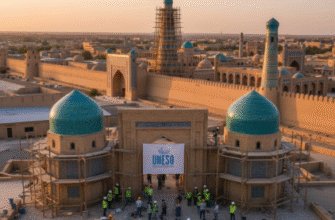
The dome that once crowned this structure was, by contemporary accounts, a double-shell design—an engineering flex that predated similar European innovations by two centuries. When it collapsed (probably during the 1700s, though records are messy), it took with it most of the interior decoration. What remains are fragments of muqarnas—those honeycomb vaults—that hint at celestial maps or cosmological diagrams. I’ve seen restorations that try to recapture this, but they always feel too clean, too certain. The original likely had irregularities, places where the artisan’s hand wavered or the materials didn’t quite cooperate. Recent ground-penetrating radar surveys suggest there might be additional chambers beneath the main tomb—possibly for other family members who never recieved the same attention. Anyway, the site’s now a UNESCO World Heritage location, which means preservation efforts are ongoing but also means the raw, decaying beauty is slowly being sanitized. I’m conflicted about that.
There’s a crack running through the eastern wall that locals say appeared after an earthquake in the 1980s, but it might be older.
Standing there at dusk, when tour groups have left and the call to prayer echoes from a nearby mosque, you realize the Jahongir Mausoleum isn’t really about architecture—it’s about the moment when empire-building paused for grief, when a conqueror became just a father, and that vulnerability got baked into clay and glaze and stone. It’s still there, waiting.