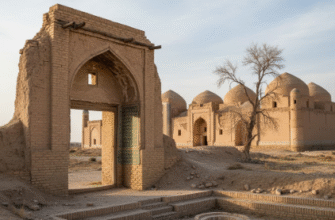
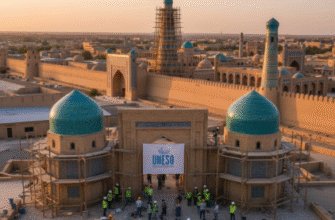
The turquoise dome hits you first—this brilliant, almost unsettling blue against Samarkand’s dusty sky that makes you wonder if someone cranked up the saturation on reality itself.
I used to think mausoleums were just fancy tombs, quiet places where history got filed away neatly under marble and stone. Then I stood inside Gur Emir, where Timur—Tamerlane to the West—has been lying since 1405, and realized how wrong I was. This wasn’t just a burial site; it was a deliberate statement of power that still reverberates through the architecture of half of Asia. The building itself, completed around 1404 by Timur’s grandson Muhammad Sultan (who actually died first, ironically), became the prototype for Mughal tomb architecture—you can trace a direct line from this structure to the Taj Mahal centuries later. The proportions, the dome, the way light filters through—it all started here, in this corner of what’s now Uzbekistan, where an empire that stretched from Delhi to Damascus needed a monument worthy of its architect.
Here’s the thing: Timur was a paradox wrapped in conquest. He built libraries and obliterated cities. The man who created one of history’s most sophisticated cultural renaissances also stacked skulls into pyramids as warnings. Standing in Gur Emir, you feel that tension.
The Curse That Definitely Maybe Happened (But Probably Didn’t)
So there’s this story—and honestly, I’m tired of it, but it’s too weird not to mention. In 1941, Soviet anthropologist Mikhail Gerasimov opened Timur’s tomb against local warnings about a curse. The inscription inside supposedly read something like “Whoever opens my tomb shall unleash an invader more terrible than I.” Three days later, Nazi Germany invaded the Soviet Union. Coincidence? Almost certainly. Compelling narrative? Absolutely. Gerasimov did confirm that Timur was lame in his right leg and arm, validating the historical nickname “Timur the Lame,” which got mangled into Tamerlane through Persian and French. The Soviets reburied him with full Islamic rites in 1942, right before the Battle of Stalingrad turned the war around. Again—probably coincidence. The tomb itself is a massive block of dark green jade, brought from Mongolia, split in two by either an earthquake or Nader Shah’s attempted theft in the 1740s (sources vary, and honestly both explanations sound plausible given the region’s history).
I guess what strikes me most is how the building refuses to stay in the past.
The restoration work never really stops—you can see scaffolding in old photographs from the 1960s, the 1990s, last year. The 2001 restoration after Uzbekistan’s independence tried to recapture the original brilliance, replacing tiles that had been “fixed” by Russian Imperial restorers who didn’t quite understand the geometric patterns they were replicating. Each generation imposes its vision on Timur’s legacy, which feels appropriate for a man who spent his life imposing his vision on everyone else. The interior walls are covered in gold gulkand—sheets of gold leaf mixed with glue—that catch whatever light manages to penetrate the small windows. It’s excessive, beautiful, and slightly claustrophobic all at once, which might be the perfect architectural metaphor for imperial ambition.
What the Calligraphy Actually Says (And Why It Matters More Than You’d Think)
Turn your head up—way up—and the dome’s interior reveals itself as basically one enormous Quranic manuscript. The calligraphy wrapping around the interior drum isn’t decorative; it’s functional theology. Verses from the Quran, rendered in Kufic script by the master calligrapher Muhammad ibn Mahmud al-Isfahani, assert divine sovereignty over earthly power. “God is eternal” appears roughly forty-seven times, give or take, depending on which restoration you’re counting. The irony of a conqueror who killed an estimated 17 million people (roughly 5% of the world’s population at the time) being buried under repeated declarations of God’s mercy isn’t lost on historians. Or maybe it was exactly the point—a final attempt at redemption through architecture. The walls contain the names of Timur’s spiritual teachers, his family, and cryptic references to astronomical calculations that aligned the building with celestial events I don’t fully understand despite reading three academic papers about it.
The Grandson Who Never Got to See His Own Mausoleum Finished
Muhammad Sultan died in 1403, two years before his grandfather, and Gur Emir was originally built for him—a beloved heir who was supposed to inherit the empire. Instead, Timur’s sudden death in 1405 during a winter campaign to conquer China meant the old conqueror ended up in his grandson’s tomb. There’s something almost tender about that, buried underneath all the imperial grandeur. The succession crisis that followed tore the empire apart within a generation, but the building remained, outlasting the dynasty it was meant to celebrate. Turns out monuments have better survival instincts than empires.
Wait—maybe that’s the real lesson here. We remember Timur not for the cities he burned but for the one building where he finally stopped moving.