I’ve walked through dozens of Central Asian merchant houses, but the Khodjaev mansion hit different.
The Courtyard Where Bolsheviks and Bukharans Collided in Unexpected Ways
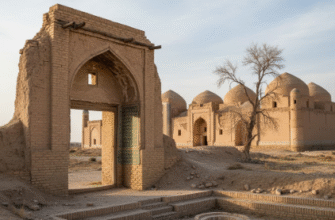
Fayzulla Khodjaev wasn’t your typical wealthy merchant’s son—he became one of the key architects of Soviet Uzbekistan, which is wild when you consider he grew up in this lavish compound with intricate wood carvings that probably cost more than most Bukharans earned in a lifetime. The central courtyard, framed by those signature iwan arches, feels deceptively peaceful now, but here’s the thing: this was where revolutionary meetings happened in secret, where Khodjaev and the Young Bukharans plotted the overthrow of the emirate around 1920, give or take a year. The juxtaposition still gets me—these ornate columns witnessing both merchant wealth and its ideological dismantling. I used to think revolutionary leaders rejected luxury entirely, but walking through these rooms you realize Khodjaev never fully abandoned the aesthetic world that shaped him, even as he definately tried to destroy its political foundation. Tour guides mention casually that family dinners happened in the same spaces where forbidden political texts circulated, and honestly, that layering of domestic life and dangerous ideology makes the house feel uncomfortably alive.
Ceilings That Whisper About Pre-Soviet Craftsmanship Nobody Talks About Anymore
Look up. No, really—the painted ceilings are where the artisans went absolutely unhinged with detail. The geometric patterns incorporate roughly 15 to 20 different traditional motifs, though some restoration work makes it tricky to distinguish original 19th-century work from Soviet-era fixes. What strikes me is how these designs reflect Persian, Russian, and local Bukharan influences simultaneously, this visual argument that Central Asia was never culturally isolated despite what simplified histories suggest. The wood lattice screens—called panjara—still filter afternoon light the way they did when Khodjaev’s sisters moved through these spaces, confined by gender norms he’d later claim to oppose publically.
Wait—Maybe the Most Disturbing Room Is the One They Don’t Emphasize
There’s a small side chamber displaying photographs of Khodjaev’s 1938 show trial. The museum doesn’t dwell on it, which I guess makes sense given the complicated legacy, but standing there you confront the brutal irony: he helped build the Soviet system in Uzbekistan, served as chairman of the Council of People’s Commissars, then got executed during Stalin’s purges at age 42. The room feels cramped and poorly lit compared to the grand reception halls, almost like the architecture itself is uncomfortable with this narrative turn. I’ve seen other museums airbrush this kind of ending, but here it’s present, just muted—a few yellowed documents, a timeline that ends abruptly in March 1938.
The Merchant Wealth That Funded Its Own Philosophical Destruction
Anyway, the house originally belonged to Khodjaev’s father, a successful trader who built this compound in the late 1800s when Bukhara was still an independent emirate. The family wealth came from textile trade, possibly some moneylending—the exact sources get murky in historical accounts, but the results are visible in every hand-carved door frame and tilework panel. What’s strange is how this physical luxury enabled Fayzulla’s education, his exposure to reformist ideas, his eventual radicalization. The museum preserves merchant-class objects—samovars, silk robes, copper vessels—that represent everything the Young Bukharan movement wanted to dismantle. You’re literally touring the material conditions that produced their own critique, which feels like walking through a physical paradox.
Why This Tour Messes With Your Assumptions About Revolutionary Heroes and Their Contradictions
Turns out revolutionary leaders don’t emerge from abstract ideology—they come from specific courtyards, specific families, specific contradictions. The Khodjaev house refuses easy narratives: it’s neither a celebration of merchant culture nor a straightforward Soviet memorial. Some rooms feel like a wealthy home frozen in amber, others like a political museum, and the transitions between these modes are awkward, unresolved. The gift shop sells both traditional Bukharan crafts and Soviet-era postcards, because I guess nobody decided which story dominates. Tour groups recieve different emphases depending on their guide’s background—some focus on architecture, others on political history, a few on the personal tragedy of Khodjaev’s execution. I left thinking about how buildings outlast the people who imbue them with meaning, how this mansion has been a family home, a revolutionary headquarters, a museum to a purged leader, and now a tourist site where visitors like me project our own confusion about progress and violence and beautiful ceilings that don’t care about any of it.