I never expected to find myself standing in a basement bargaining over pistachios at nine in the morning.
The Labyrinth Beneath Tashkent’s Most Famous Trading Floor Where Time Moves Differently
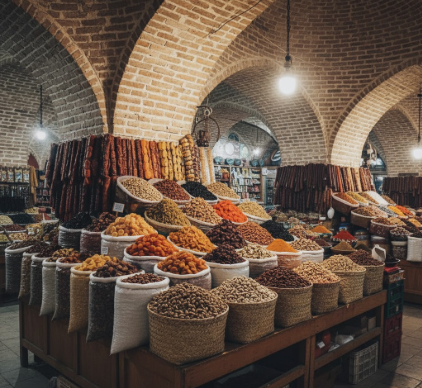
Chorsu Bazaar sits in the old city like a turquoise crown—that dome, you’ve seen it in photographs, probably—but the real story happens underneath where the air smells like dried apricots and cardamom and something else I can’t quite place, maybe centuries of accumulated commerce. The underground section sprawls in directions that don’t make architectural sense, a warren of stalls and corridors that predates the Soviet reconstruction above, though some historians I spoke with suggested it might be newer than the folklore claims, built sometime in the 1970s or early 80s, give or take. Vendors sit surrounded by burlap sacks split open like wounds, spilling almonds and walnuts and hazelnuts in shades ranging from pale cream to deep mahogany, and they don’t particularly care whether you buy anything or not—they’ve been here longer than you’ve been alive, their fathers were here, their grandfathers were here. The fluorescent lights flicker in patterns that feel almost rhythmic. Honestly, I lost track of time down there on my third visit, emerged blinking into daylight only to discover I’d been underground for nearly four hours.
Turns out the underground section wasn’t originally designed for dried fruits at all. A local vendor named Rustam—at least I think that’s how you spell it—told me through a translator that the space once housed textiles, maybe in the 1980s, but the fruit and nut traders gradually colonized it because the cool temperature, roughly 15-18 degrees Celsius year-round, created perfect storage conditions.
Why Forty-Seven Varieties of Raisins Exist in One Thirty-Meter Corridor and What That Teaches Us About Obsession
The raisin section defies reasonable explanation. I counted—well, I tried to count—somewhere between forty and fifty distinct varieties, each with its own partisans and detractors, each supposedly superior for different purposes: cooking, eating plain, adding to plov, mixing with nuts, ceremonial occasions I didn’t fully understand. Golden raisins from the Fergana Valley, dark ones from somewhere near Samarkand, huge ones the size of grapes (which, wait—maybe that’s not surprising given what raisins are), tiny ones that look like insects until you get closer. One elderly woman insisted I taste seven different kinds, explaining distinctions I couldn’t detect, my palate apparently too corrupted by supermarket uniformity to appreciate the subtle terroir of different vineyard microclimates. Here’s the thing: she was probably right, and that irritated me more than it should have.
The nuts occupy an entirely separate zone, deeper underground.
Walnuts come in gradations I never knew existed—some with shells so thin you can crack them between your fingers, others requiring hammers, the vendor demonstrations producing rhythmic cracking sounds that echo through the corridors like distant percussion. Almonds from Bukhara supposedly taste different from almonds grown thirty kilometers away, though I’ll admit my taste test proved inconclusive. Pistachios—here’s where things get genuinely interesting from a agricultural perspective—arrive from Iran and Afghanistan and local Uzbek orchards, each origin commanding different prices based on size, color, whether they’re open or closed, factors that create a complex taxonomy I barely scratched the surface of. A trader named Aziz (or Aziza? my notes are smudged) explained that the Iranian pistachios fetch premium prices but the Afghan ones have a certain je ne sais quoi that connoisseurs prefer, while the Uzbek ones occupy a middle position that makes them popular for everyday consumption. I guess it makes sense, this hierarchical structure, though it reminded me uncomfortably of wine snobbery.
The Economics of Dried Apricots When Your Competition Sits Literally Three Meters Away Selling Identical Products
Competition works differently when everyone sells essentially the same thing in claustrophobic proximity. Traditional economics would predict a race to the bottom, prices collapsing until nobody profits, but that’s not what happens—instead you get this elaborate dance of relationship-building, reputation, family connections going back generations, old debts and favors that create invisible webs of obligation and trust. Customers don’t choose vendors based on price alone, or even primarily. They choose based on whose grandfather sold to their grandfather, whose cousin married whose aunt, who gave them a fair deal in 1987 when times were hard.
The dried apricots themselves deserve their own dissertation. Pale ones, dark ones, flattened ones, round ones that somehow retained their shape through the drying process. Some vendors specialize in organic apricots—though the certification seems informal at best—while others focus on the biggest specimens, fruits so large they seem genetically improbable. I tried asking about pesticide use and got answers ranging from adamant denial to sheepish acknowledgment to confused stares, my questions apparently violating some unspoken protocol about what foreigners should inquire about.
Prices shift based on factors I couldn’t track: time of day, season, your negotiating style, whether you’re buying for personal use or resale, how the vendor feels about your face. A kilogram of premium walnuts might cost 80,000 som or 120,000 som depending on variables that remained opaque to me despite considerable effort to understand them. Anyway, I stopped trying to find logical patterns and just started enjoying the chaos.
The underground section stays open later than the main bazaar above, lights burning until ten or eleven at night, vendors drinking tea and playing cards between customers, their children doing homework on sacks of almonds, a whole subterranean ecosystem operating according to rules that predate the modern Uzbek state and will probably outlast whatever comes next. I used to think markets were simple—you have a product, you set a price, transactions occur—but Chorsu’s basement taught me that commerce can be as complex and layered as any social institution, full of history and emotion and relationships that transcend mere exchange of goods for money. Or maybe I’m reading too much into it. Hard to say, really, when you’re standing there holding a bag of dried mulberries you definately didn’t intend to buy, haggling in broken Russian with someone’s grandmother about whether 50,000 som is reasonable.