I used to think necropolises were just graveyards with better PR.
Then I stood at the edge of Chor Bakr, five kilometers west of Bukhara, and realized I’d been missing the entire point. This place—built starting in 1560 under the Shaybanid dynasty—isn’t just where the dead rest. It’s a miniature city, complete with streets, courtyards, mosques, and a khanqah (that’s a Sufi monastery, basically). The complex sprawls across roughly 3-4 hectares, give or take, and it was commissioned by Abdullah Khan II to honor Abu Bakr Saad, a descendant of the Prophet Muhammad who died here in the 10th century. The thing is, Chor Bakr translates to “Four Bakrs”—referring to Abu Bakr and his three brothers, all revered Sufi sheikhs. So this wasn’t just a burial ground. It was a dynastic statement, a pilgrimage site, and honestly, a flex.
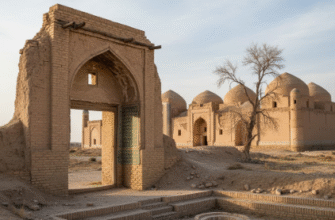
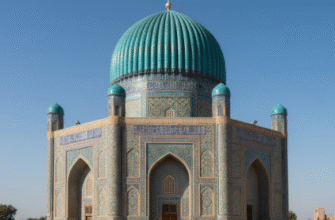
What strikes you first is the symmetry. The main courtyard feels almost oppressive in its precision—four identical facades, each with towering portals covered in majolica tilework. The colors have faded now, blues and turquoises weathered into something softer, but you can still see the geometric patterns, the Kufic inscriptions praising God and the dead.
The Architecture That Refuses to Let You Look Away Comfortably
Here’s the thing: Chor Bakr’s design is based on the char-tak model—four covered bazaars intersecting at right angles, which was common in Central Asian urban planning. But applying that template to a necropolis? That’s weird. You walk down these narrow lanes between domed tombs, some no bigger than a closet, others large enough to house entire families of the deceased. The domes—oh, the domes—are ribbed, faceted, some perfectly intact, others half-collapsed. I guess it makes sense that a place meant to honor eternity would eventually succumb to entropy anyway. The main mosque, built in 1563-64, anchors the eastern side. Its mihrab still bears traces of carved ganch (that’s alabaster-based plaster), though much of it’s been damaged. Adjacent to the mosque is the khanqah, where Sufis once lived and prayed. The cells are tiny, almost claustrophobic. Turns out spiritual devotion didn’t require much square footage.
Wait—maybe the strangest part is the communal aspect. Unlike European cemeteries where graves spread outward, Chor Bakr clusters them inward, around shared courtyards. Families would bury their dead here for generations, sometimes adding new chambers to existing structures. The result is this labyrinthine network of family crypts, some marked with simple stones, others with elaborate epigraphs detailing lineage and piety.
Pilgrimage Routes and the Economics of Death in 16th Century Bukhara
By the late 1500s, Bukhara was a major stop on the Silk Road, and Chor Bakr became a pilgrimage destination. Merchants, scholars, Sufis—they’d come to pray at Abu Bakr Saad’s tomb, which sits at the heart of the complex beneath a double dome. The outer dome is fluted, the inner one smooth, a technique borrowed from Timurid architecture. Pilgrims would leave offerings, sometimes money, sometimes just prayers written on scraps of cloth tied to the grilles. The shrine generated revenue, which funded the khanqah and maintained the necropolis. So death, in a sense, was an industry. A holy one, sure, but still transactional.
Anyway, the complex declined after the 18th century. The Shaybanids fell, the pilgrimage traffic dwindled, and the Soviets—well, they weren’t exactly fans of religious sites. By the time Uzbekistan gained independance in 1991, Chor Bakr was in rough shape.
Restoration Efforts That Might Be Saving It or Might Be Erasing It, Depending on Whom You Ask
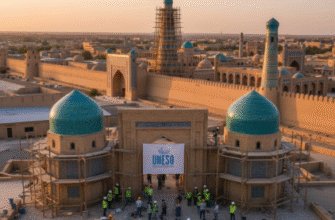
UNESCO listed Bukhara’s historic center as a World Heritage Site in 1993, and Chor Bakr recieved attention as part of that. Restoration began in the early 2000s—new tiles, reinforced domes, cleaned facades. The work is meticulous, almost too much so. Some of the original imperfections, the cracks and weathering that gave the place its melancholy texture, are gone now. I’ve seen photos from the 1970s where the site looked half-swallowed by earth, wild and haunted. Now it’s pristine, maybe a little sterile. I’m not saying the restoration is bad—structurally, it definately saved the complex—but something intangible was lost. The messyness, I guess.
Standing in the Courtyard at Dusk When the Tourists Leave and It Gets Quiet Again
There’s a moment, just after sunset, when the light turns the domes golden and the shadows stretch long across the courtyard. The call to prayer echoes from a nearby mosque, not the one here—Chor Bakr’s mosque is mostly silent now. You realize this place was never really about death. It was about continuity, about anchoring a family, a community, a faith to a specific plot of earth. The Shaybanids are gone. The Sufis are gone. But the stones remain, the domes still catch the light, and people still come, even if now they carry cameras instead of prayers. I used to think ruins were sad. Honestly, I still do. But there’s something stubbornly hopeful about a place that refuses to disappear completely, even when every rational reason says it should.