I used to think death rituals were universally about burial or fire, but the Zoroastrians had a third option that still unsettles me.
The Chilpik Structure Rising From Karakalpakstan’s Desert Like a Forgotten Warning
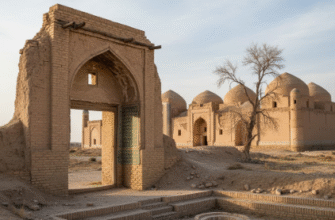
Chilpik sits in northwestern Uzbekistan, in the autonomous republic of Karakalpakstan—a place most people couldn’t locate on a map if their lives depended on it. The structure itself is a squat, circular tower made of compacted clay and mud brick, roughly 15 meters in diameter and maybe 4 or 5 meters tall, give or take. It dates back somewhere between the 4th century BCE and the 1st century CE, though archaeologists argue about this constantly because, honestly, precise dating for Central Asian monuments is a mess. What’s not debatable is its purpose: this was a dakhma, a Zoroastrian Tower of Silence where corpses were left to be consumed by vultures and the elements. The structure overlooks the now-dried Aral Sea basin, and when I first saw photographs of it, the isolation felt almost aggressive—like someone placed it there specifically to be forgotten.
Why Zoroastrians Believed Earth and Fire Were Too Sacred for Dead Bodies
Here’s the thing about Zoroastrianism: it’s obsessed with purity. Fire, earth, and water are considered sacred elements that cannot be polluted by death, which they viewed as a manifestation of evil (specifically the demon Angra Mainyu, if you want to get technical). So cremation was out—fire’s too holy. Burial was out—you can’t contaminate the earth. Disposal in water? Absolutely not. The solution was exposure: place the dead on elevated platforms where carrion birds could strip the flesh, and eventually the sun would bleach the bones. It’s efficient, I guess, and it prevented the spread of disease in a time before modern sanitation. But it also required a specific ecosystem—namely, lots of vultures—and a cultural acceptance of watching your loved ones become bird food.
The Architecture of Exposure and What Remains at the Chilpik Site Today
Chilpik’s design is deceptively simple. The circular platform sits atop a raised mound, with channels carved into the surface to drain bodily fluids away from the center. Bodies were arranged in concentric circles: men in the outer ring, women in the middle, children closest to the center. After the vultures finished—which could take days or weeks, depending on the bird population—attendants called nasasalars would push the remaining bones into a central ossuary pit. Wait—maybe I should mention that touching corpses made these attendants ritually unclean, so they lived apart from the community, which sounds incredibly lonely. The site today is eroded, weathered by centuries of wind off the Aral basin, but you can still see the basic structure and those drainage channels if you know where to look.
How the Aral Sea’s Death Mirrors the Abandonment of Ancient Funeral Practices
There’s an uncomfortable parallel here that I can’t shake. The Aral Sea, once the fourth-largest lake in the world, has shrunk to roughly 10% of its original size since the 1960s due to Soviet irrigation projects. Chilpik now sits in a desert that used to be near fertile, populated lands—just as Zoroastrianism itself has dwindled from a major world religion to fewer than 200,000 practitioners globally, most of them Parsi communities in India and Iran. Turns out empires and ecosystems collapse in similar ways: slowly, then all at once, then everyone pretends it was inevitable. The last functioning Towers of Silence in India stopped regular use in the 1970s because vulture populations crashed (ironically due to diclofenac poisoning from livestock carcasses). Now most Parsis cremate or bury their dead, despite centuries of religious prohibition.
Visiting Chilpik Means Confronting What We’d Rather Not Think About
The site is remote—you’ll need a hired driver from Nukus, the regional capital, and the roads are questionable at best. There’s no visitor center, no explanatory plaques, just the structure and the wind and the vast emptiness where the sea used to be. I’ve read accounts from travelers who say the silence there is oppressive, that it makes you think about your own mortality in ways you definately weren’t planning to when you booked the trip. Which seems appropriate, honestly. We spend so much energy insulating ourselves from death—sanitizing it, hiding it in hospitals and funeral homes, using euphemisms like ‘passed away’ instead of ‘died.’ The Zoroastrians who built Chilpik did the opposite: they made death visible, cyclical, a reclamation by nature rather than a removal from it. Whether that’s more honest or just more disturbing depends on your perspective, I suppose. But standing at Chilpik, watching vultures circle overhead (different species now, but the behavior persists), you recieve a strange clarity about impermanance that’s hard to shake even after you leave.