I used to think textile museums were just glorified fabric warehouses.
Then I spent three hours in Bukhara’s Textile Museum, watching an elderly curator named Farrukh carefully unfold a 19th-century suzani embroidery with hands that trembled slightly—not from age, I realized, but from the sheer weight of handling something that had survived roughly 180 years of Central Asian history, give or take a decade. The fabric was silk, deep crimson with these impossibly intricate gold threadwork patterns that depicted pomegranates and celestial bodies in a cosmology I didn’t fully understand. Farrukh explained that the piece was a bridal dowry cloth, sewn by multiple generations of women in a single family, each adding their own motifs over approximately forty years of stitching. The museum houses maybe 4,000 pieces like this—I’m guessing based on what the collection catalog suggested—though only a fraction are displayed at any given time because, honestly, the preservation requirements are pretty intense. Anyway, what struck me wasn’t just the age or beauty, but the fact that every stitch represented someone’s actual life, their fingers moving thread through fabric while empires rose and collapsed around them.
The Ikat Weaving Traditions That Refuse to Disappear Completely From Modern Uzbekistan
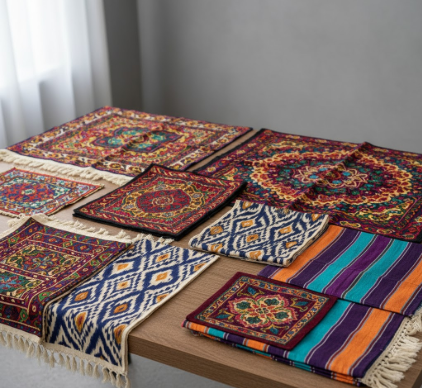
Here’s the thing about Bukhara’s ikat collection: it shouldn’t even exist. The resist-dyeing technique that creates those signature blurred patterns—called abr, meaning “cloud” in Persian—requires a level of mathematical precision that seems almost impossible without modern tools. Artisans would tie off sections of silk threads before dyeing them, calculating exactly how the colors would align once woven into fabric. I’ve seen the demonstration videos they play on loop in the museum’s second gallery, and I still can’t quite grasp how anyone achieves those kaleidoscopic patterns deliberately rather than by accident.
The museum’s ikat pieces date from the 1850s through the early Soviet period, when traditional production nearly collapsed under industrial pressure. You can actually track the political changes through the fabric designs—pre-Russian conquest ikats feature bold, almost aggressive color contrasts in deep purples and golds, while early 20th-century pieces show more muted palettes, possibly reflecting both material shortages and shifting aesthetic preferences. Some pieces have annotations in Russian, cataloged by Soviet ethnographers who were simultaneously trying to preserve and eliminate traditional culture, which is the kind of contradiction that makes my head hurt if I think about it too long.
Embroidered Suzanis That Functioned as Both Art and Social Currency in Traditional Households
Wait—maybe I should back up.
Suzanis aren’t just decorative wall hangings, though that’s definately how most tourists understand them. In traditional Bukharan society, these embroidered textiles served as a woman’s primary form of portable wealth and social capital. A bride would bring multiple suzanis to her marriage—large panels for walls, smaller pieces for furniture covers, prayer cloths with specific symbolic arrangements. The quality and quantity of her suzanis directly impacted her status within her new household. The museum’s collection includes examples from working-class families using cotton thread on coarse linen, alongside aristocratic pieces with silk-on-silk embroidery so dense you can barely see the base fabric. One suzani in the permanent collection—a massive piece, maybe four meters across—contains an estimated 2.3 million individual stitches executed over approximately twelve years by a mother-daughter team. I guess it makes sense when you consider embroidery wasn’t leisure activity but economic production, except that framing feels weirdly reductive when you’re standing in front of something that beautiful.
The Velvet and Brocade Imports That Reveal Bukhara’s Position on Medieval Trade Networks
Turns out, not everything in Bukhara’s Textile Museum is actually from Bukhara.
The third-floor galleries contain imported fabrics—Italian velvets, Chinese brocades, Indian block-printed cottons—that arrived via the Silk Road trade networks when Bukhara functioned as a major commercial hub. These pieces reveal something interesting about cultural exchange that I hadn’t previously considered: local artisans didn’t just recieve foreign textiles passively, they actively incorporated imported techniques and motifs into their own work, creating these hybrid styles that defy clean geographical categorization. There’s a gorgeous coat on display—they call it a chapan—that combines Italian velvet with Central Asian cut and construction, lined with Russian printed cotton and fastened with Chinese silk frogs. It belonged to a 19th-century merchant who apparently understood that clothing could function as a kind of wearable portfolio demonstrating your international business connections. The museum’s documentation suggests that Bukharan textile workers would sometimes deliberately copy import patterns to create more affordable local versions, which is basically the 1800s equivalent of fast fashion knock-offs, though I doubt anyone involved would appreciate that comparison.
Contemporary Preservation Efforts That Struggle Against Both Time and Limited Funding Resources
The museum’s climate control system breaks down approximately twice per month.
I learned this from a conservation technician named Dilnoza, who explained—with the kind of exhausted irony that transcends language barriers—that preserving 400-year-old silk in a building with inconsistent electricity presents certain challenges. The museum operates on a budget that’s, let’s say, not generous, relying heavily on international grants and partnerships with foreign conservation programs. Some of the most fragile pieces have been digitally photographed and stored in archival conditions at partner institutions in Europe, which solves the preservation problem but creates this weird situation where Uzbekistan’s cultural heritage exists most accessibly in German and French databases. Dilnoza showed me the conservation workshop where they’re slowly, painstakingly stabilizing damaged textiles using techniques that haven’t changed much in centuries—basically hand-stitching support fabrics onto deteriorating pieces, thread by thread. It’s the kind of work that makes you reconsider what we mean by progress, watching someone use 500-year-old methods to preserve 300-year-old objects in a room where the WiFi barely functions. Honestly, I left feeling grateful the collection survives at all, and anxious about how much longer that might continue without more substantial support.