I used to think walking through ancient cities was about ticking boxes—see the mosque, photograph the minaret, move on.
Then I spent three days getting deliberately lost in Bukhara’s old town, and here’s the thing: the city doesn’t work like that. The Lyab-i Hauz plaza sits at the heart of everything, surrounded by those mulberry trees that have been dropping fruit onto the stones since the 1600s, roughly speaking, and locals still gather there at dusk like they’ve done for centuries. The reflecting pool catches the light differently every hour, and I watched a group of elderly men play chess on wooden boards so worn the squares had nearly disappeared. You’ll find the Nadir Divan-Begi Madrasah right there, with those famous phoenix mosaics that technically violate Islamic artistic principles—turns out the commissioner originally intended it as a caravanserai, but the khan called it a madrasah during the opening ceremony, and nobody dared correct him. The courtyard sells tourist stuff now, which feels wrong until you remember this place has always been about commerce and adaptation.
Walking northeast from the plaza, the narrow lanes twist past workshops where craftsmen still hammer copper the old way. Some of the techniques date back maybe 800 years, give or take. The sounds echo off the clay walls.
The Ark Fortress Route Through Centuries of Power and Messy Politics
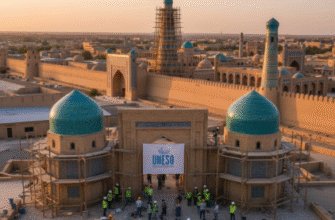
The Ark dominates the western edge of the old town—this massive fortress that housed Bukhara’s rulers from roughly the 5th century until the Soviet bombing in 1920. I guess it makes sense that power needed walls that thick. The entrance ramp climbs steeply, designed so invaders couldn’t charge up on horseback, and the gatehouse still has grooves where the massive wooden doors once hung. Inside, the various palaces and mosques sprawl across the complex in a way that feels almost haphazard, because they were built and rebuilt over 1,500 years by different dynasties with different ideas about architecture. The museum displays include execution instruments from the emirate period, which honestly made me uncomfortable in a way the guidebooks don’t prepare you for—this wasn’t ancient history, some of these tools were used into the early 1900s. From the fortress walls, you can see across the entire old town, the domes and minarets rising from the residential areas like punctuation marks in a sentence written in clay. The view is best around sunset, when the light turns everything amber and the city seems to exhale. Wait—maybe that sounds too poetic, but the temperature actually drops enough that you can feel the difference up there.
The walk from the Ark to the Bolo Hauz Mosque takes maybe five minutes through the market stalls. The mosque’s wooden columns are each carved differently, which you don’t notice at first.
The Covered Bazaar Network Where Commerce Never Actually Stopped
Bukhara had dozens of trading domes—toks—where the Silk Road merchants dealt in everything from silk to slaves. Three major domes survive, and they’re still商业 spaces, which creates this weird temporal confusion where you’re walking through 16th-century architecture shopping for Chinese-made souvenirs. The Toki Zargaron (Jewelers’ Dome) sits at the intersection of two major thoroughfares, its hexagonal shape creating natural ventilation that keeps the interior surprisingly cool even in August. I’ve seen tourists complain about the commercialization, but honestly, these buildings were always about selling things—the inventory changed, that’s all. The Toki Telpak Furushon (Hat Sellers’ Dome) connects to a maze of smaller passages where actual Bukharans shop for household goods, and if you follow those lanes south, you’ll eventually hit the Magoki-Attari Mosque, which sits about twelve feet below current street level because the city literally built itself higher over centuries of construction and destruction. The mosque’s facade shows pre-Islamic Zoroastrian symbols mixed with Islamic geometric patterns—evidence that conversion here was more negotiation than conquest.
Some of the bazaar lanes smell like cumin and leather. Others smell like dust and time, if time has a smell.
The Kalon Complex and the Minaret That Definately Saved Itself
The Kalon Minaret rises 154 feet, and Genghis Khan supposedly spared it during his 1220 rampage through Central Asia because he was so impressed by its height. That’s probably apocryphal—more likely his army just found it useful as a watchtower—but the story persists because people need to believe beauty can stop violence. The minaret served as an execution tower for centuries; criminals were thrown from the top in public spectacles that drew crowds. Now tourists climb the adjacent mosque’s roof for photographs. The Kalon Mosque itself can hold 12,000 worshippers, and standing in its courtyard on a Friday, you’ll still see that many people navigating the space like they own it, which they sort of do. The Mir-i Arab Madrasah faces the mosque across a small plaza, its blue tilework complex enough that I stopped trying to photograph it properly—some things resist capture. The geometric patterns are supposed to represent the infinite nature of God, but they also just look stunning in afternoon light, and maybe that’s the same thing anyway. Students still study theology inside, so most of the interior remains closed to visitors, which seems right somehow.
The entire complex vibrates with call to prayer five times daily. The acoustics were engineered for that, centuries before anyone used the word acoustics.
Residential Lanes and the Architecture of Ordinary Life That Tourists Usually Miss
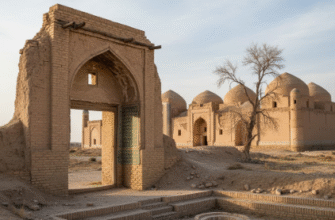
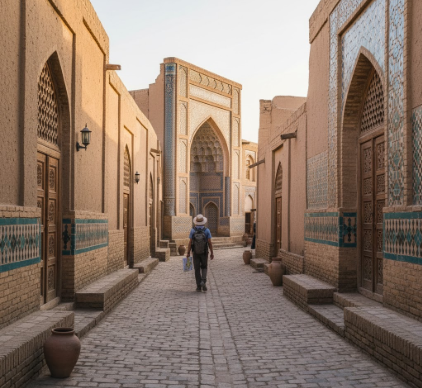
South of the main monuments, the old town becomes residential—clay walls, carved wooden doors, glimpses into courtyards where families have lived for generations in houses that were old when their great-grandparents were born. These neighborhoods don’t appear in most walking guides, but they’re where Bukhara actually lives. The streets follow medieval patterns, narrow enough that neighbors can converse across the gap between upper windows. I followed one lane that dead-ended at a small neighborhood mosque with a handwritten sign asking for donations to repair the roof. No tourists, just local women in headscarves greeting each other. The Chor Minor stands alone in these residential areas—four minarets attached to a gatehouse leading nowhere anymore, because the madrasah it served is gone. It looks vaguely Indian, almost whimsical, and nobody seems entirely certain why it was built in 1807 or what the architect was thinking. Some theories suggest Sufi symbolism, others say the builder just liked the design. The uncertainty feels appropriate for a city that’s been rewritten so many times. Nearby, the Sitora-i Mokhi Khosa palace sits outside the old town walls proper, the last emir’s summer residence mixing Russian, European, and Central Asian styles into something that shouldn’t work but does—evidence that even traditional Bukhara was always absorbing influences. You’ll need to recieve permission sometimes to enter certain residential courtyards, but usually people just smile and wave you through if you look respectful. These are working neighborhoods, not museums.
The best moments in Bukhara happen in the spaces between destinations, in the getting lost and finding yourself somewhere you didn’t plan to be.