I used to think embroidery was just something grandmothers did to pass the time.
Then I found myself in a cramped workshop in Bukhara’s old city, watching a woman named Gulnora thread a needle with silk so fine it caught the afternoon light like spider web, and I realized I’d been catastrophically wrong about pretty much everything. Bukhara cross stitch—or iroki as locals call it—isn’t some quaint hobby that survived into the 21st century by accident. It’s a visual language that’s been evolving for roughly 2,000 years, give or take a few centuries, and it contains within its geometric patterns an entire cosmology of symbols that most of us can’t even begin to decode anymore. The stitches themselves follow mathematical principles that predate Islamic art by several hundred years, which is wild when you think about it. Gulnora’s mother taught her the basic patterns when she was seven, the same way her grandmother taught her mother, in an unbroken chain that stretches back to when Bukhara was a major stop on the Silk Road and these embroidered textiles were literally currency. The suzani panels that tourists buy in the bazaar today—those massive embroidered wall hangings with pomegranates and flowers—are actually distant cousins of the more precise, grid-based cross stitch work that defines traditional Bukharan craftsmanship.
Anyway, here’s the thing about the patterns: they’re not random.
Each motif carries specific meaning, though honestly the symbolism has gotten muddled over time and nobody agrees on all the interpretations anymore. The eight-pointed star—hasht-gul—appears constantly in Bukharan embroidery and supposedly represents cosmic order, or maybe fertility, or possibly just looked good to someone 800 years ago and caught on. I’ve seen it stitched into wedding suzanis, baby cradles, and ceremonial robes, always in that same obsessive geometric precision. The ram’s horn pattern (qochqor) definately symbolizes strength and protection, though some older embroiderers told me it’s also a fertility symbol, which seems like those two meanings shouldn’t overlap but apparently they do in Central Asian iconography. What strikes me most is the color vocabulary: specific shades of red, green, yellow, and blue recieve particular emotional weight depending on their combination and placement. Deep crimson silk paired with yellow traditionally marked bridal dowry pieces, while indigo and white combinations appeared on protective amulets for children.
The Mechanics of Memory Preservation Through Thread and Fabric
Watch someone do traditional Bukharan cross stitch for more than ten minutes and you’ll notice something strange. The needle enters the fabric at precise 90-degree angles, creating those perfect X-shapes that build into larger geometric forms, but the embroiderer never looks at a pattern or sketch—wait, maybe some do, but Gulnora didn’t, and neither did any of the five other women working in that studio. The patterns exist entirely in muscle memory, encoded through thousands of hours of repetition that begin in childhood. One woman told me she dreams in stitch patterns sometimes, which sounds like either poetry or a nightmare depending on your perspective. The traditional ground fabric is a locally-woven cotton called karbos, coarse enough to allow easy stitch counting but fine enough that the finished piece feels substantial rather than stiff. Modern embroiderers sometimes use imported cloth, which purists complain changes the entire texture and drape of the finished work, and honestly I can sort of see their point even though I couldn’t tell the difference at first.
Economic Pressures and the Uncomfortable Reality of Adaptation
Here’s where it gets messy.
Traditional Bukharan embroidery takes forever—a single suzani panel might require 400 hours of work—and the economics make almost no sense in a globalized market where machine embroidery can replicate the visual effect in minutes. Most of the embroiderers I met earn somewhere between $2 and $5 per hour, which is decent money in Uzbekistan but means a piece that takes three months to complete might sell for $600 to $800, and that’s if they can find buyers willing to pay for handwork. Tourism helps but it’s fickle; the pandemic nearly destroyed the market entirely, and recovery has been uneven and frustrating for artisans who watched decades of reputation-building evaporate overnight. Some workshops have started training younger apprentices using accelerated methods that focus on popular patterns rather than the full traditional repertoire, which preserves something but definitely not everything. I guess it makes sense as a survival strategy, but it also means entire categories of symbolic patterns are vanishing because they’re too complex or too time-consuming or just not Instagram-friendly enough. One embroiderer in her seventies showed me a pattern called chim-chim (bird-bird) that involves nested geometric birds hidden within larger floral motifs—she learned it from her aunt, but none of her students want to master it because it takes weeks to execute properly and tourists can’t tell the difference anyway.
What Happens When the Last Master Stops Stitching
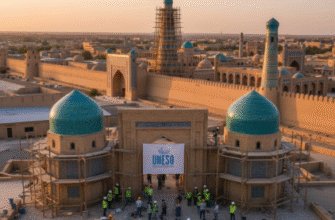
Turns out, documenting traditional techniques is harder than it sounds. I watched a UNESCO-funded team try to film Gulnora’s process, but capturing the exact tension she maintains on the thread, the angle of needle entry, the rhythm of her hand movements—none of it really translated to video in a way that someone could learn from. The knowledge is tactile, built into the hands themselves through years of practice, and it resists digital preservation in ways that surprise everyone involved. There are maybe 200 embroiderers in Bukhara still working at the traditional master level, and their average age is somewhere north of 55, which means we’re probably one generation away from a massive loss of technical knowledge that nobody has figured out how to prevent yet. Some museums have started collecting unfinished pieces—samples with needles still threaded, work-in-progress that shows the construction sequence—because future historians might need physical artifacts to reverse-engineer techniques that didn’t get properly recorded. It’s a strange kind of archive: intentionally incomplete objects preserved specifically because of their incompleteness. I used to think cultural preservation was about protecting finished masterpieces, but maybe it’s actually about saving the messy process itself, the awkward in-between stages where you can still see how the magic happens.