I used to think fabric art was just, you know, quilts your grandmother made.
Then I spent three weeks in Bukhara’s old city, watching a seventy-two-year-old woman named Gulnora slice through velvet with scissors so sharp they caught the light like knives, and I realized I’d been catastrophically wrong about what hands can do with cloth. Bukhara applique work—called “zardozi” locally, though that term technically refers to gold embroidery, which shows you how tangled Central Asian textile terminology gets—emerged somewhere around the 16th century, give or take a few decades, when the city was flush with Silk Road money and artisans had both the materials and the patronage to experiment. The technique involves layering cut fabric pieces onto a base cloth, stitching them down with such precision that the seams become nearly invisible, then adding embroidery, sequins, beads, sometimes small mirrors that flash when you move. It’s labor-intensive in a way that makes modern fast fashion look obscene. A single wall hanging might take four months. A ceremonial robe? Try eight.
The thing is, nobody agrees on where the technique actually originated. Some scholars point to Persian influence, others to indigenous Sogdian traditions that predate Islam. Honestly, it probably doesn’t matter—cultures along the Silk Road borrowed and remixed so aggressively that trying to assign ownership feels pointless.
The Geometry of Devotion and the Problem With Perfect Circles
Walk into any Bukhara workshop and you’ll see the same motifs repeating: pomegranates, almond shapes called “bodom,” eight-pointed stars, stylized cypress trees. These aren’t random. Islamic geometric tradition forbids representational imagery in religious contexts, so artisans developed this visual language of abstraction—nature reduced to its essential curves and angles. But here’s the thing: the hand-cut fabric pieces are never mathematically perfect. I measured once, with a ruler I probably shouldn’t have brought out in front of the artisans. The “circles” in a suzani panel I was examining varied by up to three millimeters in diameter. When I pointed this out (tactlessly, I admit), Gulnora laughed and said something in Uzbek that my translator rendered as “machines make perfect circles, humans make alive ones.” Which, okay, is maybe a bit romanticized in translation, but the point stands. The irregularities aren’t defects—they’re evidence of human presence. Each slight wobble in a cut line, each stitch that doesn’t quite align, marks the piece as made by someone with a body, with hand tremors, with eye strain, with the muscle memory of ten thousand previous cuts.
Modern practitioners face a weird tension. Tourists want “authentic” pieces but also expect them to be affordable, which is incompatible with paying artisans fairly for four months of work. So you get workshops producing simplified versions—fewer layers, machine-stitched edges, synthetic fabrics instead of silk and velvet.
I guess it makes sense economically, but it also means the technical knowledge is eroding.
What Scissors Remember That Lasers Can’t Learn Yet
There’s a specific way master artisans hold their scissors—not with the thumb and fingers in the loops, but gripped like a knife, using the whole hand to control pressure. This lets them cut curves in velvet without the pile shifting, which sounds trivial until you try it and realize you’ve just ruined twenty dollars worth of fabric in three seconds. Gulnora’s apprentice, a nineteen-year-old named Madina, was still learning this grip after eight months of training. Her hands would cramp. She’d switch back to the “normal” scissor hold when she got tired, and Gulnora would swat her wrist with a wooden ruler—not hard, just enough to break the habit. I asked Madina once if she’d considered using a laser cutter, which can slice fabric with micron-level precision. She looked at me like I’d suggested replacing her grandmother with a toaster. “The laser doesn’t feel where the thread wants to go,” she said, which didn’t make sense to me until I watched her work for another hour and noticed she was following the velvet’s weave, letting the fabric’s structure guide her cuts. A laser follows a programmed line. A human hand negotiates with the material.
Anyway, this is why digital reproduction of applique work always looks slightly off.
The Economics of Beauty and Why UNESCO Listings Don’t Pay Rent
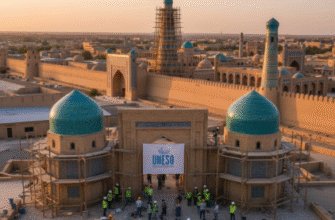
Bukhara applique got added to UNESCO’s Intangible Cultural Heritage list in 2019, which sounds prestigious until you realize it doesn’t come with funding. What it does provide is a logo that workshops can put on their websites and a vague sense of international validation that maybe helps with tourism marketing. The real money, turns out, comes from wedding commissions—Uzbek weddings still use traditional textiles heavily, and families will pay substantial amounts for a custom-made wall hanging or ceremonial cloth. But weddings are seasonal, and the market is flooded with cheaper imports from China that mimic the style with printed fabric and glue. Gulnora told me her workshop’s income dropped by forty percent between 2015 and 2023. Two of her former apprentices now work in a shopping mall in Tashkent. A third married a guy from Turkey and moved to Istanbul, where she—wait for it—works in a textile factory producing machine-made “traditional” designs for export. The irony is so thick you could cut it with improperly held scissors. I don’t have a solution here, honestly. The global economy doesn’t reward slow craftsmanship, and telling artisans to just “preserve their heritage” while they struggle to pay rent feels grotesque. Maybe the answer is higher prices and smaller production, treating applique work like the luxury good it actually is. Maybe it’s government subsidies, though Uzbekistan’s economy has its own problems. Or maybe—and this is the possibility that keeps me up at night—maybe some craft traditions simply can’t survive modernity’s economics, and we’re watching a slow extinction we can document but not prevent.