I’ve photographed a lot of sacred sites at dawn, but Shah-i-Zinda hit different.
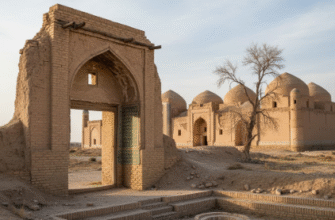
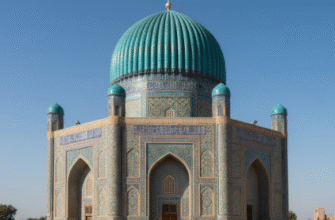
The necropolis sits on the northeastern edge of Samarkand, a cascade of turquoise domes and minarets tumbling down a hillside that’s been holy ground since roughly the 11th century—give or take a few decades, depending on which archeological survey you trust. The name translates to “The Living King,” referring to Qusam ibn Abbas, a cousin of the Prophet Muhammad who, legend says, didn’t actually die but retreated into a well where he still lives. Whether you buy that or not, the place pulls about 300,000 visitors annually, most of whom arrive midday when the light is flat and the tour buses clog the narrow approaches. Which is exactly why you don’t want to be there then. Sunrise is when the tile work—those intricate majolica patterns in cobalt and turquoise—catches the low-angle light and practically ignites. I used to think the photos I’d seen were oversaturated Lightroom fantasies, but turns out the colors are legitimately that intense. The ceramic glaze contains cobalt oxide and copper compounds that refract morning light in ways that make your camera’s RGB histogram look like it’s having a seizure. It’s disorienting and beautiful and you’ll definately miss it if you sleep in.
Here’s the thing: most photographers set up at the base of the staircase, aiming upward at the portal of the first mausoleum. It’s a solid composition—symmetrical, dramatic, the usual stuff. But you’re also shooting into a crowd of pilgrims and selfie-stick wielders by 6:45 a.m., which kind of kills the vibe.
The stepped terrace halfway up the main stairway—specifically between the Shadi Mulk Aka mausoleum and the Tuman Aka complex—offers something most people walk right past. From here you get a diagonal sightline across the cluster of domes, with the morning sun raking across the ribbed cupolas and casting these long, almost architectural shadows that emphasize the three-dimensionality of the structures. I stumbled onto this spot by accident in 2019, trying to escape a German tour group, and the light was so perfect I literally gasped, which made a local babushka selling dried apricots laugh at me. Anyway, the elevation gives you clearance over the heads of early arrivals, and the recessed archways frame secondary compositions if you’ve got a zoom lens. The tile work here dates to the 1380s—restoration by Timur’s craftsmen—and there’s this one panel with a geometric star pattern that, at around 6:20 a.m. in late April, catches a sunbeam and glows like someone flipped a switch. I’ve seen it three times and it still feels like a glitch in reality.
Wait—maybe I should mention the rooftop access situation, because this is where things get legally ambiguous.
There’s a caretaker’s quarters attached to the Khoja Ahmad mausoleum near the top of the complex, and if you show up around 5:45 a.m. with a respectful attitude and maybe 20,000 som (about two bucks), sometimes—sometimes—you can negotiate access to a maintenance ladder that leads to a narrow walkway behind the dome line. I’m not saying you should do this. I’m saying I did it twice, and the view is absolutely unreal. You’re looking down the entire Avenue of Mausoleums with the rising sun behind you, illuminating the whole complex in this warm, even glow while the city of Samarkand is still in shadow below. The tilework becomes this river of blue and gold, and you can shoot long exposures without vibration because there’s no foot traffic up there—just you, the wind, and the occasional pigeon. The ethical question of whether this constitutes trespassing or cultural disrespect is something I’m still working through, honestly. The caretaker didn’t seem bothered, but I also don’t speak Uzbek well enough to have understood if he was telling me off.
The lower courtyard near the spring—where pilgrims collect holy water—is the safest bet for newcomers.
The fountain area provides foreground interest and the reflected light off the water fills in shadows on the mausoleum facades in a way that’s almost studio-quality. You’ll need to arrive by 6:00 a.m. to beat the morning prayer crowd, and be prepared for some awkward interactions because you’re basically setting up a tripod in a active worship space. I once had an elderly man politely but firmly move my camera bag because I’d inadvertantly placed it on a prayer rug someone had left to reserve their spot. Mortifying. But the compositions work: you can shoot wide to capture the whole ensemble with the water in the foreground, or go tight on individual tile panels where the dawn light reveals the hand-painted calligraphy and the slight irregularities in the glaze that prove this stuff was made by humans, not machines. There’s a particular panel on the eastern wall—14th century, turquoise on midnight blue—where the Arabic inscription reads something like “the only eternal beauty is the work of the soul,” and at sunrise the oxidized copper in the glaze shifts from green to almost gold. I guess it makes sense that artisans who believed their work was worship would time the aesthetic effects to the call to prayer, but experiencing it in person still messes with your head.