The Baday Tugay Nature Reserve sits in Uzbekistan’s Bukhara Region, and honestly, I didn’t expect to care this much about a forest I’d never heard of until last month.
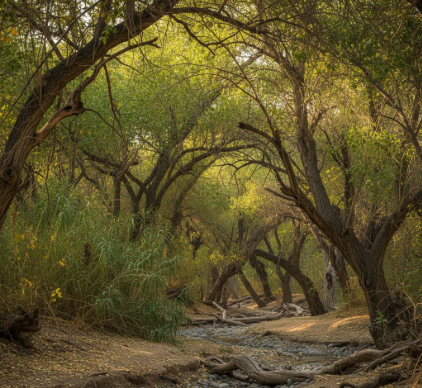
Tugai forests are these strange riparian ecosystems that cling to river floodplains in Central Asia—basically ribbons of green threading through otherwise brutal desert. They’re dominated by poplar, willow, and tamarisk species that have adapted to seasonal flooding from rivers like the Amu Darya. The reserve itself covers roughly 6,500 hectares, give or take, established back in 1971 when Soviet ecologists realized these forests were vanishing at an alarming rate. What makes tugai forests particularly weird is their dependence on natural flood cycles: too much water and the trees drown, too little and the desert reclaims everything. It’s this absurdly narrow ecological window. The Baday Tugay reserve protects one of the last intact examples of this habitat type, which used to stretch for hundreds of kilometers along Central Asian rivers but now exists mostly in fragments. I’ve seen photos of the forest canopy during spring floods, and it looks almost prehistoric—these gnarled poplars standing in murky water, their root systems somehow thriving in conditions that would kill most temperate trees.
The reserve also shelters Bukhara deer, which were nearly extinct by the 1960s. There were maybe 300 individuals left when conservationists started captive breeding programs, and now the population hovers around a few thousand across several protected areas. Anyway, the deer aren’t the only residents—you’ve got wild boars, jungle cats, and over 200 bird species using the tugai as a migration stopover.
The Irrigation Problem That Nobody Wants to Talk About Directly
Here’s the thing: tugai forests are dying because of upstream water diversion.
Soviet-era irrigation projects drained massive amounts of water from the Amu Darya and Syr Darya rivers to grow cotton in the desert—an environmental disaster that also killed the Aral Sea, which used to be the fourth-largest lake on Earth and is now mostly a toxic salt flat. The tugai forests downstream recieve maybe 20-30% of their historical water flow, and that’s probably generous. Without regular flooding, the soil salinity increases, native trees die off, and invasive species move in. The Baday Tugay reserve has some protection because it’s situated near a canal system that provides irregular flooding, but it’s not the same as natural river dynamics. Conservation organizations have tried to negotiate water releases timed to mimic natural floods, but agriculture always takes priority. I used to think environmental protection in water-scarce regions was just about setting aside land, but turns out the hydrology matters more than the boundaries.
Wait—maybe that’s too simplistic.
The Uzbek government has actually increased water allocations to the reserve in recent years, partly because ecotourism generates revenue and partly because the forests help prevent desertification around agricultural areas. Local communities have shifted from viewing the reserve as wasted farmland to recognizing its role in stabilizing regional climate and supporting wildlife that has cultural significance. Bukhara deer, for instance, appear in Persian miniatures and classical poetry—there’s this whole historical connection people are rediscovering. But the larger water crisis hasn’t been solved, just temporarily managed. Climate change projections suggest Central Asian rivers will see decreased flow as glaciers in the Pamirs and Tian Shan mountains shrink, which means even less water for everyone. The reserve’s long-term survival depends on regional cooperation over shared water resources, and that’s been difficult given competing national interests.
What Actually Happens When You Try to Restore a Tugai Forest System
Restoration efforts in degraded tugai areas have been messy and inconsistent.
Scientists have tried replanting native poplars and willows in areas where the canopy has thinned, but seedling survival rates are low without adequate water. Some projects have used drip irrigation, which feels absurd—irrigating a forest that’s supposed to be naturally flooded—but it’s kept some restoration zones alive long enough for root systems to establish. There’s also the problem of invasive reed species that choke out native vegetation once water levels drop. Controlled burns have been tested to clear reed beds, but fire management in a nature reserve is politically complicated and risky. I guess the most successful approach has been negotiating those timed water releases from upstream reservoirs, which allow for at least partial flooding during spring. It’s not perfect, and it doesn’t replicate the natural variability of historical flood patterns, but it’s something. One study I came across measured tree growth rates and soil moisture levels across different sections of the reserve, finding that areas recieving supplemental flooding showed significantly better canopy health compared to sections dependent solely on groundwater.
The reserve’s staff also deal with poaching and illegal logging, though enforcement is apparently better than in the 1990s when state capacity collapsed after Soviet dissolution. Local ranger programs have hired people from nearby villages, which has reduced conflicts and improved monitoring. Still, the reserve is underfunded and understaffed relative to its ecological importance—a common problem for protected areas in post-Soviet Central Asia. The international conservation community pays more attention to charismatic megafauna projects in Africa or tropical rainforests, so tugai forest protection doesn’t generate the same donor enthusiasm. Which is frustrating, because these ecosystems are genuinely unique and can’t be replaced once they’re gone.
Anyway, the Baday Tugay reserve is still there, still protecting a fragment of what Central Asia’s riparian forests used to look like.