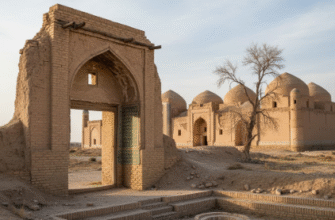
I’ve stood in a lot of madrasahs across Central Asia, but the Abdulaziz Khan in Bukhara—built in the 1650s, give or take—still makes me pause.
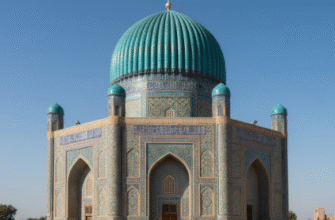
The thing about Islamic architectural decoration is that it operates on principles most Western viewers don’t immediatley grasp. We’re conditioned to look for representational art, for faces and bodies and recognizable scenes. But step into the courtyard of Abdulaziz Khan and you’re confronted with something else entirely: geometric tessellations that seem to vibrate in the afternoon light, calligraphic bands that spiral upward in rhythms you can almost hear, glazed tiles in cobalt and turquoise that shift tone depending on where you stand. The craftsmen who created this weren’t just decorators—they were mathematicians, theologians, chemists who understood how metallic oxides behave at different kiln temperatures. I used to think ornament was secondary to structure, honestly, but buildings like this taught me otherwise. Here, the decoration *is* the architecture. It’s not applied afterward; it’s conceived as integral from the first sketch.
What strikes you first is the polychrome majolica work covering the main façade. Blues dominate—lapis lazuli pigments imported from mines in Badakhshan, probably—but there’s also this ochre-yellow from antimony compounds and a green derived from copper. The patterns interlock in ways that feel both systematic and wild.
Anyway, the interior takes this complexity and amplifies it. The walls of the main prayer hall are sheathed in carved ganch—a kind of alabaster plaster—that’s been sculpted into muqarnas, those honeycomb-like stalactite forms you see throughout Islamic architecture. Each cell catches shadow differently, creating a three-dimensional texture that changes as you move through the space. I guess what I’m trying to say is that the decoration here isn’t static. It’s durational, experiential. You can’t photograph it adequately because it exists in time as much as in space.
Calligraphy weaves through everything. Quranic verses, mostly—Surahs rendered in Kufic and Thuluth scripts, the letters elongated and stylized until they become almost abstract. Turns out the artisans working on Abdulaziz Khan were part of guilds that had been refining these techniques for centuries, passing down not just motifs but entire cosmological frameworks encoded in proportion and geometry.
The Mathematical Ecstasy Embedded in Every Tile and Carved Plaster Surface
Here’s the thing: Islamic art prohibits figural representation in religious contexts, which meant craftsmen channeled their creative energy into pattern. And pattern, when you really look at it, is applied mathematics. The tile work at Abdulaziz Khan employs what mathematicians now call “quasiperiodic tessellations”—patterns that never exactly repeat but maintain underlying symmetry. This wasn’t discovered in the West until the 1970s, but Central Asian artisans were encoding it into mosque walls four centuries earlier.
I remember running my hand along one of the ganch panels—probably shouldn’t have, given conservation concerns—and feeling the precision of each carved ridge. The depth varies by millimeters, creating a kind of Braille for light. Some sections use floral motifs: stylized peonies and lotuses that reflect the Persian influence flowing through Bukhara during the Shaybanid period. Other sections are purely geometric: interlocking stars that radiate outward in sequences based on root-two rectangles and golden ratios. The artisans understood these mathematical relationships intuitively, even if they didn’t formalize them the way European mathematicians later would. Wait—maybe that’s not quite right. Recent scholarship suggests they *did* formalize them, just in different symbolic languages we’re only now learning to decode.
The mihrab—the prayer niche indicating Mecca’s direction—is where the decoration reaches peak intensity. Layers of carved stucco frame glazed tile panels, which in turn frame more stucco, creating a nested complexity that draws the eye inward. It’s exhausting to look at, honestly, but in a good way. Like staring at ocean waves.
When Political Power Demands Beauty This Obsessive and Historically Layered
Abdulaziz Khan himself was an Uzbek ruler navigating a complicated geopolitical landscape—Safavid Persia to the west, Mughal India to the south, nomadic Kazakh tribes to the north. The madrasah he commissioned wasn’t just an educational institution; it was a statement. A declaration that Bukhara remained a center of Islamic learning and artistic sophistication despite the fragmentation of the old Timurid empire.
The craftsmen came from everywhere. Tileworkers from Mashhad and Isfahan, calligraphers from Herat, ganch carvers from local Bukharan workshops. You can see the stylistic collisions if you know where to look: a very Persian palmette motif adjacent to a more Central Asian geometric star pattern. Sometimes they harmonize beautifully. Sometimes they clash in ways that feel almost deliberate, like the patron wanted to showcase range rather than coherence.
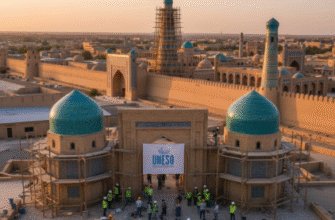
Funding this level of decoration required immense resources—taxes on Silk Road trade, agricultural surplus from the Zeravshan River valley, maybe plunder from military campaigns. Beauty on this scale is never apolitical. It’s a flex, a way of saying: we have the wealth, the labor, the technical expertise to create something that will outlast us. And it has. The madrasah functioned as an educational institution for roughly three centuries before Soviet secularization repurposed it. Now it’s a museum, a tourist site, a UNESCO heritage property.
I guess what lingers with me is the contradiction. This is religious art, meant to direct the soul toward the infinite and ineffable. But it’s also deeply material—dependent on mineral extraction, trade networks, political stability, skilled labor. The spiritual and the economic are inseperable here, fused in every tile.
Restoration work over the past few decades has been uneven. Some sections gleam with fresh glaze, colors almost too saturated compared to the weathered originals. Other areas retain their four-century patina, tiles cracked and faded but somehow more honest. Conservators face impossible choices: preserve the decay as historical evidence, or restore the original brilliance and risk Disneyfication. There’s no perfect answer.
But standing in that courtyard, watching afternoon light slide across those blue tiles, I’m not thinking about conservation ethics. I’m thinking about the hands that shaped this plaster, mixed these pigments, calculated these angles. People whose names we’ll never know, who left behind something that still has the power to stop you mid-step and make you reconsider what decoration even means.