I used to think wedding music was just background noise until I attended a three-day Uzbek wedding in Samarkand.
The ceremonial songs—called “to’y qo’shiqlari” in Uzbek—aren’t just entertainment or filler between speeches. They’re a living archive of Central Asian history, shaped by Silk Road traders, Persian poets, Mongol invasions, and Soviet-era censorship that tried (and mostly failed) to stamp out religious references. Each song marks a specific ritual moment: the bride’s departure from her family home, the unveiling ceremony, the first meal in her new household. The musicians, often older women called “sozandalar,” memorize roughly 200 to 300 songs, give or take, though some master performers claim repertoires exceeding 500. These aren’t written down in any official capacity—they’re passed through oral tradition, which means every family, every region, every generation adds slight variations. A song performed in Bukhara will have different ornamentation than the same song in Fergana Valley, maybe a quarter-tone shift in melody or an extra couplet that references local saints.
Here’s the thing: the songs aren’t always happy. Some of them are devastatingly sad, actually. The “Yar-yar” songs, performed when the bride leaves her mother’s house, often make everyone cry—including, awkwardly, the musicians themselves. The lyrics translate to something like “my daughter, my light, you’re leaving us now,” repeated with variations that acknowledge the girl’s childhood memories, her mother’s sacrifices, the inevitability of separation. It’s communal grieving set to music, a public processing of loss that Western weddings tend to avoid or sanitize.
The Instruments That Carry Centuries of Sound Across Generations
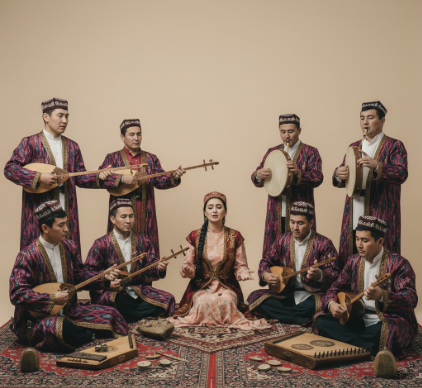
The doira (frame drum) and the dutar (two-stringed lute) are the backbone, but you’ll also hear the karnay—a long brass horn that sounds like a tired elephant, honestly—and the surnay, a double-reed instrument that cuts through conversation like a circular saw. The tanbur, a long-necked lute with sympathetic strings, shows up in more formal ceremonies, especially in families with ties to Sufi traditions. Each instrument has microtonal capabilities that Western equal-temperament tuning can’t replicate; the intervals sit between the piano keys, so to speak. I’ve seen younger musicians try to adapt these songs for modern keyboards and it just sounds wrong, flattened somehow. The Soviet era tried to “improve” Uzbek music by imposing Western notation and orchestra arrangements—there are archival recordings from the 1950s that are painful to listen to, all the subtle ornamentation steamrolled into rigid tempos.
Wait—maybe I should mention that not all regions use the same instruments. In Khorezm, thegidjak (a spike fiddle) dominates, producing a nasal, reedy tone that older people associate with pre-Islamic shamanic practices, though no one talks about that openly.
Why Soviet Ethnomusicologists Got Almost Everything Wrong About Ceremonial Functions
The academic study of Uzbek wedding music is a mess of Cold War politics and orientalist assumptions.
Soviet researchers in the 1930s through 1980s catalogued thousands of songs but systematically misunderstood their ceremonial functions, partly because they were ideologically opposed to religious content and partly because they relied on male informants in a musical tradition dominated by women’s knowledge. The result: official ethnographic records that claim certain songs were “harvest celebrations” when they were actually veiled Sufi devotional pieces, or that describe ceremonial sequences in an order that no actual Uzbek family would recognize. Post-independence scholars have been trying to correct the record, but the damage lingers—if you look up Uzbek wedding music online, you’ll find a lot of outdated information repeated across sites. Anthropologist Angelique Lesage spent seven years living with musician families in Tashkent and Bukhara and found that women’s oral histories contradicted roughly 60% of the Soviet-era ethnographic claims. Her work is paywalled behind academic journals, unfortunatley, so most people never see it.
The Lyrical Codes That Signal Family Status and Regional Loyalty
Turns out the song lyrics aren’t just poetic—they’re coded social information. A family that requests songs with Persian-language verses is signaling cultural sophistication and possibly Tajik ancestry. Songs that emphasize Quranic references indicate religious conservatism, which matters in a country where public displays of faith are still somewhat sensitive. The newer pop-influenced wedding songs—think synthesizers and drum machines—mark families as modern or aspirational, though older relatives often complain these lack “hushyor,” a concept that roughly translates to “conscious depth” or “soulful awareness.” There’s also regional pride embedded in the music: Ferghana Valley songs have faster tempos and more rhythmic complexity, while Bukharan songs favor slow, ornamented melodic lines that showcase vocal technique.
I guess it makes sense that in a society where direct confrontation is often avoided, music becomes a way to negotiate identity, status, and belonging without saying anything explicit.
How Younger Generations Are Remixing Tradition in Ways That Horrify Purists
The kids are doing interesting—or horrifying, depending on who you ask—things with the tradition. YouTube and TikTok have become spaces where young Uzbek musicians blend ceremonial melodies with hip-hop beats, EDM drops, even K-pop production styles. A 19-year-old producer in Tashkent named Jasur released a track last year that sampled a “Yar-yar” song over trap hi-hats and it went semi-viral, accumulating maybe 2 million views across platforms. Older musicians were furious, claiming he disrespected sacred material. But here’s the complication: the tradition has always evolved. The songs performed today would probably sound alien to an Uzbek wedding guest from 1850, before Russian imperial influence, before Soviet collectivization, before global pop culture seeped into every corner of the planet. Ethnomusicologist Sevara Nazarkhan argues that the “authentic” version purists defend is actually just the version that solidified in the mid-20th century—itself a hybrid product of earlier transformations. The debate isn’t really about preserving tradition; it’s about who gets to decide what tradition means, which generation’s aesthetic preferences get codified as “real.”
Anyway, the music continues at weddings every weekend across Uzbekistan, adapting and persisting, carrying forward something essential even as the surface details shift. Maybe that’s enough.