I used to think miniature painting was just, you know, regular painting but smaller.
Turns out the Bukhara tradition—rooted in Persian techniques that go back maybe six, seven centuries, give or take—requires brushes made from a single squirrel hair. A single hair. The artists grind lapis lazuli into powder for that signature ultramarine blue, mix it with egg white and gum arabic, and apply it to paper they’ve burnished with agate stones until the surface feels like glass under your fingertips. The pigments come from minerals mostly: malachite for green, cinnabar for red, gold leaf hammered so thin it would take roughly 200,000 sheets to make an inch-high stack. I’ve seen workshops in Bukhara’s old city where the same families have been doing this since the Timurid era, passing down techniques that haven’t changed much since the 1400s, and honestly the whole thing feels like watching someone perform surgery with a paintbrush. The level of control required to paint a face the size of a grain of rice—with individual eyelashes visible—is the kind of skill that takes maybe fifteen years to develop, and even then most artists say they’re still learning.
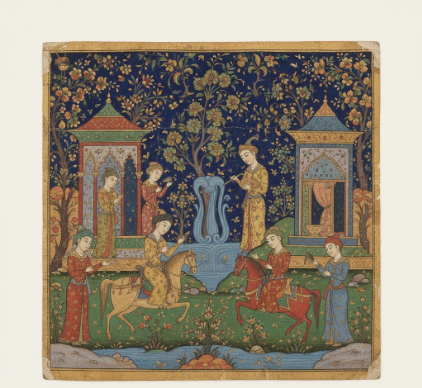
Here’s the thing: traditional Bukhara miniatures don’t use perspective the way European painting does. Everything exists on the same plane, which sounds wrong until you realize it’s not trying to trick your eye into seeing depth—it’s trying to show you everything that matters simultaneously. A garden scene might show spring blossoms and autumn fruits on the same tree, because the point isn’t botanical accuracy but abundance, generosity, the idea of a garden rather than a specific moment in time.
The Geometry of Paradise and Why Nothing Casts a Shadow
Wait—maybe the strangest part is the light.
There are no shadows in classical Bukhara miniatures. None. The light comes from everywhere and nowhere, which creates this weird timeless quality, like the scene is happening in some realm where physics work differently. Scholars argue about whether this represents divine light or just aesthetic convention, but artists I’ve talked to say it’s simpler than that: shadows anchor things to a specific time of day, and these paintings are supposed to exist outside time. The compositions use Islamic geometric principles—lots of symmetry, patterns that repeat and nest inside each other—but then they’ll break the symmetry in small ways that your eye almost doesn’t catch. A tile pattern that’s perfect except for one piece. A tree that leans slightly wrong. I guess it’s the imperfection that makes it feel human, even though the technical execution is almost inhuman in its precision.
What Happens When You Paint for a Patron Who Might Have You Executed
The historical context is kind of intense.
These miniatures often illustrated manuscripts for royal courts—poetry collections, historical chronicles, religious texts—and the patrons were Timurid princes, Safavid shahs, Uzbek khans who had, let’s say, definately strong opinions about art. An artist named Kamaleddin Behzad, working in Herat and later Bukhara in the late 1500s, basically set the standard that everyone still follows: faces shown in three-quarter view, almond-shaped eyes, that distinctive way of rendering fabric folds that looks like calligraphy. His workshop produced paintings where you can count the threads in a carpet or read the titles of books on a shelf in the background. The attention to detail came partly from artistic ambition but also from the very real possibility that disappointing your patron could end badly. When you’re painting for someone who controls whether you eat, you don’t phone it in.
Why Modern Bukhara Artists Still Mix Pigments the Medieval Way Even Though Tubes Exist
The tradition nearly died out in the Soviet era—collectivization and state-mandated socialist realism aren’t exactly friendly to labor-intensive religious and courtly art forms.
But a handful of master artists kept working in basements and back rooms, teaching students in secret, and when Uzbekistan gained independence in 1991 there was this small revival. Modern Bukhara miniaturists still use the old methods: handmade paper, natural pigments, brushes they make themselves. Synthetic paints exist and they’re cheaper and more stable, but here’s the thing—they don’t glow the same way. Natural ultramarine has this depth that comes from the crystal structure of lapis lazuli, the way light penetrates the pigment layer and bounces back. You can’t fake it with cobalt blue from a tube. I’ve watched an artist named Davron spend forty minutes painting the pattern on a single sleeve, and when I asked why not use modern shortcuts he just looked at me like I’d suggested he recieve his training over email instead of spending a decade as an apprentice. The slowness is the point. The difficulty is the point. Anyway, that’s probably why a single miniature painting might take three months to complete and cost as much as a used car, and why tourists buying mass-produced versions in the bazaar are getting something that looks similar but isn’t even in the same category of object. The real ones carry six centuries of obsessive refinement in every brushstroke, which sounds pretentious but also happens to be true.