I used to think madrasahs were just, you know, small prayer rooms with a handful of students hunched over dusty manuscripts.
The Sprawling Educational Complex That Dominated 19th Century Central Asia
Turns out, the Muhammad Amin Khan Madrasah in Khiva—built between 1851 and 1854—was basically the Harvard of its time, except way more architecturally ambitious and, honestly, probably more intimidating. This wasn’t some modest theological school tucked away in a quiet corner. We’re talking about a massive two-story structure with something like 125 cells (or hujras, as they’re called), each one housing students who came from across the Khorezm region and beyond. The sheer scale of it still catches me off guard when I look at old photographs. The building wrapped around a central courtyard, creating this enclosed world where hundreds of students lived, studied, and debated Islamic law, mathematics, astronomy, philosophy—wait, maybe I’m romanticizing it a bit, but the curriculum was genuinely broad for its era. The madrasah’s patron, Muhammad Amin Khan, was the ruler of the Khanate of Khiva, and he poured resources into this project like he was trying to cement his legacy in bricks and glazed tiles. Which, I guess, he was.
Why Size Mattered in the Competitive World of Islamic Scholarship
Here’s the thing: in 19th-century Central Asia, madrasahs weren’t just schools—they were political statements. The larger and more ornate your madrasah, the more prestige you commanded, both as a ruler and as a center of learning. Muhammad Amin Khan wanted Khiva to rival Bukhara and Samarkand, cities that had centuries-long head starts in the scholarship game. So he went big. Really big. The madrasah became the largest in Khiva, and possibly one of the largest in the entire Khanate at the time, though pinning down exact rankings gets tricky because records from that period are, let’s say, inconsistently preserved.
The architecture itself tells you something about ambition.
Turquoise Tiles, Unfinished Minarets, and the Khan’s Untimely Death
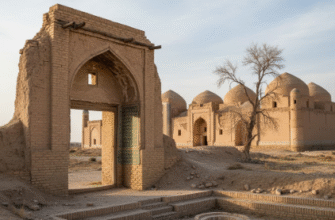
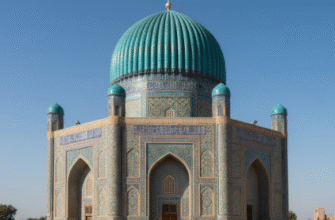
The facade is covered in those signature turquoise and blue tiles that Central Asian architecture is famous for—geometric patterns interlocking in ways that make your eyes do weird things if you stare too long. There was supposed to be a minaret, too. A massive one. Construction started on what was planned to be the tallest minaret in Khiva, maybe even taller than the Kalta Minor minaret that still stands nearby, but Muhammad Amin Khan died in 1855 during a military campaign against the Turkmens, and the project just… stopped. The unfinished minaret base is still there, this stubby reminder of interrupted ambition. I’ve seen it in person, and there’s something almost melancholy about it—a monument to hubris, maybe, or just bad timing.
What Students Actually Did Inside Those 125 Cells
Daily life for students was regimented but also surprisingly autonomous. Each hujra was basically a tiny dorm room, usually shared by two or three students. They’d wake up before dawn for prayers, attend lectures on Quranic exegesis, Hadith, Arabic grammar, logic—subjects that sound dry but were taught through intense dialectical methods that could get, from what I understand, pretty heated. Students were expected to memorize vast amounts of text, but also to engage critically, to argue, to challenge interpretations. It wasn’t all rote learning, though that was definately part of it. Meals were communal, funded by the waqf (endowment) that Muhammad Amin Khan established to keep the madrasah running after his death. Some students stayed for years, even decades, slowly climbing the ranks of scholarly authority.
Honestly, the dropout rate must have been brutal.
The Madrasah’s Decline and Its Current Life as a Tourist Magnet
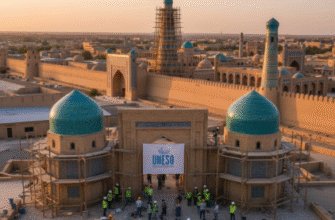
By the early 20th century, the madrasah’s influence was waning. The Russian Empire had absorbed the Khanate of Khiva in 1873, and Soviet policies in the 1920s and ’30s actively suppressed religious education. The madrasah was repurposed—first as administrative offices, then as storage, then as nothing much at all for a while. It wasn’t until Uzbekistan gained independence in 1991 that restoration efforts began in earnest. Now, it’s part of the Itchan Kala UNESCO World Heritage Site, and tourists wander through those same courtyards where students once debated the finer points of Hanafi jurisprudence. Some of the hujras have been converted into souvenir shops, which feels a bit weird, I guess, but also kind of inevitable. The building survived, which is more than you can say for a lot of Central Asian madrasahs from that era. Walking through it today, you can still feel the weight of all that accumulated knowledge, even if the classrooms are empty and the tiles need constant repair. The scale still impresses. It was built to be the largest, and in Khiva at least, it still holds that title—though now it competes for attention with selfie-takers instead of rival scholars.