The first thing that hits you isn’t the spices—it’s the light.
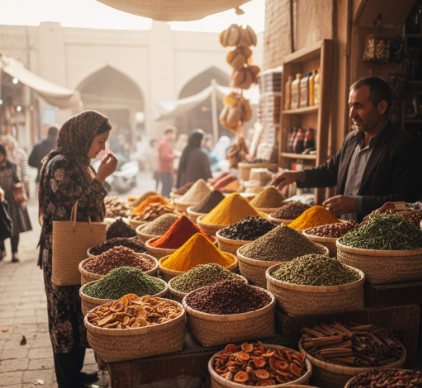
I walked into Bukhara’s Taki-Telpak Furushon covered market on a Tuesday morning in late September, expecting pyramids of saffron and turmeric like you see in travel magazines, but instead I got this amber glow filtering through the dome’s ancient apertures, illuminating dust particles that smelled like centuries of cumin and coriander trading hands. The vendors were already mid-argument about something—price, probably, or maybe whose grandfather’s grandfather actually introduced black cumin to the Silk Road first. Turns out, spice markets aren’t just about commerce; they’re living archives of culinary grudges and family legends that contradict each other depending on which stall you’re standing at. I used to think “authentic” meant old, but here’s the thing: the woman selling me dried barberries was using a smartphone to calculate exchange rates while her mother, maybe seventy-five, kept interrupting in rapid Tajik to correct her measurements. Authenticity, I guess, is just tradition arguing with itself in real time.
What You’ll Actually Find When You Stop Looking for Instagram Moments
Forget the saffron—I mean, yes, buy the saffron, but it’s not what you came for, even if you think it is. The real revelation is zira, the wild cumin that grows in the Pamir foothills and tastes nothing like the dusty jar in your pantry back home. It’s darker, almost earthy-sweet, with this sharpness that makes you reconsider every plov recipe you thought you understood. One vendor, Rustam (or maybe Rasul—I wrote it down wrong and now I can’t read my own handwriting), showed me three varieties: the standard Uzbek zira, the Afghan version that’s slightly more aggressive, and something he called “mountain zira” that he claimed was harvested at, I don’t know, roughly 3,000 meters altitude, give or take. Did I verify that? No. Did it smell different enough that I bought 200 grams anyway? Definately.
Wait—maybe I should mention the barberry situation. These tiny, tart dried berries (zereshk in Persian markets, but here they just call them “red”) are what actually makes Bukharan plov taste like it came from someone’s great-grandmother’s kitchen and not a restaurant trying too hard. They’re sour. Aggressively sour. The kind of sour that makes you wince the first time, then crave it in every rice dish forever after.
The Unspoken Rules Nobody Tells You Until You’ve Already Violated Them
So here’s what happened: I pointed at a pile of dried red peppers and asked for “some.”
The vendor—older guy, magnificent white beard, the kind of face that’s been squinting at spice scales since before I was born—just stared at me. Not hostile, just… waiting. Turns out “some” isn’t a quantity that exists in Bukhara’s spice economy. You say grams, or you say “for one kilo of rice” or “for pilaf for six people,” and then they measure accordingly. The whole interaction runs on assumed knowledge of ratios I absolutely did not posess. I watched him measure out exactly 40 grams of those peppers without asking me anything else, wrap them in Soviet-era newspaper (still! in 2024!), and charge me 15,000 som, which is either a fantastic deal or mild tourist inflation—honestly, I still don’t know. But those peppers later made the best adjika I’ve ever tasted, so maybe precision doesn’t matter when the product’s this good. A younger vendor two stalls down spoke enough English to explain that most locals buy spices in specific combinations: the plov mix, the shurpa mix, the samsa mix. You don’t buy individual components unless you’re a professional chef or, apparently, a confused foreigner trying to seem knowledgeable.
Anyway, I left with a bag that smelled like a different century and weighed approximately nothing but cost less than a mediocre lunch.