I’ve walked Broadway Street in Tashkent maybe a dozen times, and each visit feels like stumbling into a slightly different version of the same fever dream.
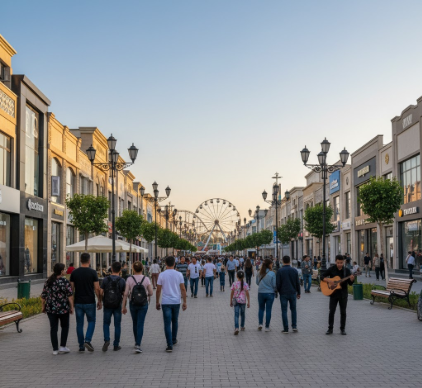
The pedestrian zone stretches for roughly two kilometers through the heart of Uzbekistan’s capital, though depending on who you ask, it’s either 1.5 or 2.5—nobody seems entirely sure where the “official” boundaries sit. What started in the early 2000s as a somewhat desperate attempt to create a European-style promenade has morphed into this weird hybrid of Soviet-era architecture, aggressively modern shopping centers, and street performers who range from genuinely talented to… well, let’s just say enthusiastic. The pavement itself is this mix of ornate tilework and practical concrete, because apparently the city ran out of budget halfway through the original renovation and just kind of rolled with it. You’ll see families pushing strollers past luxury brand knockoff stores, teenagers clustered around bubble tea stands that appeared seemingly overnight, and older folks sitting on benches that look like they were designed by someone who’d never actually sat down before. It’s exhausting and magnetic at the same time, honestly.
Wait—maybe I should back up. The thing about Broadway isn’t just the shopping, though there’s plenty of that. It’s how the whole strip operates as this strange social laboratory where Tashkent’s contradictions play out in real time. I used to think it was just a tourist trap, but turns out locals use it as a kind of neutral meeting ground.
Here’s the thing: the entertainmnet options (yeah, I know, but that’s how the signs spell it sometimes) range from bewildering to surprisingly sophisticated. Street artists set up their easels near the Sayilgoh Street intersection, churning out portraits that capture something genuine about their subjects—I’ve seen a grandmother cry looking at her painting, which wasn’t something I expected that Tuesday afternoon. Further down, there’s usually a small crowd around whoever’s doing caricatures, though the quality varies wildly day to day. On weekends, you might stumble across a string quartet playing Vivaldi next to a guy in a Spider-Man costume taking photos with kids for 10,000 som. The juxtaposition should feel jarring, but somehow it just… works? Or maybe we’ve all just accepted that this is what public spaces look like now, a collision of high and low culture where nobody’s entirely sure what’s ironic anymore.
The shopping situation is its own peculiar ecosystem.
You’ve got international chains like Zara and Mango occupying the newer buildings, their glass facades reflecting the older Soviet-style structures across the street in a way that feels almost confrontational. But squeezed between these retail giants are dozens of smaller shops selling everything from handmade ceramics to suspiciously cheap electronics to traditional Uzbek textiles that may or may not be authentic—I honestly can’t tell anymore, and I’m not convinced the shopkeepers can either. There’s this one store that sells exclusively decorative plates, and I mean exclusively, just plates, floor to ceiling, and it’s been there for at least five years, which raises questions about Tashkent’s plate-buying habits I’m not equipped to answer. The pricing is weird too; sometimes you’ll find a beautiful silk scarf for twenty dollars, other times an identicle-looking one costs sixty, and the vendors just shrug when you point this out. I guess it makes sense in a city still figuring out its post-Soviet capitalist identity, where market forces and traditional bargaining practices exist in this uncomfortable tension that nobody’s quite resolved yet.
Anyway, the food scene along Broadway deserves its own anthropological study. American-style fast food sits next to traditional Uzbek cafes serving plov and shashlik, and somehow Italian gelato shops have multiplied like rabbits over the past three years. I watched a teenager order a cappuccino, a Big Mac, and fresh tandir bread all from different vendors within a fifty-meter radius, consuming this bizarre fusion meal on a bench while scrolling through Instagram. That’s Broadway in a nutshell, really—everything smashed together, nothing quite making sense, but somehow functioning as this vital artery of urban life where Tashkent comes to see and be seen, to shop for things they may not need, to eat food from six different culinary traditions, to remember what public space can feel like even when it’s crowded and comercial and a little bit exhausting. It’s messy and imperfect and probably not what the urban planners originally envisioned, but it’s definitely, undeniably alive.