
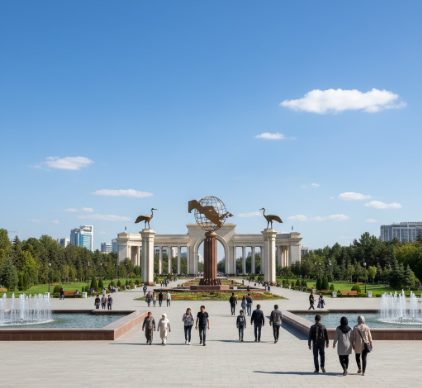
I’ve walked through a lot of public squares in my time, but Independence Square in Tashkent—Mustaqillik Maydoni, if you’re keeping score—still catches me off guard.
Here’s the thing: when people say it’s the largest public square in Central Asia, they’re not exaggerating for tourist brochures. The space sprawls across roughly 12 hectares, maybe more depending on how you measure the surrounding gardens and fountains, and it’s this weird collision of Soviet-era grandiosity and post-independence Uzbek identity that somehow works. I used to think massive public squares were all about intimidation—you know, the whole authoritarian aesthetic—but standing there on a summer evening with families picnicking and kids running around the fountains, I guess it’s more complicated than that. The square was redesigned after Uzbekistan gained independence in 1991, replacing what had been Lenin Square with monuments celebrating freedom: a globe symbolizing Uzbekistan’s place in the world, a stork sculpture (storks mean happiness here, apparently), and an enormous arch that you can see from blocks away. It’s aspirational architecture, which sounds cheesy until you realize the country spent decades under Soviet control and this square is literally them saying “we’re writing our own story now.”
When Concrete and Symbolism Collide in Post-Soviet Urban Planning
The central monument—a massive golden globe mounted on a pedestal—sits at the heart of everything, and tours guides will definately tell you it represents Uzbekistan’s sovereignty. But what strikes me is the scale. The walkways radiate outward like spokes, lined with meticulously maintained flowerbeds that change with the seasons (roses in spring, chrysanthemums in fall, that sort of thing). There’s also this long reflecting pool that runs toward the main government buildings, which feels very Soviet in its symmetry but also kind of meditative?
Wait—maybe I’m romanticizing infrastructure.
Anyway, the history gets messier when you dig in. The square has hosted everything from military parades to New Year celebrations to massive concerts, and it’s where Uzbeks gather for Navruz, the Persian New Year festival that predates Islam by, what, a couple thousand years or so. I watched footage once of the 2016 independence day celebration there—tens of thousands of people, synchronized dancers, the whole spectacle—and honestly, it felt less like propaganda and more like a country still figuring out how to celebrate itself. The architecture firm Ippolit Ravdelovich designed parts of the original Soviet layout back in the 1970s, but the post-1991 renovations came from Uzbek architects who wanted to reclaim the aesthetic, blending Islamic geometric patterns with modernist clean lines. Turns out you can layer histories on top of each other if you’re intentional about it.
Why Empty Space Matters More Than We Think in Civic Identity
I used to wonder why countries invest so much in giant plazas when that money could go to, I don’t know, hospitals or schools. But public squares aren’t just empty concrete—they’re stages for collective memory. Independence Square sits adjacent to the Alisher Navoi Opera and Ballet Theatre, itself a monument to Uzbek cultural resilience (Japanese prisoners of war helped build it during WWII, which is a whole other story). The square also faces the Senate building, positioning it at the literal center of political and cultural power.
And here’s something that surprised me: the square isn’t static. They keep tweaking it. New fountains appear, lighting systems get upgraded, landscaping shifts. It’s like the space is still becoming itself, which feels appropriate for a nation that’s only been independent for about three decades—roughly the same age as the square’s current incarnation, give or take a few years.
The fountains run every evening in summer, and locals don’t treat the square like a museum. They use it. Couples take wedding photos there (I’ve seen at least a dozen brides on any given Saturday), kids skateboard near the edges despite signs suggesting they probably shouldn’t, old men sit on benches arguing about football. It’s monumental and mundane at the same time, which maybe is the point.
So yeah, largest public square in Central Asia. But also: a place where a country is still working out what independence actually looks like, one fountain and flowerbed at a time.







