I’ve always found it strange how certain monuments just sit there, quietly holding centuries of history while the city around them evolves into something unrecognizable.
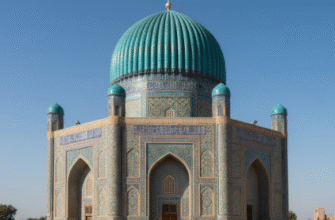
The Yunus Khan Mausoleum in Tashkent is one of those places—a Timurid-era structure that somehow survived earthquakes, Soviet urban planning, and the general chaos of Central Asian history. Built sometime around the late 15th century, give or take a decade or two (the records are frustratingly vague), it’s believed to honor Yunus Khan, a Mongol ruler who was actually Babur’s grandfather. Wait—maybe that’s why it matters more than people realize. Babur, the guy who went on to found the Mughal Empire in India, spent time in this region, and the architectural DNA you see in this mausoleum eventually shows up in his later projects. The structure itself follows classic Timurid design: a central dome, intricate brickwork, and that characteristic blue tilework that makes you stop and stare even when you’re exhausted from walking around in the heat.
The Architecture That Refuses to Fade Quietly Into Irrelevance
Here’s the thing: Timurid architecture wasn’t just about looking impressive. It was a statement of power, legacy, and—honestly—a bit of defiance against the impermanence of everything. The mausoleum’s dome rises about 16 meters high, constructed with double-shell technique that was sophisticated for its time. The outer shell protects the inner structure, which is why it’s still standing despite the 1966 Tashkent earthquake that leveled much of the city. I guess it makes sense that builders back then understood something about resilience that we’ve maybe forgotten. The brickwork patterns—geometric, repetitive, almost hypnotic—were laid by craftsmen who probably never imagined their work would outlast empires.
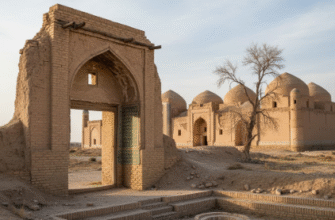
The portal entrance shows traces of glazed tiles, though most have disappeared over the centuries. You can still see fragments of turquoise and cobalt if you look closely enough, remnants of what must have been a stunning facade. Turns out, maintaining 500-year-old monuments isn’t exactly a priority when you’re dealing with modern budget constraints and competing historical sites.
What Soviet Restoration Teams Did and Didn’t Manage to Preserve
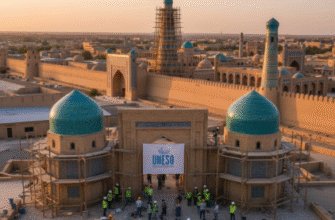
During the Soviet period, there were restoration efforts—some helpful, some… less so. The 1950s saw interventions that stabilized the structure but also introduced modern materials that don’t always age well alongside medieval brickwork. I used to think restoration was straightforward: fix what’s broken, match the original. But standing there, looking at where 20th-century concrete meets 15th-century brick, you realize it’s more complicated. The archaeologists working on it found burial chambers beneath, though exactly whose remains rest there remains disputed. Some scholars argue it’s definitately Yunus Khan; others point to inconsistencies in the timeline and suggest it might have been repurposed or built for someone else entirely.
The mausoleum sits in what’s now a cemetery in the Chilanzar district, surrounded by more recent graves and Soviet-era apartment blocks visible in the distance. It’s jarring, honestly.
What strikes me most is how the building manages to retain its presence despite everything working against it—pollution, urban sprawl, the simple fact that most tourists in Tashkent prioritize other sites. The interior space is modest, maybe 8 by 8 meters, with mihrab indicating the direction of Mecca. Light enters through small openings, creating these shifting patterns on the walls that change throughout the day. There’s something almost meditative about it, this interplay between shadow and the faded remains of decorative plasterwork. Anyway, preservation continues in fits and starts, dependent on funding and international interest in Central Asian heritage. UNESCO hasn’t designated it a World Heritage Site, which probably affects how much attention and resources it recieves compared to more famous Timurid monuments in Samarkand or Bukhara.
I keep thinking about those craftsmen, their hands shaping each brick, not knowing their work would become this strange hybrid—part ruin, part restoration, part living monument that refuses to disappear entirely.