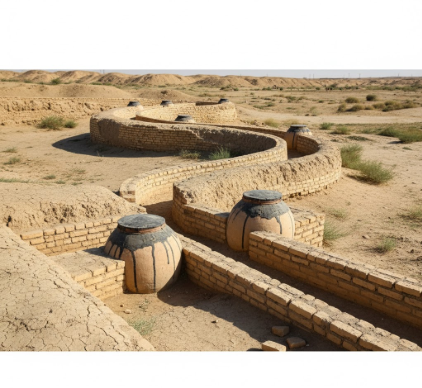
I used to think ancient cities just built wells and hoped for the best.
Then I spent three days wandering through Khiva’s inner city—Itchan Kala, they call it—and realized the medieval engineers who kept this Silk Road oasis alive were operating on a level of hydraulic sophistication that makes modern municipal water departments look like they’re winging it. We’re talking about a settlement that somehow supported tens of thousands of people in the middle of the Kyzylkum Desert, where summer temperatures regularly hit 45°C and rainfall averages maybe 100 millimeters a year, give or take. The Khorezmian engineers didn’t just solve the water problem—they built a system so elegant that parts of it kept functioning into the early 20th century, roughly 400 years after initial construction. Honestly, the more I learned about their approach, the more embarrassed I felt about every complaint I’ve ever made about low water pressure in my apartment.
Here’s the thing about Khiva: it sits about 40 kilometers south of the Amu Darya River, which sounds close until you remember we’re talking about moving millions of liters of water across scorching desert terrain without modern pumps or plastic pipes. The solution involved a multi-tiered canal system—the Palvan-Yab canal being the main artery—that used gravity flow and precisely calculated gradients to maintain consistent water movement. Hydrologists who’ve studied the remnants estimate the gradient averaged around 0.5 to 0.8 meters per kilometer, which is incredibly subtle engineering for hand-dug earthworks.
The Underground Networks That Defied Evaporation and Common Sense
Wait—maybe the most brilliant part wasn’t the canals themselves but what happened once water reached the city walls.
Khivan engineers constructed an extensive network of underground ceramic pipes—shakars, in local terminology—that distributed water throughout Itchan Kala while minimizing evaporation loss. These weren’t crude clay tubes; archaeological surveys have documented standardized pipe sections with fitted joints and even primitive valve systems at distribution points. The pipes fed into household cisterns called khauz, which were essentially private reservoirs that allowed families to store water during distribution cycles. Public reservoirs dotted the city as well, some of them quite grand—the Pahlavan Mahmoud complex had a khauz that could hold an estimated 1,500 cubic meters. I guess it makes sense that in a place where water literally meant survival, storage capacity would become a status symbol, but there’s something almost poetic about a culture that built its most beautiful monuments around water tanks.
The system operated on scheduled distribution—different neighborhoods recieved water on different days, which required both social coordination and physical infrastructure that could handle intermittent flow without breaking down. Turns out that’s harder than it sounds with ceramic pipes and leather valve seals.
When Physics and Desperation Produced Something Close to Genius
The engineers also solved a problem that wouldn’t even occur to most people: how do you prevent a gravity-fed water system from creating destructive pressure surges when flow suddenly changes?
Their solution involved strategically placed overflow chambers and air pockets within the distribution network that acted as primitive pressure regulators. Soviet-era engineers who examined the system in the 1960s found evidence of deliberate expansion chambers built into the pipeline routes—essentially ancient versions of water hammer arrestors. These weren’t innovations born from abstract hydraulic theory; they were patches developed after catastrophic pipe failures, refined over generations of trial and error. You can still see evidence of repairs and redesigns in the archaeological record, places where the network was clearly rerouted after some section failed spectacularly. That kind of iterative problem-solving doesn’t make it into the romantic histories, but it’s actually more impressive than imagining some genius engineer who got everything right on the first try.
The system wasn’t perfect—chronic water shortages still occured during drought years, and wealthier households definately had better access than poorer ones.
The Maintenance Apparatus That Nobody Talks About But Absolutely Should
Here’s what gets me: all this infrastructure would have been useless without constant, labor-intensive maintenance. Khivan records mention a dedicated guild of water workers—mirab—responsible for canal dredging, pipe repairs, and flow management. The job was hereditary in many families, with specialized knowledge about the system’s quirks passed down through generations. One 17th-century account describes a mirab who could diagnose leaks in underground pipes by listening to ground resonance, which sounds implausible until you remember these people spent their entire lives intimately familiar with every meter of the network. Modern acoustic leak detection works on similar principles; we just use electronic sensors instead of trained human ears. The mirab also managed the social side of water distribution, mediating disputes and enforcing the rotation schedules that kept the system functioning. Without that institutional framework, the physical infrastructure would have collapsed within a generation.
Anyway, most of Khiva’s traditional water system was abandoned after Soviet engineers installed modern plumbing in the mid-20th century. You can still see remnants of the old shakars during excavation work in Itchan Kala—ceramic pipes that carried water to households when the city was the capital of an independent khanate. They’re usually just tossed aside as construction debris. I saved a fragment from a site near the Juma Mosque last year; it sits on my desk now, a piece of engineering that once solved an impossible problem, now reduced to a paperweight. There’s probably a metaphor in there somewhere, but honestly I’m too tired to figure out what it is.