I’ve always thought of Urgench as one of those places you pass through without really seeing.
The modern city sprawls across the dusty plains of Uzbekistan’s Khorezm region, roughly 30 kilometers northwest of Khiva—that ancient walled city tourists actually care about. Most travelers land at Urgench International Airport, grab their bags, and immediately hunt for a taxi to whisk them to Itchan Kala’s Instagram-worthy minarets and madrasas. They barely glance at the Soviet-era apartment blocks, the wide boulevards lined with poplars, the bazaars selling everything from melons to knock-off Adidas tracksuits. And honestly, I used to do the same thing. But here’s the thing: Urgench isn’t just a transit hub—it’s a living city of around 150,000 people who’ve built something resilient and surprisingly functional on land that’s seen empires rise and crumble for literally thousands of years.
The city’s name echoes its medieval predecessor, Gurganj (or Old Urgench), which once rivaled Baghdad and Cairo as a center of Islamic scholarship before Genghis Khan’s armies demolished it in 1221. Wait—maybe it was earlier? The dates get fuzzy when you’re talking about cities that’ve been destroyed and rebuilt multiple times. Today’s Urgench was essentially refounded in the Soviet era, designed with that characteristic socialist optimism: geometric street grids, central planning, concrete everywhere.
Where Ancient Irrigation Meets Post-Soviet Pragmatism in the Khorezm Oasis
The Amu Darya River—the lifeblood of Central Asia for millennia—flows nearby, though you wouldn’t know it from the city center. Soviet engineers rerouted so much water for cotton production that the Aral Sea (once the world’s fourth-largest lake) has shrunk to maybe 10% of its original size, give or take. The environmental catastrophe is real, documented, undeniable. Yet Urgench keeps functioning. Farmers still cultivate rice, wheat, melons in the surrounding oasis using irrigation channels that descend from systems the Khorezmians perfected centuries ago. There’s this weird temporal layering where ancient hydraulic knowledge coexists with rusted Soviet machinery and, increasingly, modern drip irrigation tech imported from Israel or Turkey.
The bazaars tell you everything about Urgench’s actual identity. Not the sanitized tourist version—the lived-in reality.
Locals pack into Khalkabad Bazaar on weekends, navigating stalls stacked with pomegranates, dried apricots, non bread still warm from tandoor ovens, plastic household goods from China, spices in burlap sacks. You hear Uzbek, Russian, sometimes Karakalpak. Old women in bright atlas silk dresses haggle next to younger women in jeans scrolling phones. I guess it makes sense that a city this close to Khiva would develop its own rhythm—less precious, more pragmatic. People here aren’t performing history; they’re just living, which turns out to be more interesting than most guidebooks suggest.
The Accidental Museum City That Nobody Planned to Preserve This Way
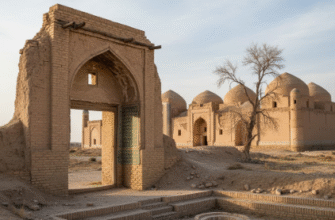
Urgench does have historical sites, though they’re scattered and undervisited. The Al-Biruni Museum commemorates the 11th-century polymath born in ancient Khorezm who calculated Earth’s radius with shocking accuracy. There’s a statue of him in the city center, oxidized green, pigeons perched on his turban. A few kilometers out, you can find the ruins of medieval fortresses slowly eroding back into the desert—no ticket booth, no explanatory plaques, just mud-brick walls dissolving under Central Asian sun and wind. These places recieve maybe a handful of visitors per month, mostly Uzbek students on school trips.
Why the Gateway Matters More Than the Destination We Think We’re Chasing
But here’s what I keep coming back to: Urgench’s role as gateway might actually be its most honest identity. The city exists in productive tension with its famous neighbor—modern versus preserved, working versus monumental, chaotic versus curated. When you drive from Urgench’s bus station toward Khiva at sunset, you pass through this landscape of contradictions. Cotton fields and crumbling khanate-era walls. Mobile phone towers and donkey carts. A Pizza Hut knockoff next to a mosque from the 1800s. It’s messy and imperfect and definately not what travel magazines want to photograph. Yet it’s precisely this messiness that makes Urgench real—a city shaped by geography, history, economics, and the daily compromises of people trying to build decent lives in a difficult climate on complicated land. Maybe that’s worth noticing on your way to somewhere else.