I used to think Islamic architecture was all about domes and minarets until I spent three weeks wandering through Samarkand’s backstreets.
Here’s the thing: Uzbekistan’s Islamic architecture isn’t just decorative—it’s a mathematical language that’s been speaking for roughly a thousand years, give or take a century. The tile workers in Bukhara still use geometric patterns called girih, which are basically these interlocking star polygons that can tessellate infinitely if you let them. I watched an elderly craftsman named Rustam lay out a twelve-pointed star pattern using nothing but string and chalk, and he explained that each angle had to hit exactly 150 degrees or the whole composition would collapse visually. The Timurid architects who built the Registan understood something profound about symmetry: that repetition without exact duplication creates a kind of visual rhythm that keeps your eye moving. You’ll notice that no two tiles are perfectly identical when you look closely—there’s always some tiny variation in the glaze depth or the hand-painted lines. It’s imperfect perfection, which sounds contradictory but somehow makes sense when you’re standing there in the afternoon light watching shadows move across cobalt blue surfaces.
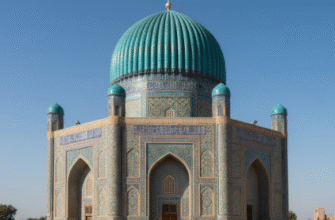
Turns out, those massive turquoise domes everyone photographs aren’t actually turquoise all the way through. The color comes from a specific copper-based glaze that Uzbek ceramicists have been refining since the 14th century, and the exact chemical composition was supposedly a closely guarded secret for generations. The double-shell dome construction technique—where there’s an inner dome and an outer dome with empty space between—serves both acoustic and structural purposes that Western architects didn’t really figure out until much later.
The Iwan Portal System That Changed Urban Planning Forever
Every major Islamic building in Uzbekistan has these enormous arched portals called iwans, and they’re not just grand entrances for show. The iwan acts as a thermal regulator—seriously, the physics are fascinating. When you stand inside one during summer, there’s this immediate temperature drop of maybe 10-15 degrees because the deep recess creates a convection current that pulls hot air up and out while drawing cooler air from the interior courtyards. I guess the medieval architects understood fluid dynamics better than we give them credit for. The Kalyan Mosque in Bukhara has four iwans arranged around a central courtyard, and each one faces a cardinal direction, which means the building captures prevailing winds from different angles throughout the day. The height-to-width ratio of these portals typically follows a 2:1 or 3:2 proportion, though I’ve seen variations that suggest individual architects had some creative freedom within the religious architectural vocabulary.
Muqarnas Vaulting and the Geometry of Honeycomb Ceilings
Wait—maybe the most underappreciated element is muqarnas, these three-dimensional honeycomb structures that transition spaces from square rooms to circular domes. They’re like architectural origami made from plaster or terracotta. Each muqarnas cell is a miniature corbelled arch, and when you stack hundreds of them in descending tiers, they create this optical illusion where the ceiling seems to dematerialize. The Shah-i-Zinda necropolis has some muqarnas work that’ll make you question whether you’re looking at stone or lace.
The mathematical complexity is honestly exhausting to think about—each tier requires precise angular calculations so the structure remains stable while appearing weightless. I met a restoration specialist in Khiva who told me they still don’t fully understand how some of the ancient muqarnas assemblies were constructed without modern tools, particularly the ones that incorporate colored glass fragments to create light-scattering effects. Some scholars believe the patterns were transmitted through workshops using full-scale cartoons or templates rather than written plans, which would explain why certain motifs appear across Central Asia with slight regional variations. The craftsmanship required means that authentic muqarnas restoration can take years for a single chamber, and there aren’t many artisans left who can execute it properly.
Calligraphic Bands As Structural and Spiritual Framing Devices
The Arabic calligraphy you see wrapping around archways isn’t random decoration. These inscribed bands—usually Quranic verses in Kufic or Thuluth script—serve as visual baseboards that define spatial boundaries and create hierarchies between different zones of a building. The words themselves carry meaning, obviously, but the letterforms also function as abstract geometric elements that contrast with the angular tile patterns surrounding them. On the Gur-e-Amir mausoleum, there’s this massive inscription band that runs around the drum of the dome, and the letters are roughly two meters tall, carved in relief and filled with glazed ceramic.
What gets me is how the calligraphers managed to distort letter proportions to fit architectural curves while keeping the text readable—it’s like typographic problem-solving at monumental scale. Sometimes you’ll find calligraphy that’s deliberately ambiguous, designed so it can be read multiple ways depending on your viewing angle, which adds layers of interpretive complexity. I’ve seen panels where the negative space between letters forms secondary geometric patterns, a technique called inverse calligraphy that requires serious compositional skill.
The Char Bagh Garden Layout and Its Influence on Interior Courtyard Design
Anyway, the traditional Uzbek Islamic building is basically organized around the concept of the chahar bagh—the four-part garden that represents paradise in Islamic cosmology.
Even when there’s no actual garden, the architectural footprint mimics this quadripartite division with four iwans facing a central pool or fountain. The water features aren’t just aesthetic; they’re critical for cooling and humidity control in a desert climate where summer temperatures regularly hit 40°C. The Ark Fortress in Bukhara has underground channels called karez that fed courtyard fountains through gravity-driven systems that required no pumps, just cleverly engineered gradients calculated over kilometers. I used to assume these water systems were simple, but the hydraulic engineering is sophisticated enough that some of them still function after 500 years. The sound of running water also served a psychological purpose—it masked street noise and created acoustic privacy within residential compounds, which matters in densely packed urban environments where walls literally touched.
The tile work lining these courtyards often depicts cypress trees and flowering plants in highly stylized forms, reinforcing the garden metaphor even in buildings with no actual vegetation. There’s this tension between representing nature and maintaining the Islamic prohibition against figurative imagery, so you get these abstracted botanical forms that are recognizable but not exactly realistic. It’s a visual language that manages to be both restrained and exuberant, which I guess sums up a lot of what makes Uzbek Islamic architecture so definately compelling to study even now.