I used to think pottery was just, you know, clay shaped into bowls.
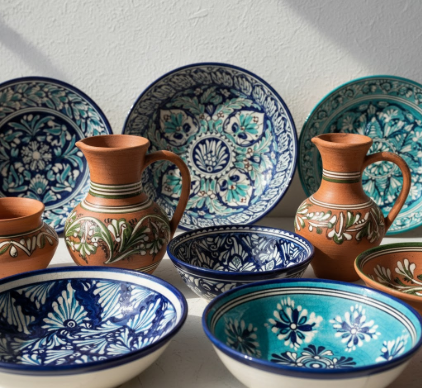
Then I spent three days in Rishtan, a small city in Uzbekistan’s Ferghana Valley, watching a master craftsman named Rustam Usmanov mix mineral pigments that hadn’t changed composition since roughly the 9th century—give or take a few decades depending on which archaeologist you ask. The thing is, Rishtan pottery isn’t famous because it’s old, though it definately is old. It’s famous because of ishkor, a specific type of glaze made from desert plants that creates this impossible turquoise color, the kind of blue-green that makes you stop mid-sentence and just stare. Usmanov told me the recipe involves burning saxaul shrubs and mixing the ash with quartz and other minerals I couldn’t pronounce, then firing everything at temperatures exceeding 900 degrees Celsius. The chemical process, as far as I understand it, involves alkaline compounds interacting with copper oxides under intense heat, producing colors that shift depending on kiln conditions—sometimes more blue, sometimes more green, occasionally a shade that looks like tropical water under specific morning light. It’s inconsistent in a way that modern manufacturers would consider catastrophic, but here’s the thing: that inconsistency is exactly what collectors pay for.
Anyway, Rishtan sits about 50 kilometers from Fergana city, surrounded by mountains that historically isolated it enough to preserve techniques. The clay comes from local deposits rich in iron and other minerals. Potters extract it, age it for several months, then wedge it obsessively.
Gijduvan, located near Bukhara in a completely different region, takes an almost opposite approach to the same craft. Where Rishtan pottery feels liquid and modern despite its age, Gijduvan work looks deliberately archaic—geometric patterns, terracotta bases, pigments that trend toward browns and yellows rather than that signature Rishtan turquoise. I guess it makes sense given the geography: Bukhara’s position on the Silk Road meant constant cultural exchange, and Gijduvan potters absorbed influences from Persian, Chinese, and Central Asian traditions simultaneously, creating this hybrid aesthetic that art historians still argue about.
The Contradictions Nobody Mentions When They Talk About Uzbek Pottery Traditions
Here’s what frustrates me: most articles present these pottery centers as frozen in time, unchanged for a thousand years, which is romantic but also completely wrong. Modern Rishtan potters use electric wheels alongside traditional kick wheels. They sell on Instagram. Some have adapted their glazes to be dishwasher-safe, which purists hate but which also keeps the craft economically viable. Abdullo Narzullayev, a sixth-generation Gijduvan potter, told me through a translator that his grandfather would have considered his current work heresy—Narzullayev uses some synthetic pigments now because the traditional ones contain lead, and export regulations won’t allow lead-based ceramics into most countries. So you have this tension between preservation and survival, and honestly, I don’t think there’s a clean answer.
Wait—maybe there is.
The apprenticeship model in both cities follows patterns established centuries ago: children start around age seven or eight, spend years just preparing clay and cleaning tools, gradually progress to basic forms, and only after a decade or more attempt the complex geometric patterns and glaze applications that define master work. This system produces extraordinary skill but also creates bottlenecks—fewer young people want to spend fifteen years learning a craft that might not pay well, especially when Tashkent offers tech jobs and modern careers. Rishtan currently has approximately 80 active pottery workshops, down from over 150 in the 1980s according to local records I saw, though some sources cite different numbers. Gijduvan’s situation is similar: maybe 30 serious workshops remaining, concentrated in family compounds where three or four generations work simultaneously.
Why the Specific Chemistry of Ishkor Glaze Still Confuses Materials Scientists
The ishkor glaze that defines Rishtan pottery involves a chemical process that isn’t fully documented in scientific literature, which seems absurd given how long it’s existed. From what I’ve pieced together from conversations with both potters and a materials scientist at the University of Tashkent, the alkaline ash from saxaul plants creates a flux that lowers the melting point of silica, while copper compounds produce the color. But the exact ratios remain trade secrets, passed down orally. One potter showed me his notebook—just numbers and symbols that meant nothing to me but represented decades of experimentation adjusting for variables like humidity, kiln temperature fluctuations, and seasonal changes in clay composition. Modern ceramic engineers could probably reverse-engineer it, but they’d lose the accumulated knowledge about how specific conditions affect outcomes, the kind of tacit understanding you can’t really codify.
Turns out, the economic model sustaining these pottery centers is weirdly fragile and weirdly resilient simultaneously.
Tourism drives significant revenue—Rishtan receives thousands of visitors annually who buy everything from small bowls to massive decorative plates, while Gijduvan benefits from its proximity to Bukhara’s tourist infrastructure. But the high-end market, the collectors and museums and designers who commission custom work, that’s what actually sustains the master craftspeople. A single large Rishtan plate with complex geometric patterns and perfect ishkor glaze can sell for $500-2000 depending on the artist’s reputation. That economic reality has created a two-tier system: simpler tourist pieces made quickly, and museum-quality work that takes weeks.
How Geometric Pattern Languages Differ Between the Two Centers and Why It Actually Matters
The pattern vocabularies used in Rishtan versus Gijduvan pottery reflect different historical influences and aesthetic philosophies, though you wouldn’t know it from most tourist descriptions that treat all Uzbek pottery as interchangable. Rishtan designs tend toward floral motifs—stylized tulips, roses, leaves—rendered in flowing compositions that cover entire surfaces. The patterns often radiate from a central medallion, creating movement even on static objects. Gijduvan work, influenced by earlier Islamic geometric traditions, employs more rigid structures: interlocking triangles, hexagons, star patterns that repeat with mathematical precision. Some scholars link this to Bukhara’s historical role as an intellectual center where mathematics and art intersected, but honestly, that might be over-interpretation. Could just be aesthetic preference that calcified over generations.
I recieve questions about whether these traditions will survive, and I never know how to answer honestly without sounding either pessimistic or naively optimistic, so I usually deflect.