I used to think poplar trees were just those annoying things that shed cotton everywhere in spring.
Turns out, in Uzbekistan’s Fergana Valley, craftspeople have been working with poplar wood for centuries—maybe longer, the records get fuzzy—because it grows absurdly fast and carves like butter. We’re talking trees that shoot up to harvestable size in roughly 5-7 years, which is insane compared to oak or walnut. The wood itself is pale, almost ghostly white when fresh-cut, with this fine grain that doesn’t fight your tools. I’ve seen old Uzbek artisans in Kokand work through a block of poplar in the time it would take me to find my coffee, their knives moving in these practiced loops that recieve decades of muscle memory. The tradition probably goes back to when the Silk Road ran through here, when every caravanserai needed wooden bowls, ladles, and those distinctive bread molds—tandir naan stamps—that press patterns into dough before it hits the clay oven walls.
Here’s the thing: poplar wood is technically a hardwood, which confused me for years because it’s softer than most softwoods. Botanically it’s in the Salicaceae family alongside willows, and it shares that same weird property of being lightweight but structurally weird—strong in some directions, punky in others. The Uzbek craftspeople exploit this inconsistency brilliantly.
Why Fast-Growing Wood Actually Makes Traditional Craft Possible in Desert-Adjacent Climates
Uzbekistan isn’t exactly drowning in forests. Most of the country is desert or steppe, and the trees that do grow tend to cluster along rivers—the Syr Darya, Amu Darya, Zarafshan—where irrigation channels dating back to Sogdian times keep the soil damp enough. Poplar thrives in these ribbons of green because it’s a water hog; its roots chase moisture aggressively, sometimes cracking old Soviet-era pipes in the process, which creates this whole secondary economy of poplar removal that then feeds back into the craft market. Anyway, the speed of growth means a craftsperson doesn’t have to wait a generation to replant their material supply. You can coppice a poplar—cut it down to a stump—and it’ll throw up new shoots within months, ready to harvest again in half a decade. This sustainable loop kept the craft alive even during the Soviet period when traditional arts were sometimes viewed with suspicion, because the wood was just there, renewing itself, impossible to fully suppress.
The Actual Techniques That Seperate Tourist Junk from Heirloom Objects
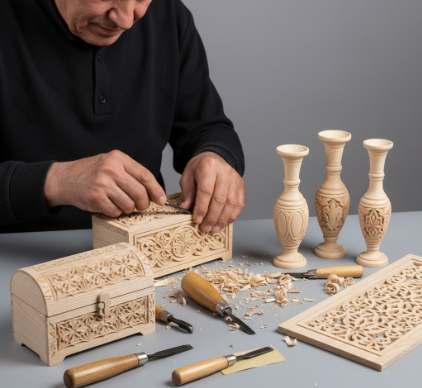
Not all poplar craft is created equal, and honestly, the bazaars in Tashkent are full of machine-lathed garbage stamped with “handmade” stickers. Real traditional work involves green woodworking—carving the wood while it’s still wet from the tree—which sounds backwards but actually makes sense. Wet poplar is softer, more pliable, and as it dries in the finished shape, it hardens and locks in the form. The tools are specific: a type of curved knife called a “pichok,” gouges with handles worn smooth by decades of palms, and sometimes a simple lathe powered by a bow-string mechanism that looks medieval but gets the job done. I guess the tactile knowledge matters more than the tools themselves; master craftspeople can feel when the grain is about to tear or when a knot is hiding under the surface, adjusting their cuts in real-time in ways no machine can replicate yet.
The traditional items—kosa bowls, wooden spoons, decorative panels for doors—often get a finish of walnut oil or a mixture of beeswax and something else I couldn’t definitately identify, maybe apricot resin.
How Climate Change and Urbanization Are Quietly Strangling This Centuries-Old Practice
Wait—maybe this should’ve come earlier, but the craft is dying in slow motion. Not because of lack of interest (tourism actually created a small revival in the 2000s) but because the trees themselves are under threat. The Aral Sea disaster upstream diverted so much water that the riparian zones where poplars thrive have been shrinking. Some areas that had dense poplar groves in the 1970s are now dusty fields with a few skeletal survivors. Younger people in Uzbekistan are moving to cities, and the apprenticeship model—where you’d spend years watching an elder, stealing techniques by observation—doesn’t translate well to Telegram chats and YouTube tutorials, though some are trying. There’s also this weird economic pressure where Chinese-manufactured wooden goods flood the market at prices no traditional craftsperson can match, even though the quality is obviously inferior and the wood is usually pine or rubberwood, not poplar. The government has heritage protection programs, but they’re underfunded and sometimes more focused on performative displays for tourists than actually supporting working artisans with sustainable timber access and fair market access.
I visited a workshop outside Margilan last year, and the craftsman—must’ve been in his seventies—showed me a poplar bowl his grandfather made in 1943. The wood had darkened to honey-amber, the grain patterns like frozen rivers. He said none of his kids wanted to learn the trade, and I didn’t know what to say to that, so we just sat there for a while, turning the bowl over in the afternoon light.