I used to think traditional music was something you endured at weddings, politely clapping while checking your phone.
Then I stumbled into a basement performance hall in Tashkent’s old city—one of those places with peeling Soviet-era wallpaper and questionable ventilation—and watched a doira player’s hands move so fast they blurred. The drum’s jingles created this cascading shimmer that felt less like rhythm and more like liquid metal pouring through the air. Turns out, Uzbek music isn’t background noise for tourist brochures. It’s this living, breathing thing that’s been evolving for roughly a thousand years, give or take a few centuries, absorbing Persian poetry traditions, Turkic nomadic songs, and Soviet conservatory training into something that defies easy categorization. The instruments alone—tanbur lutes with sympathetic strings that vibrate untouched, nay flutes that require circular breathing techniques most wind players can’t master, and the aforementioned doira drums that sound like controlled thunder—create textures Western ears struggle to process. And here’s the thing: you can’t really understand it through recordings, no matter how high the bitrate. You need the physical experience, the way the sound bounces off tile walls, the slight imperfections when a singer’s voice cracks on a particularly high ornament.
Honestly, the Navoiy Opera Theatre in Tashkent feels like cheating—it’s too polished, too accessible. But that’s exactly why it works for first-timers. The building itself is this gorgeous blend of Uzbek architectural motifs and Soviet grandeur, all turquoise mosaics and chandeliers that probably weigh more than my car. They regularly stage performances combining classical Shashmaqom suites with choreographed dance, and while purists might grumble about commercialization, the production quality is undeniable. I’ve seen tourists literally gasp when the lazgi dancers start their shoulder-shimmying sequences—wait, maybe that’s underselling it.
The movements look physically impossible, isolated muscle control that would make anatomists reconsider skeletal limitations.
Samarkand’s Hidden Courtyard Venues Where Authenticity Still Breathes
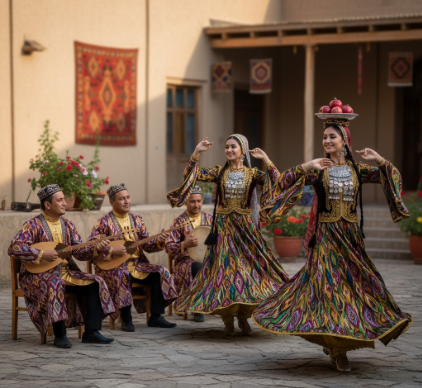
Samarkand’s restaurant-venue hybrids occupy this weird space between authentic preservation and tourist trap, and I can never quite decide which side they fall on. Places like Karimbek or Samarkand Restaurant advertise “traditional evenings” that include multi-course plov dinners alongside music performances, which sounds suspiciously packaged. But then the musicians start playing, and you realize half of them are masters who studied under Soviet-era ustads—teachers who maintained oral transmission traditions even when authorities tried stamping out “bourgeois nationalist” culture. The dance performances lean theatrical, sure, with costumes that probably cost more than historically accurate versions. Yet there’s something genuinely moving about watching a khorezm dance, with its sharp head movements and percussive footwork, performed in a courtyard surrounded by fourteenth-century madrasah walls. The acoustic properties of those spaces do strange things to sound, creating natural reverb that modern concert halls spend millions trying to replicate. I guess it’s less about purity and more about the transmission continuing at all.
Bukhara’s Lyab-i-Hauz Performances That Capture the Twilight Hour Perfectly
The Lyab-i-Hauz pond in Bukhara hosts informal performances that feel almost accidental, though obviously someone’s organizing them. As evening settles and the call to prayer echoes from the surrounding mosques, musicians gather near the mulberry trees and just… start. Sometimes it’s a solo dutar player working through a classical makam, those modal systems that can last forty minutes without repeating a phrase. Other times it’s a small ensemble—maybe a ghijak spike fiddle, a chang jaw harp, and vocals—playing what sounds improvisational but follows centuries-old compositional rules I definately don’t understand. The sound competes with cafe chatter and vendor calls, which should ruin the experience but somehow doesn’t. Maybe because this is how music functioned historically: not as separated art-for-art’s-sake, but woven into daily commercial and social life. I’ve watched local teenagers stop mid-conversation when a particularly skilled vocalist hits those microtonal intervals that don’t exist in Western scales, their faces showing the same confused appreciation I felt. Nobody applauds between pieces because nobody’s quite sure when one ends and another begins.
The Fergana Valley’s Wedding Hall Circuit Where Real Life Happens
Here’s the thing nobody tells you: the most intense musical experiences happen at actual Uzbek weddings, not staged performances.
Problem is, you need an invitation, which requires either local friends or shameless networking. I once talked my way into a Kokand wedding after befriending a carpet seller who decided I needed “real cultural education,” and the four-hour musical marathon that followed rewrote my understanding of endurance performance. Wedding ensembles play continuously, shifting between energetic dance numbers and mournful lyrical songs without breaks, fueled by endless tea and the occasional shot of something stronger. The lead vocalist at this particular event had a voice that could shatter the elaborate glass tea sets, hitting notes that seemed to bypass my ears and vibrate directly in my chest cavity. Guests would spontaneously jump up to dance—not choreographed tourist-show moves, but loose, joyful interpretations that ranged from elegant to chaotic. The musicians would adjust tempo and intensity based on crowd energy, creating this feedback loop where everyone fed off everyone else’s enthusiasm. It was messy, loud, occasionally off-key, and the most alive I’ve felt watching any performance art. Unfortunately, I can’t exactly reccommend “crash random weddings” as a sustainable tourism strategy, but Fergana cities like Margilan and Rishton sometimes advertise public concerts in their cultural centers that approximate the experience without the family obligation aspects.
Tashkent’s Conservatory Concerts That Prove Classical Training and Folk Roots Can Coexist
The State Conservatory of Uzbekistan hosts concerts that navigate the awkward tension between academic formalization and folk spontaneity with varying success. These are performances where musicians have both conservatory degrees and apprenticeships with traditional masters, trying to honor both lineages simultaneously. Sometimes it works brilliantly—a surnay oboe player using Western breath control techniques to sustain notes longer than traditional methods allow, creating this haunting extension of folk melodies. Other times it feels stiff, like the music’s been pressed flat under the weight of notation systems designed for completely different sound worlds. The audience tends toward older Tashkent intellectuals and confused foreigners clutching program notes they can’t read, which creates a strange formality absent from teahouse performances. But there’s value in hearing how younger musicians are reimagining tradition, even when experiments fail. I watched a string quartet attempt Shashmaqom adaptations that didn’t quite work—the microtones fought against equal temperament tuning—yet the ambition was fascinating. Anyway, tickets are absurdly cheap by Western standards, usually under $5, making failed experiments low-risk propositions.