I’ve stood in a lot of ancient cities at dusk, but Khiva does something different to you.
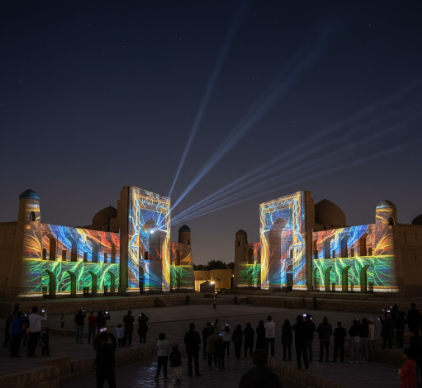
The sound and light show here—staged most evenings inside Itchan Kala, the walled inner city—isn’t some Disney-fied hologram spectacle, though honestly, I half-expected that when I first heard about it. It’s more like watching history argue with itself in real time. Lasers trace the outlines of madrassas and minarets while recorded voices in Uzbek, Russian, and English narrate conquest, poetry, slave markets, silk roads. The thing is, the technology feels deliberately unpolished, like someone in 2008 got really excited about projectors and then just… kept using them. But here’s the thing: that awkwardness works. It makes the whole experiance feel less like a tourist trap and more like a city trying to remember itself out loud, which I guess is what these shows are supposed to do anyway.
The performance usually starts around 9 PM in summer, earlier in winter when the sun sets faster. You sit on metal chairs facing the Kalta Minor minaret—that squat, turquoise-tiled tower that was supposed to be the tallest in Central Asia until the khan who commissioned it died and everyone just… stopped building. The lights hit it first, turning the tiles electric blue, then gold, then this deep crimson that makes the whole thing look like it’s burning from the inside.
When the Projections Start Telling Stories You Didn’t Expect to Hear
Wait—maybe I should back up.
The narrative structure is weird. It jumps from the 6th century to the 1800s to the Soviet era without much warning, which initially annoyed me because I like chronology, but then I realized that’s kind of the point. Khiva’s history isn’t linear—it’s layered, contradictory, violent, beautiful, depending on who’s talking. One minute you’re hearing about Zoroastrian fire temples, the next about Khan Muhammad Amin’s military campaigns, then suddenly there’s footage of Soviet archaeologists restoring the city in the 1960s. The emotional whiplash is real. I used to think these shows needed tighter scripts, but now I’m not so sure. The messiness mirrors the actual experiance of wandering Khiva during the day, where a 10th-century mosque sits next to a 1970s concrete hotel and nobody seems bothered by it.
The music is this blend of traditional Khorezm instruments—the dutar, the doira drum—layered with synthesizers that sound definately dated but somehow fit. It swells at moments you don’t expect, like when they’re talking about water management systems instead of battles. Which, honestly, makes sense. In a desert city, the engineering that brought water from the Amu Darya river is more miraculous than any conquest.
Why This Particular Show Feels Different From Every Other Historical Light Show
I’ve seen light shows at the Pyramids, at Angkor Wat, at Edinburgh Castle. They follow a formula: dramatic music, sweeping statements about legacy, lots of words like “eternal” and “glory.” Khiva’s version is quieter, more uncertain. There’s a section where the narrator talks about the slave markets that operated here until the 1870s, and the lights go dim, and there’s just silence for maybe ten seconds. No music. No justification. Just the fact, sitting there. It made me uncomfortable, which I think was the point.
The show runs about 45 minutes, give or take. Tickets are sold at the west gate of Itchan Kala, usually around $8-10 USD, though prices fluctuate depending on season and whether you’re booking through a hotel. The seating area holds roughly 200 people, but I’ve been there with maybe 30 others on a random Tuesday in October. The smaller crowds are better—you can hear the wind moving through the alleys between projections, which adds this strange ambient layer the sound designers probably didn’t plan for.
Anyway, if you go, bring a jacket. Desert nights get cold fast, and the show doesn’t stop for weather. I sat through one performance where a sandstorm started halfway through, and they just kept going, dust swirling through the light beams like the city was disintegrating in real time. Everyone stayed. Nobody asked for refunds. We just watched Khiva flicker and persist, the way it has for something like 2,500 years, give or take a few centuries of uncertainty in the historical record.