I used to think madrasahs were just austere study halls—quiet, dim, humorless.
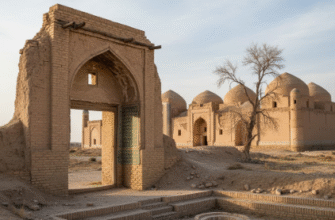
Then I visited the Nazarkhan Madrasah in Khiva, and honestly, I realized I’d been carrying around a cartoon version in my head for years. This 19th-century educational complex, tucked into the walled inner city of Itchan Kala, was built around 1810 under the patronage of a local nobleman named Nazarkhan. It’s not grand like the Mir-i-Arab in Bukhara or sprawling like Registan’s trio in Samarkand—it’s smaller, quieter, almost domestic in scale. The courtyard is maybe 20 meters across, give or take, with two-story student cells (hujras) lining three sides and a modest mosque anchoring the fourth. The tilework is faded turquoise and cobalt, some panels chipped or missing entirely, which somehow makes the place feel more real, more lived-in. You can still see the niches where oil lamps sat, the worn thresholds where centuries of students shuffled in and out. I stood in one of those cells—basically a shoebox with a vaulted ceiling—and tried to imagine studying Islamic jurisprudence or astronomy in that dimness, and I couldn’t decide if it felt cozy or claustrophobic. Probably both.
The Architecture That Taught Humility Before the First Lecture Even Started
Here’s the thing: the design wasn’t accidental. Madrasahs like Nazarkhan were built to shape behavior as much as minds. The cells are deliberately small—roughly 3 by 4 meters, with a single window facing the courtyard. Privacy was minimal; you could hear your neighbor coughing or reciting Quranic verses through the thin walls. The courtyard itself functioned as a communal study space, a prayer area, and a social hub all at once, which meant there was no escape from the collective rhythm of learning. The iwan (vaulted portal) over the entrance is low and unadorned compared to grander madrasahs, almost humble, which I guess was the point—entering wasn’t supposed to feel triumphal. It was supposed to feel like crossing into a space where ego had no place.
The mosque, positioned at the far end of the courtyard, is even smaller than you’d expect—maybe 30 square meters inside, with a mihrab (prayer niche) so plain it’s almost stark. No gold leaf, no intricate muqarnas (stalactite vaulting), just geometric brickwork and a few bands of calligraphy. I asked a local guide why it was so restrained, and he shrugged and said, “Nazarkhan wasn’t trying to impress God, I think—just serve Him.” Which felt like the kind of answer that’s either profound or a polite way of saying the budget ran out.
What They Actually Studied Here and Why It Definately Wasn’t Just Theology
Wait—maybe this is where my assumptions really fell apart.
The curriculum at Nazarkhan, like most Central Asian madrasahs of the era, wasn’t purely religious. Students started with the Quran and Hadith, sure, but they also studied Arabic grammar, logic (mantiq), rhetoric (balagha), mathematics, astronomy, and even medicine. The sciences were considered essential because understanding the natural world was seen as a way to understand divine order. There’s a reason so many medieval Islamic scholars were polymaths—the educational system didn’t partition knowledge the way we do now. I found a reference in a 19th-century Russian ethnographic survey (admittedly hard to verify, but it rings true) that students at Nazarkhan spent roughly three years on foundational texts before specializing in law, philosophy, or mathematics. The teaching method was oral and dialectical—lots of debate, memorization, and repetition. No desks, no blackboards, just students sitting cross-legged on carpets, arguing over interpretations of Avicenna or al-Ghazali. It sounds exhausting, frankly.
The Madrasah’s Decline and What Tourism Has Done to Its Bones
By the early 20th century, Nazarkhan was already fading.
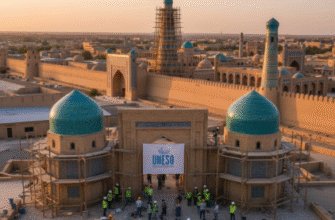
The Soviet period accelerated the collapse—many madrasahs were shuttered, repurposed as warehouses or administrative offices, sometimes demolished outright. Nazarkhan survived, barely, as a storage facility for grain and textiles. The hujras lost their doors, the courtyard filled with debris, and the tilework crumbled under decades of neglect. Restoration began in the 1980s, and today the complex is part of the Itchan Kala UNESCO site, which means it’s technically protected but also commodified. Souvenir stalls crowd the entrance, selling suzani embroideries and knock-off ceramics. Tourists wander through snapping photos, rarely lingering. I spent an hour there on a Thursday afternoon in April, and I saw maybe a dozen other visitors, none of whom seemed to notice the inscriptions over the cell doorways—Quranic verses about the pursuit of knowledge, now faint and half-erased. There’s something melancholy about a place built for contemplation becoming a backdrop for selfies, but I guess that’s the bargain we make to keep these structures standing.
Why You Should Visit Anyway Despite All the Contradictions and Crowds and Inevitable Disappointment
Because it’s still worth it, somehow. The light in the courtyard at dusk is golden and soft, and if you squint, you can almost see the students who once sat there, hunched over manuscripts, arguing, dozing, dreaming. The imperfections—the cracked tiles, the uneven floors, the faded paint—make the place feel honest in a way pristine restorations never do. And maybe that’s the real lesson of Nazarkhan: that education, like architecture, is never finished, never perfect, always a little broken and beautiful and stubbornly enduring. I left feeling like I’d barely scratched the surface, which I suppose is how you’re supposed to feel after visiting a place built for lifelong learning.