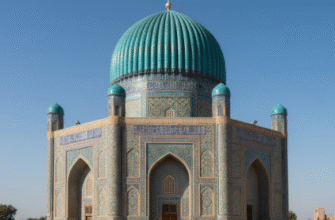
I used to think necropolises were just fancy words for graveyards until I stumbled across Mizdahkan.
Mizdahkan Necropolis sprawls across three wind-scraped hills in Karakalpakstan, an autonomous republic wedged into northwestern Uzbekistan that most people couldn’t locate on a map if their lives depended on it. The cemetery complex has been in continuous use for roughly 2,000 years, give or take a few centuries—archaeologists love hedging their bets—and it’s still accepting burials today. Which is, honestly, kind of unsettling when you think about it. You’re walking past crumbling mud-brick mausoleums from the 10th century and then boom, fresh flowers on a grave from last Tuesday. The site covers about 200 hectares, though I’ve seen estimates that vary wildly depending on who’s measuring and whether they’ve included the scattered outlying tombs that dot the landscape like forgotten punctuation marks.
Here’s the thing: Mizdahkan isn’t just old, it’s layered. The earliest structures date back to the 4th century BCE, when this area was part of ancient Khorezm, a civilization that thrived along the Amu Darya delta before most of us had ancestors worth mentioning. The necropolis grew as empires rose and collapsed—Zoroastrian fire temples gave way to Islamic shrines, and architectural styles morphed from pre-Islamic Sogdian designs to the blue-tiled domes you’d recognize from Samarkand tourist brochures.
The Mausoleum That Supposedly Holds the End of the World (Or Maybe Just a Really Important Guy)
The crown jewel, if you can call a crumbling structure a jewel, is the Mazlumkhan-Sulu mausoleum. Built sometime in the 12th to 14th centuries—again, nobody agrees on exact dates because medieval Central Asian record-keeping was, let’s say, inconsistent—this multi-chambered complex features a central dome that’s collapsed more times than it’s stood upright. Local legend insists it houses the grave of a warrior who’ll rise when the apocalypse begins, which sounds dramatic until you realize half the sacred sites in Central Asia have similar origin stories. What’s verifiable is the sophisticated brickwork: intricate geometric patterns that required mathematical precision we tend to assume ancient builders couldn’t manage. Turns out they could, and they did it without CAD software or YouTube tutorials.
I guess the most fascinating aspect is the Shamun-Nabi complex, allegedly the burial site of a prophet—some say it’s Shamun from the Old Testament, others claim different lineages entirely. Pilgrims have been trekking here for centuries, wearing grooves into stone stairs with their footsteps. The site includes a khanqah (Sufi monastery) and a series of underground chambers that archaeologists only partially excavated in the Soviet era before funding evaporated.
Wait—maybe I should mention Gyaur-Kala, the ruined fortress adjacent to the necropolis.
This citadel predates most of the graves and served as a Zoroastrian religious center before Islam swept through the region in the 8th century CE. You can still see remnants of fire temple foundations if you know where to look, though erosion and centuries of looting have reduced most structures to ankle-high rubble. Soviet archaeologists conducted digs here in the 1950s and 60s, unearthing pottery shards, corroded coins, and fragmentary inscriptions in Khwarezmian script—a language so obscure that maybe three living scholars can read it fluently. The finds suggested Mizdahkan was a major pilgrimage destination even before Islamic traditions took root, which complicates the neat chronological narratives tour guides prefer.
Why This Place Feels Different From Every Other Ancient Cemetery You’ve Definately Seen on Instagram
Honestly, what strikes me most is the absence of preservation efforts. There are no velvet ropes, no admission fees, no interpretive plaques written in five languages. Mizdahkan exists in a state of managed decay—locals bury their dead here, shepherds graze sheep among the tombs, and the occasional adventurous tourist wanders through looking slightly lost. UNESCO hasn’t swooped in with restoration funds, and the Uzbek government seems content to let the site age naturally, which is either admirably hands-off or depressingly negligent depending on your perspective. The mud-brick structures melt a little more each rainy season, and nobody’s rushing to stop it. Some of the mausoleums have been patched up by descendants of the buried, using modern cement that clashes jarringly with thousand-year-old masonry. It’s messy and imperfect and somehow more authentic than the over-restored Silk Road monuments that end up looking like theme park replicas. I’ve seen photographs from the 1970s compared to recent images, and the deterioration is visible but gradual—Mizdahkan isn’t collapsing, it’s just slowly returning to the desert it came from.
The necropolis sits about 25 kilometers from Nukus, the regional capital, in a landscape so flat and featureless that the burial mounds become the only vertical elements for kilometers. Getting there requires either hiring a driver who knows the rutted dirt roads or convincing a shared taxi to make the detour, which may or may not happen depending on the driver’s mood and your negotiation skills.