I used to think mints were just, you know, modern industrial places with security cameras and guys in white coats.
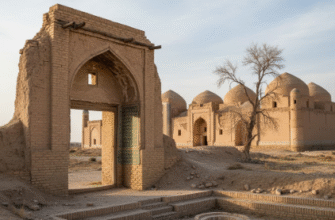
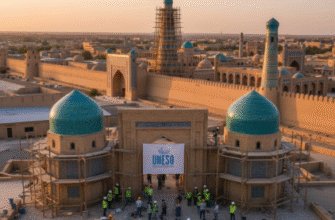
Then I walked into the Mint Museum in Khiva—tucked behind crumbling mud walls in Uzbekistan’s Ichan-Kala fortress—and realized I’d been completely wrong about how money gets made, or at least how it used to get made. The building itself dates back to the early 19th century, when the Khanate of Khiva was minting its own silver coins called tenga, and honestly the whole operation was shockingly low-tech compared to what I expected. There were no precision machines, no digital scales—just hammers, dies, and human muscle. The coins weren’t even perfectly round, which I guess makes sense when you think about it, but still. You could see the irregularities in the museum’s collection, each tenga slightly different from the next, bearing the marks of whoever struck it that day. It’s weirdly personal for something that’s supposed to be standardized currency.
The craftsmen—called zargar in Persian—would heat silver ingots over charcoal fires until they were malleable enough to pound into rough discs. Then came the striking: one die underneath, one on top, and a sledgehammer brought down hard enough to impress the Khan’s seal and Arabic inscriptions into the metal. Sometimes they’d mess up and have to melt it down again.
Where Ancient Metallurgy Meets Bureaucratic Chaos (and Somehow Worked Anyway)
Here’s the thing about pre-industrial mints—they were as much about political control as they were about economics. The Khiva mint operated under direct supervision of the Khan’s treasury officials, who would periodically check the silver content to make sure workers weren’t skimming precious metal for themselves. Turns out that was a huge problem, because—wait—monetary debasement wasn’t invented by modern governments; it’s been around for roughly 2,500 years, give or take. Workers would sometimes mix in copper or lead to stretch the silver supply, and if they got caught, punishments were brutal. The museum has ledgers showing production quotas from the 1820s and 1830s, written in Chagatai Turkic, documenting how many coins each team was supposed to produce daily. The numbers are kind of exhausting to look at: 800 tenga per shift, six days a week, with penalties for shortfalls.
I’ve seen similar setups in Nepal and Morocco, but Khiva’s mint feels uniquely preserved because it basically froze in time after Russian colonization in 1873 ended local coin production. The tools are still there—original anvils, tongs, even some of the wooden-handled hammers.
The Acoustics of Money (Or Why Coin-Striking Sounded Like a Blacksmith’s Nightmare)
One detail that doesn’t come across in photos: the noise must have been absolutely unbearable. The mint’s workshop is this small vaulted chamber, maybe 20 feet across, with stone walls that would’ve amplified every hammer strike into a deafening clang. Workers definately suffered hearing loss—there’s no way around it when you’re pounding metal for ten hours a day in an enclosed space. Modern occupational health standards would shut the place down instantly, but in 19th-century Central Asia, that wasn’t really a concern. The museum guide mentioned, almost as an aside, that mint workers often lived shorter lives than average, probably due to silver dust inhalation combined with the physical toll. It’s one of those grim reminders that premodern craftsmanship came with costs we don’t usually think about.
What Survives When Empire Collapses (Spoiler: Not Much, But Enough to Reconstruct)
Anyway, the museum’s collection includes around 600 coins spanning different rulers—Muhammad Rahim Khan, Allah Quli Khan, others whose names I can’t pronounce correctly—and each reign brought slight design changes. Some coins have floral motifs, others just calligraphy, and a few have these tiny crescent moons that might’ve indicated mint year or silver purity; historians aren’t entirely sure. The uncertainty bothers me more than it probably should. These were official state documents in metal form, and we’ve lost the key to reading them completely. What survives is fragmentary: a building, some tools, coins that people kept as heirlooms or buried during invasions. The Russian Imperial forces didn’t destroy the mint—they just made it irrelevant by introducing rubles—but that slow obsolescence erased institutional knowledge faster than any conquest could. Now it’s a museum where tourists like me wander through, trying to imagine the rhythm of hammer strikes and the smell of hot silver, filling in gaps with guesswork.